
Bali Denpasar Airport Guide: Gateway to the Island of the Gods
Bali Denpasar Airport handles around 24 million passengers a year on a single runway built into the sea. Here is how it works and where to watch it.
 By The Aviation Hub
7 min read
Updated October 20, 2026
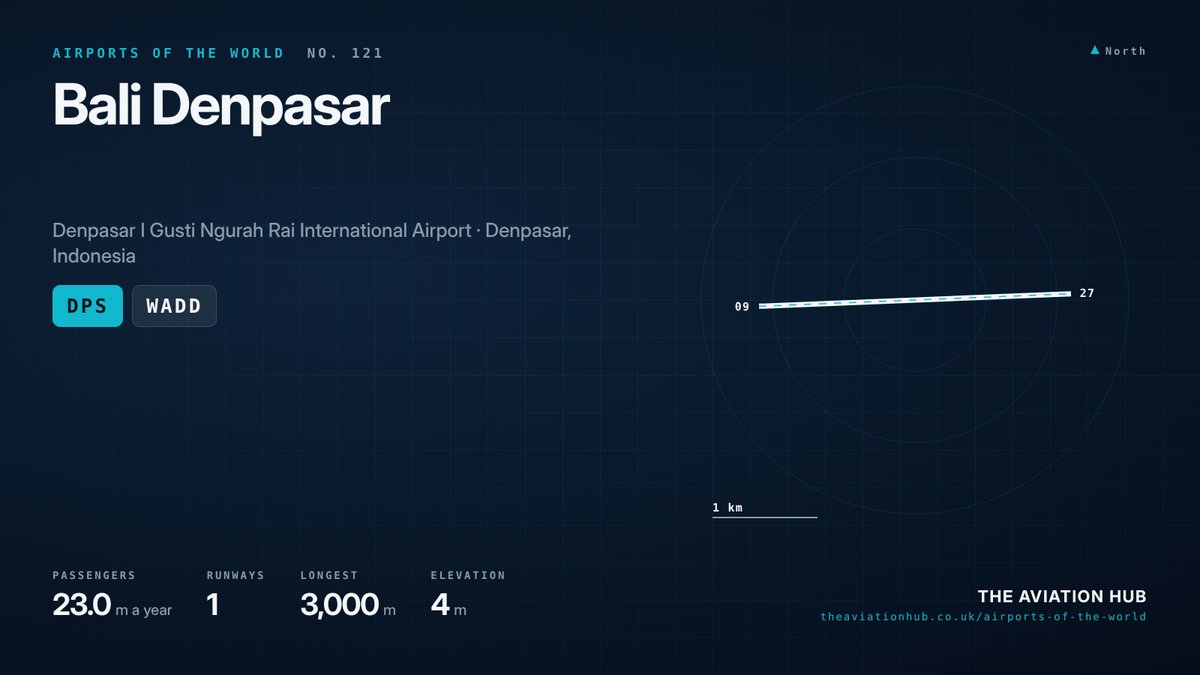
Ngurah Rai International Airport sits on the narrow isthmus that joins the Bukit peninsula to the rest of Bali, about 8 miles (13 km) south of Denpasar city centre. It is Indonesia’s main leisure gateway and its second busiest airport after Jakarta. Bali Denpasar Airport handles close to 24 million passengers a year, almost half of them on international flights from Australia, Singapore and Malaysia. A single runway that juts into the Indian Ocean makes it one of the more photogenic airfields in Asia.
Bali Denpasar Airport at a Glance
The codes are DPS and WADD. The field lies at just 4 m (14 ft) above sea level beside the resort strip of Kuta and Tuban, within Badung Regency. One asphalt runway, 09/27, serves two passenger terminals, one domestic and one international, plus a small VVIP terminal opened in 2022. State owned operator InJourney Airports, formerly Angkasa Pura I, runs the airport.
In 2024 the airport handled around 23.9 million passengers, up more than 11 per cent on the year before, with roughly 142,000 aircraft movements and almost 70,000 tonnes of cargo. Garuda Indonesia and Batik Air treat it as a hub. Citilink, Indonesia AirAsia, Jetstar, Lion Air, Super Air Jet, TransNusa and Wings Air all keep aircraft and crews based there. Flight status and parking information are on the airport’s official website.
How Bali’s Airport Came to Be
The Dutch colonial government laid out Tuban Airfield in the early 1930s as a 700 m grass strip beside a village cemetery. Japanese forces captured it intact in February 1942 after Dutch engineers misread a demolition order. The occupiers lengthened the strip to 1,200 m, and that longer runway carried Bali through the early postwar years.
Scheduled international flights started on 10 August 1966, and President Suharto inaugurated the rebuilt airport on 1 August 1968. The new name honoured I Gusti Ngurah Rai, the Balinese officer killed with 95 of his men at the Battle of Margarana in November 1946. Tourism then did the rest. By 2011 the terminals were handling 11 million passengers against a design capacity of 8 million.
The answer was a new 120,000 square metre international terminal, built between 2011 and 2013 and opened in September 2013. A new domestic terminal, four times the size of its predecessor, opened on the site of the old international building in September 2014. Emirates brought the first scheduled Airbus A380 service to Indonesia in June 2023, using a double deck airbridge installed for the type in 2015.
Runways at Bali Denpasar Airport
Runway 09/27 measures 3,000 m (9,843 ft) by 45 m and is surfaced in asphalt. The western end sits on reclaimed land with the sea on three sides, so an approach to Runway 09 crosses the water and lands almost on the beach. Departures off 27 climb straight out over the ocean. The airport is rated for Boeing 747-8 and A380 operations.
Easterly winds in the dry season from April to October favour landings on 09. The wet season brings more westerly flow and arrivals from the east onto 27, which means a low pass over the bypass road near the terminal. A single runway with no parallel taxiway at the far western end limits movements, and the queue of departures at the holding point is a familiar sight to anyone who flies out at dusk.
There is no overrun space to the west and only the Ngurah Rai bypass to the east. That geography explains why the expansion plan pins so much on reclaiming land rather than building a second runway. Bali Denpasar Airport will stay a single runway operation for the foreseeable future.
Terminals and Airlines
The international terminal has 96 check in desks and 11 airbridges. It handles all foreign carriers, including Qantas, Jetstar, Virgin Australia, Singapore Airlines, Scoot, AirAsia, Malaysia Airlines, Cathay Pacific, Korean Air, China Airlines, Emirates, Qatar Airways and Turkish Airlines. Garuda Indonesia and Batik Air also use it for their international flights. KLM links Bali to Amsterdam via Singapore.
The domestic terminal, with capacity for about 9.4 million passengers a year, is the busier building by movements. Lion Air, Batik Air, Super Air Jet, Citilink, Garuda Indonesia, AirAsia Indonesia, TransNusa and Wings Air run a constant stream of Airbus A320 and Boeing 737-800 flights to Java, Lombok, Flores and Sulawesi. The two terminals sit side by side, so a transfer from a Jakarta arrival to an Australian departure is a short walk landside.
Lounges are modest by Asian hub standards. The Garuda lounge serves SkyTeam passengers internationally, and several pay in lounges operate in both terminals. The VVIP terminal, opened for the 2022 G20 summit, sits apart and handles state visits.
Routes and Destinations
Jakarta is the dominant domestic route, with around 2.6 million passengers in 2024. Surabaya follows at roughly 690,000, then Makassar, Labuan Bajo and Yogyakarta. Labuan Bajo, gateway to Komodo, is the fastest growing of the group, up more than 27 per cent in a year.
Australia is the largest international market, with nearly 2 million passengers in 2024 spread across Perth, Melbourne, Sydney, Brisbane, Adelaide and Darwin. Singapore carried around 1.4 million and Malaysia about 880,000. Beyond South East Asia, Bali Denpasar Airport sees wide bodies from Seoul, Tokyo Narita, Hong Kong, Taipei, Shanghai, Doha, Dubai and Istanbul. The longest regular service is the Turkish Airlines flight to Istanbul, at more than 6,400 miles (10,300 km).
Traffic peaks in the European summer and over Christmas, when Australian school holidays fill every seat. Cargo grew by a third in 2024 to almost 70,000 tonnes, mostly belly freight of seafood, garments and handicrafts.
Getting to and from Bali Denpasar Airport
Bali Denpasar Airport has no railway. A light rail line to Kuta, Legian and Mengwi broke ground in September 2024, but the project has stalled for lack of investors and no opening date exists. Until that changes, road is the only option.
The Bali Mandara toll road runs across the bay on stilts and links the airport to Nusa Dua, Sanur, Benoa and the Denpasar bypass. A pre booked hotel car or a Grab or Gojek ride to Seminyak takes 20 to 40 minutes and costs around IDR 150,000 (about £7), with Ubud an hour or more away at roughly IDR 350,000. Official airport taxis quote fixed fares at a counter in the arrivals hall.
The cheapest sensible option is the Trans Metro Dewata bus, route K2, which runs between the airport and Ubung terminal in Denpasar from early morning until about 6.40 pm for a few thousand rupiah. Short stay parking sits in front of each terminal, and a multi storey car park serves longer stays.
Spotting and Photography
The classic shot is from the beach. Kelan Beach and the small fishing village south of the runway give a clear view of aircraft on short final to 09, with the water in the foreground and Mount Agung on the horizon on a clear day. The beaches of Tuban to the north of the runway work for departures off 27. Morning light favours the south side and late afternoon the north.
The end of the Bali Mandara toll road and the bypass near the threshold of 27 give road side views, though stopping on the toll road is not allowed. Some hotels in Tuban, close to the airport fence, offer glimpses of the field from their upper floors.
Dry season easterlies mean arrivals on 09 from the sea for most of the year. Expect a steady mix of A320s and 737s, broken by Qantas and Singapore Airlines wide bodies, Emirates A380s and Garuda Boeing 777-300ERs. Stay off the airport perimeter fence, keep clear of the air force base that shares the field and be polite to the fishermen whose beach you are using.
What Comes Next
Capacity is the issue. Bali Denpasar Airport was built for about 24 million passengers a year and is already there. InJourney Airports plans to reclaim around 117 hectares from the sea in two phases. Phase one adds 47 hectares and lifts capacity to roughly 28 million. Phase two adds 70 hectares and would stretch the runway to 3,400 m. The target is 37 million passengers a year.
The alternative, a new North Bali Airport on an artificial island off Buleleng, was dropped from the national strategic projects list in 2022 and reinstated in 2025. Opposition from senior politicians and the sheer cost make its future uncertain. An FL Technics maintenance hangar opened in December 2024 and can take six narrow bodies at once.
Bali Denpasar Airport will keep growing on reclaimed land because there is nowhere else for it to go. Compare it with the other island gateways on the Airports of the World map.
Continue to follow The Aviation Hub for more analysis and insight.
Advertise with us Your brand, in front of an aviation audience Home page and in-article placements, sold directly, one advertiser per slot. From £250 a year. See the rates

