
Balikpapan Airport Guide: Borneo’s Gateway to Nusantara
Balikpapan Airport serves East Kalimantan's oil city and Indonesia's new capital, Nusantara. Read about its runway, terminal, routes and transport links.
 By The Aviation Hub
6 min read
Updated October 20, 2026
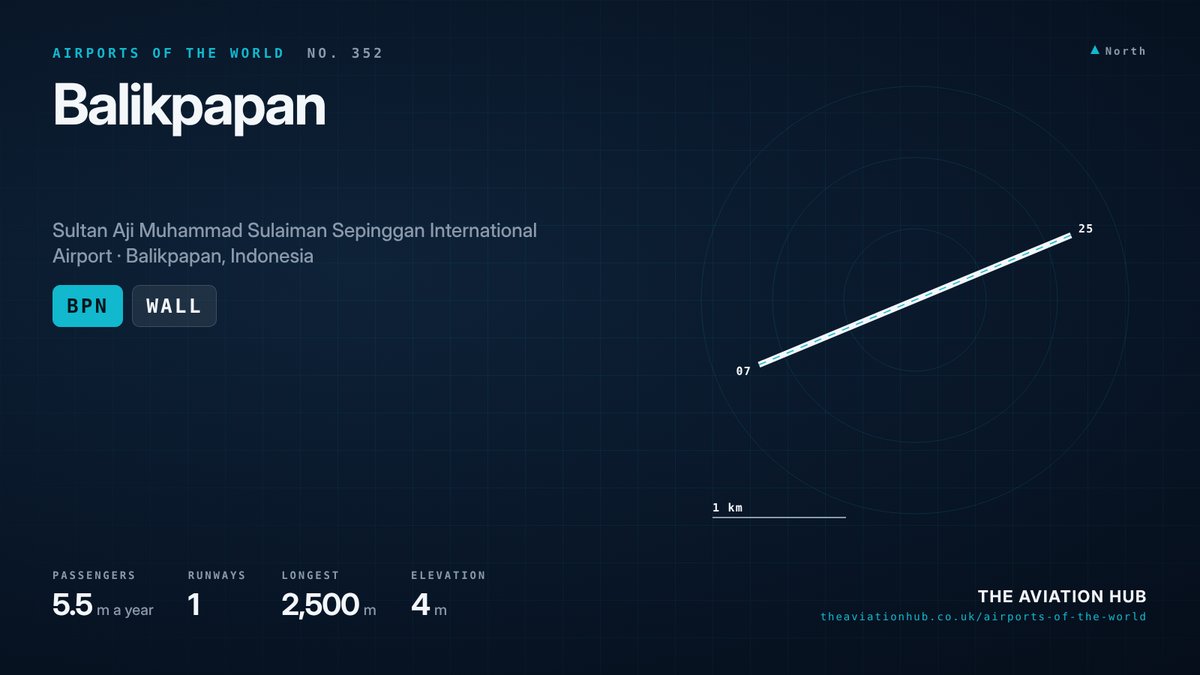
Balikpapan Airport, officially Sultan Aji Muhammad Sulaiman Sepinggan International Airport, is the main gateway to East Kalimantan on the island of Borneo. It sits on the coast at Sepinggan, on the eastern side of the oil city of Balikpapan. About 5.5 million passengers used it in 2024. Its importance is rising fast because it is the nearest major airport to Nusantara, the new Indonesian capital being built in the forest to the north west.
Balikpapan Airport at a Glance
The airport uses the IATA code BPN and the ICAO code WALL. It lies a few miles east of central Balikpapan, almost at sea level with an elevation of 4 m (12 ft). One asphalt runway, 07/25, runs along the shoreline, and a single passenger terminal handles domestic and international flights.
Balikpapan Airport handled about 5.53 million passengers, 56,500 tonnes of cargo and 51,090 aircraft movements in 2024. Lion Air Group carriers, Garuda Indonesia and Citilink provide most of the capacity, alongside Pelita Air and smaller regional operators. The state group InJourney Airports, formerly Angkasa Pura I, has managed the field since 1987. Schedules and transport options are on the airport’s official website.
How Balikpapan’s Airport Came to Be
Aviation in Balikpapan began with the Dutch, who built Manggar Airfield near the city in 1936 to support the colonial oil industry. During the Second World War the Japanese built a new airfield at Sepinggan in 1942. After the war Sepinggan became the main airport, and it has grown with the oil, gas and coal economy of East Kalimantan ever since.
For decades the airport was simply known as Sepinggan, a name drawn from the local Paser language. In 2014 it was renamed after Aji Muhammad Sulaiman, a 19th century ruler of the Kutai Kartanegara Sultanate. The change followed public debate and an agreement among the regional governments, and Sepinggan was kept as part of the full title.
The same year brought the biggest change in the airport’s history, a large new terminal that replaced the cramped old building. The old terminal is earmarked for renovation and reuse.
Runways at Balikpapan Airport
Runway 07/25 is 2,500 m (8,202 ft) long and 45 m wide, with an asphalt surface. It is ideal for the Boeing 737s and Airbus A320 family jets that fly most routes, and for the ATR turboprops on regional services. It is too short for regular wide body operations with a full payload, which limits long haul ambitions.
The runway runs along the coast, and one end leads into a densely built up area, making landings dramatic to watch and technically demanding for crews. Tropical downpours are frequent, and wet runway performance is a constant consideration. In 1988 a Bouraq Indonesia Vickers Viscount was written off after its landing gear collapsed during a tailwind landing. Plans call for extending the runway to 3,250 m, probably using reclaimed land, which would open the door to wide body aircraft.
Terminals and Airlines
Balikpapan Airport has one modern terminal, opened in 2014, with 74 check in counters, 11 jet bridges and eight baggage carousels. Its large glazed halls and high roofs are designed for a hot, humid climate, and keeping it cool is a major running cost. Domestic and international passengers share the building.
Lion Air, Batik Air and Wings Air, all part of Lion Air Group, together with the closely linked Super Air Jet, form the largest presence. Garuda Indonesia and its low cost subsidiary Citilink are the main competition. Pelita Air, the airline linked to the state energy company Pertamina, has grown on trunk routes. Wings Air and smaller operators fly ATRs and light aircraft into the Kalimantan interior. Charter and helicopter flights support the oil, gas and mining industries.
Routes and Destinations
Jakarta Soekarno Hatta is the dominant route by a wide margin, carrying civil servants, oil workers and business travellers. Surabaya, Makassar, Yogyakarta and Denpasar are other key domestic links. Regional flights connect towns elsewhere in Kalimantan and Sulawesi.
The international network is small and has fluctuated over the years. Singapore, Malaysia and Brunei have all been served, giving the region direct links to its neighbours. Traffic peaks around Eid al Fitr, when millions of Indonesians travel home, and over the Christmas and New Year holidays. As construction of Nusantara continues, government and contractor traffic adds to the base load.
Getting to and from Balikpapan Airport
There is no rail service in East Kalimantan. Balikpapan Airport is close to the city centre, and the drive into town usually takes 15 to 30 minutes depending on traffic. Taxis wait outside arrivals, and ride hailing apps operate from designated pick up points, offering the cheapest sensible door to door option for most visitors.
A city bus corridor links the airport with Semayang Harbour, the main passenger port. Shuttle buses run to Samarinda, the provincial capital, and to Bontang further north, using the toll road that now links Balikpapan and Samarinda. DAMRI buses connect the airport with Nusantara, and a toll road to the new capital is planned as the main access route. Car hire with a driver is common.
Spotting and Photography
The coastal setting makes Balikpapan Airport rewarding for spotters. Aircraft approaching or departing over the built up end of the runway pass low over rooftops, and roads along the shore give views of traffic over the water. Inside the terminal, the departure lounges overlook the apron and its mix of Lion Air Group 737s, Citilink A320s and ATRs.
Tropical light is harsh in the middle of the day, so early morning and late afternoon give the best results. Afternoon storms can build quickly. Indonesian airports take security seriously, and the Indonesian Air Force also has a presence at Balikpapan Airport. Keep to public areas, avoid photographing security installations and carry identification in case you are asked to explain yourself.
What Comes Next
The runway extension is the headline project, targeted for completion before 2030. Together with apron and taxiway upgrades, it would lift hourly capacity from 22 to around 40 movements, with long term forecasts of up to 30 million passengers a year. In 2024 four Japanese companies expressed interest in jointly operating the airport, which could bring private investment.
Everything depends on the pace of Nusantara. A separate airport for state flights is being developed near the new capital, but commercial traffic will flow through Sepinggan for years to come. If the capital project holds momentum, Balikpapan Airport is heading for rapid growth and a much larger role. See how it compares with other Southeast Asian airports on our Airports of the World map.
Continue to follow The Aviation Hub for more analysis and insight.
Advertise with us Your brand, in front of an aviation audience Home page and in-article placements, sold directly, one advertiser per slot. From £250 a year. See the rates

