
Baltimore Airport Guide: Southwest’s East Coast Powerhouse
Baltimore Airport is one of Southwest's biggest bases and a budget gateway to Washington. Read about its three runways, Amtrak link and new connector.
 By The Aviation Hub
7 min read
Updated October 20, 2026
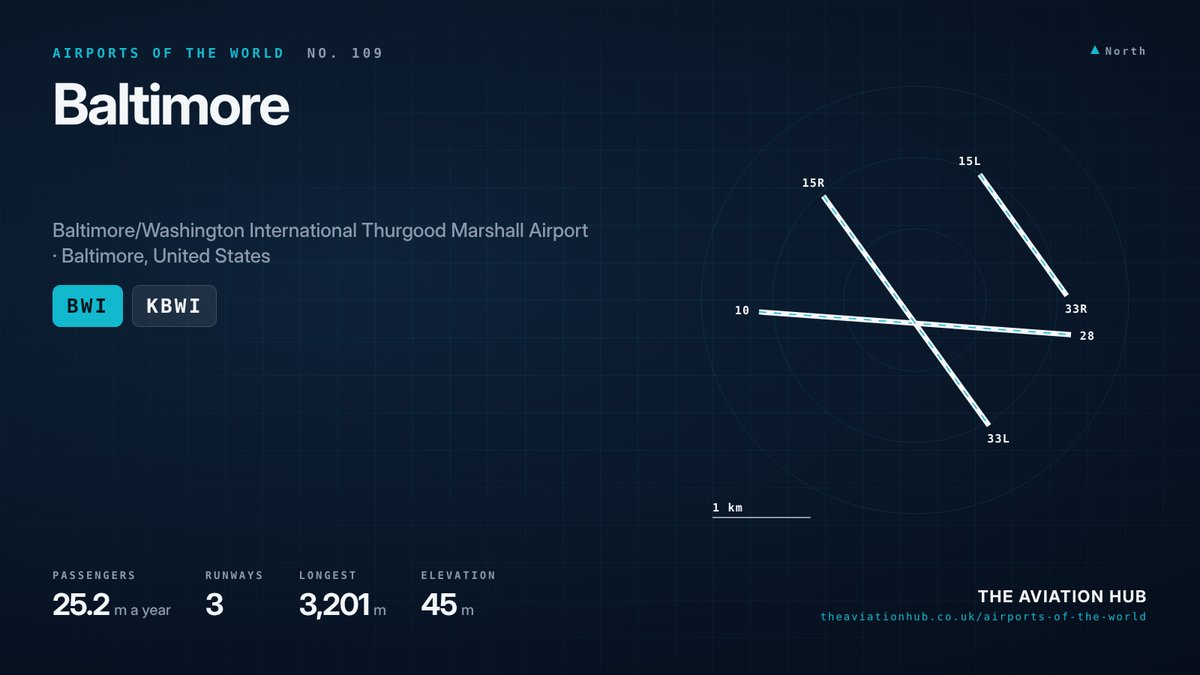
Baltimore/Washington International Thurgood Marshall Airport serves two cities at once. It sits in Anne Arundel County, Maryland, around 9 miles (14 km) south of downtown Baltimore and 30 miles (48 km) northeast of Washington, and it competes with Dulles and Reagan National for the capital’s traffic. Baltimore Airport handled around 25 million passengers in 2025, most of them on Southwest Airlines, which runs one of its largest operating bases here. It also has a rail station on the Northeast Corridor, which gives it a reach that neither Washington airport can match.
Baltimore Airport at a Glance
The codes are BWI and KBWI. The airport lies in Linthicum Heights at an elevation of 45 m (146 ft), beside Interstate 195 and the Baltimore Washington Parkway. Three active asphalt runways serve a single terminal with five concourses lettered A to E and 78 gates. A separate cargo complex on the north side includes a large Amazon Air warehouse.
In 2025 Baltimore Airport handled around 25.2 million passengers, down from about 27 million the year before as Southwest trimmed its schedule. Southwest is the largest carrier by a wide margin, with roughly 245 daily departures. Delta, American, United and Frontier run far smaller operations, and Spirit has gone. The Maryland Aviation Administration, a state agency, owns and operates the field. Parking, transport and flight information are on the airport’s official website.
How Baltimore’s Airport Came to Be
Planning began in 1944, when Baltimore’s city leaders decided that the old Harbor Field on the waterfront could never handle the coming jets. They chose a site at Linthicum, close to the city and the main rail lines, and cleared it by demolishing Friendship Methodist Church and relocating its cemetery. President Harry Truman dedicated the new Friendship International Airport on 24 June 1950 and it opened to traffic on 23 July.
Friendship struggled against Washington National and the new Dulles airport through the 1960s. The State of Maryland bought it in 1972 and renamed it Baltimore/Washington International in 1973, a deliberate move to attract passengers from the capital. In 1980 the state opened a dedicated rail station beside the Northeast Corridor, described as the first intercity rail station built for an airport in the United States, and the IATA code changed from BAL to BWI the same year.
Piedmont, US Air and later Southwest built bases here. Southwest arrived in 1993 and has grown relentlessly ever since. In 2005 the airport added the name of Thurgood Marshall, the Baltimore born lawyer who argued Brown v Board of Education and became the first black justice of the Supreme Court.
Runways at Baltimore Airport
Baltimore Airport has three runways in use, all asphalt and all 46 m wide except the shortest. Runway 10/28 is the longest at 3,201 m (10,503 ft) and serves as the main departure runway. Runway 15R/33L is 2,896 m (9,501 ft) long and takes most arrivals. Runway 15L/33R is a short 1,524 m (5,000 ft) strip, 30 m wide, used by general aviation and smaller aircraft. A fourth runway, 04/22, closed in 2014.
The crossing layout means the field normally runs with one runway for arrivals and one for departures, which keeps the flows separate but limits the hourly rate compared with a parallel system. Westerly operations landing on 33L and departing on 28 are the most common. Approaches to 33L bring aircraft in over the suburbs of Glen Burnie.
A retired World Airways McDonnell Douglas DC-10, written off after a hard landing in 2009, sits on the airfield as a training aid for the fire and rescue service. Military Space Available flights run by Air Mobility Command also have a significant presence at the airport.
Terminals and Airlines
The single terminal is a long curved building with five concourses. Concourses A and B, with 30 gates, belong entirely to Southwest and were joined by a new connector that opened on 9 January 2026, ahead of schedule and at a cost of close to USD 500 million. Concourse C, with 14 gates, hosts more Southwest flights along with American and BermudAir.
Concourse D, with 23 gates, handles the rest of the domestic carriers, including Delta, United, Frontier, Alaska and JetBlue, which returned in 2026 with flights to Fort Lauderdale and San Juan. Concourse E, with 11 gates, is the international pier and includes five arrival only positions. British Airways flies the Boeing 787 to London Heathrow, Icelandair serves Reykjavik, Copa flies to Panama City and BermudAir links Bermuda. Air Canada and Condor both left in 2024 and 2025.
Routes and Destinations
Southwest’s network makes Baltimore Airport a mini hub for the East Coast. Atlanta, Orlando, Fort Lauderdale and Denver were the busiest domestic routes in 2025, with Boston, Charlotte, Tampa, Miami, Las Vegas and Chicago O’Hare next. Florida accounts for a large share of the traffic, especially in winter when Maryland empties southwards.
International service is leisure led. Cancun, Montego Bay and Reykjavik were the top three foreign routes in 2023, with Punta Cana and London Heathrow following. London Heathrow on British Airways is the longest route and the only transatlantic service to a major European hub. Cargo is significant because of Amazon Air, whose warehouse sorts packages for the Mid Atlantic, and because of the military charters on the north side.
Getting to and from Baltimore Airport
The rail options are the airport’s trump card. BWI Rail Station sits about a mile from the terminal and is served by Amtrak Northeast Regional and Acela trains along with MARC Penn Line commuter trains. A free shuttle runs between the station and the terminal every few minutes. MARC reaches Washington Union Station in around 30 to 35 minutes for well under USD 10 and Baltimore Penn Station in about 15 minutes, which makes it the cheapest sensible route to either city.
The Baltimore Light RailLink has a station next to Concourse E, with trains into downtown Baltimore and Camden Yards in around 30 minutes. Local bus routes 75 and 201 serve the airport, and the 201 connects to the Washington Metro at Shady Grove. BayRunner shuttles cover the Eastern Shore and Western Maryland.
By road, Interstate 195 links the terminal to Interstate 95 and the Baltimore Washington Parkway in a couple of minutes. Downtown Baltimore is 15 to 20 minutes away and central Washington 45 minutes to an hour, depending on the traffic. A taxi to downtown Baltimore costs around USD 35 (about £27). Parking ranges from an hourly garage opposite the terminal to express and long term lots with shuttles.
Spotting and Photography
Baltimore Airport has one of the best public viewing spots on the East Coast. The Thomas A. Dixon Jr Aircraft Observation Area sits beside the approach to runway 33L on Dorsey Road, with a playground and picnic tables. Aircraft pass directly overhead at a few hundred feet when the wind is from the north or west. The BWI Trail, a 13 mile loop around the airport, offers several more vantage points.
When easterly or southerly winds switch arrivals to runway 10, Charwood Road catches them on final. Afternoon light is best for the observation area. The terminal itself has an observation gallery near the B and C checkpoint, though its tinted windows are backlit for much of the day. The observation area is maintained for spotters, so use it, stay off the airport perimeter road and do not climb the fence.
What Comes Next
The Concourse A and B connector and a new Southwest baggage system make up the latest investment round. The Maryland Aviation Administration is studying further gate additions at Concourse D and E to attract more international carriers, and the airport has long term plans for a midfield concourse if Southwest keeps growing.
The challenge is Southwest itself, which has pulled back capacity across its network and is changing its business model. Baltimore remains one of its strongest bases, but the days of relentless growth may be over. The verdict is that Baltimore Airport is a well run, well connected field that will stay the budget gateway to Washington for years to come. See how it compares with Dulles and Reagan National on the Airports of the World map.
Continue to follow The Aviation Hub for more analysis and insight.
Advertise with us Your brand, in front of an aviation audience Home page and in-article placements, sold directly, one advertiser per slot. From £250 a year. See the rates

