
Bangkok Don Mueang Airport Guide: Asia’s Low Cost Veteran
Bangkok Don Mueang Airport opened in 1914 and is now a giant low cost hub. Read how its two runways, golf course and terminals handle 31 million a year.
 By The Aviation Hub
7 min read
Updated October 20, 2026
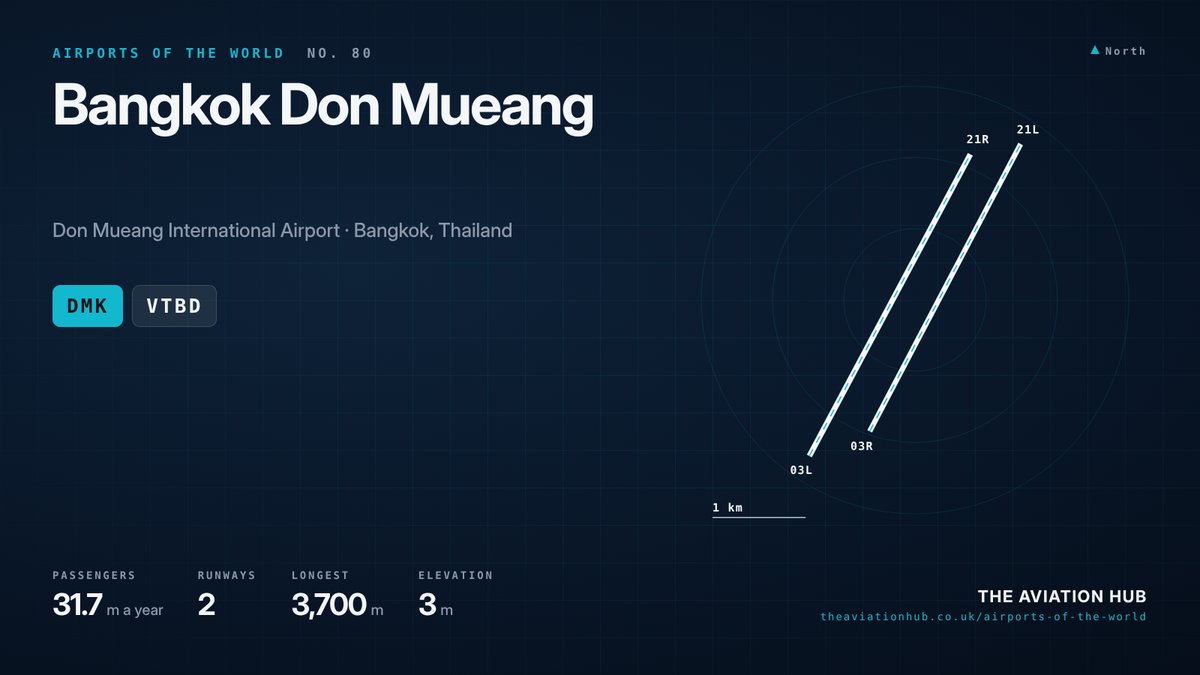
Bangkok Don Mueang Airport lies about 15 miles (24 km) north of central Bangkok in the Don Mueang district, beside the Vibhavadi Rangsit highway and the main northern railway line. It is one of the oldest airports in the world still in commercial use, having opened as a military field in 1914, and it served as Thailand’s main international gateway until Suvarnabhumi replaced it in 2006. Written off at the time, it came back as the base of Thai AirAsia, Nok Air and Thai Lion Air and now handles more than 31 million passengers a year, almost all of them on low cost carriers.
Bangkok Don Mueang Airport at a Glance
The codes are DMK and VTBD, the old IATA code BKK having passed to Suvarnabhumi. The field is just 3 m (9 ft) above sea level on the flat central plain, which left it badly exposed in the 2011 floods. It has two parallel asphalt runways with a Royal Thai Air Force golf course between them, and two passenger terminals, Terminal 1 for international and Terminal 2 for domestic flights. Airports of Thailand operates the civil side, while the Royal Thai Air Force owns the land and runs the adjoining air base.
Bangkok Don Mueang Airport handled around 31.7 million passengers in 2025, about 19.4 million of them domestic and 12.2 million international, with roughly 215,000 aircraft movements. Thai AirAsia, Thai AirAsia X, Nok Air and Thai Lion Air are all based here. The field was recognised as the largest low cost airport in the world in 2015. Flight information is on the airport’s official website.
How Bangkok’s Original Airport Came to Be
The Siamese army chose the Don Mueang site as a replacement for the Sa Pathum racecourse airfield, and the first flights took place on 8 March 1914. The field opened officially as a Royal Thai Air Force base on 27 March that year. KLM flew the first commercial service in 1924 on its route from Amsterdam.
After the Second World War the airport grew into Bangkok International Airport, the hub of Thai Airways International from 1960 and a stopover on the Kangaroo Route between Europe and Australia. At its 2004 peak the field handled more than 38 million passengers.
Suvarnabhumi opened in September 2006 and all commercial flights moved there, leaving Don Mueang empty. Cracks in the new runways and crowded terminals brought some domestic flights back in March 2007, and in 2012 the government ordered low cost and charter carriers to relocate. Floods closed the field from October 2011 until March 2012, and Terminal 2 reopened after renovation in 2015, lifting capacity to 30 million.
Runways at Bangkok Don Mueang Airport
Bangkok Don Mueang Airport has two parallel runways aligned roughly north to south. Runway 03L/21R is the longer at 3,700 m (12,139 ft) and 60 m wide, and Runway 03R/21L is 3,500 m (11,483 ft) and 45 m wide. Both are asphalt and both carry instrument landing systems. They are close together and are operated as a dependent pair, usually with one for arrivals and the other for departures.
The quirk that every visitor remembers is the Kantarat golf course, an 18 hole Royal Thai Air Force layout laid out in the strip of land between the runways with no fence. Golfers wait at a red light while aircraft land. The prevailing wind favours the 21 direction for much of the year, bringing arrivals over the northern suburbs of Rangsit, while the 03 direction puts approaches over the city.
Lauda Air Flight 004, a Boeing 767-300ER, broke up after take off in May 1991 when a thrust reverser deployed in flight, killing all 223 on board. In 1999 a Qantas 747-400 overran the runway in heavy rain without loss of life.
Terminals and Airlines
Terminal 1 handles international flights and Terminal 2 the domestic network, joined by an enclosed walkway that also connects to the Amari hotel across the road. Both buildings are functional rather than glamorous, and the older Terminal 3 has stood unused since 2011. Capacity is officially 30 million passengers a year, which the field now exceeds, so queues are common at peak times.
Thai AirAsia is the largest operator, flying Airbus A320s and A321neos across Thailand and to China, India, Japan, Vietnam, Malaysia and Singapore. Thai AirAsia X adds Airbus A330-300s to Tokyo, Osaka, Nagoya, Sapporo, Delhi and Almaty. Nok Air and Thai Lion Air run Boeing 737-800s and 737 MAX 9s on domestic and regional routes, and Thai Lion also operates A330s. AirAsia’s Malaysian sister airline, Batik Air Malaysia, flydubai and China’s Spring Airlines complete the picture.
Routes and Destinations
Chiang Mai is the busiest route from Bangkok Don Mueang Airport, with about 3.6 million passengers in the last full pre pandemic year, followed by Phuket at 3 million, Hat Yai at 2.6 million, Udon Thani at 1.7 million and Chiang Rai at 1.5 million. The three based airlines compete head to head on the trunk routes with fares often below THB 1,000 (£23).
Kuala Lumpur leads the international list at around 1.3 million passengers, with Tokyo Narita at 1.3 million, Singapore at 1.1 million, Yangon and Osaka behind. Sapporo, served by Thai AirAsia X and Thai Lion Air, is among the longest routes at about 3,150 miles (5,050 km). Cargo is minor at around 56,000 tonnes, since the freight business stays at Suvarnabhumi.
Traffic peaks in the cool season from November to February and again around Songkran in April.
Getting to and from Bangkok Don Mueang Airport
Don Mueang railway station sits opposite Terminal 1 across the highway, linked by a footbridge. The SRT Dark Red Line runs to Bang Sue Grand Station, now called Krung Thep Aphiwat, in about 20 minutes for a low fare, with connections to the MRT Blue Line into the city. Intercity trains to Chiang Mai and the northeast also call, which makes rail the cheapest sensible option.
Airport buses A1 to A4 leave from Terminal 1 for the BTS at Mo Chit, Victory Monument, Lumphini Park and the old city around Sanam Luang, for a flat cash fare of THB 30 to 50. Metered taxis cost around THB 300 to 400 (£7 to 9) to the central hotel districts plus the THB 50 airport surcharge and tolls, and take 30 to 60 minutes on the Don Mueang Tollway. A transfer to Suvarnabhumi takes an hour or more by shuttle bus or rail.
Spotting and Photography
Bangkok Don Mueang Airport has no official viewing area, but the footbridge over Vibhavadi Rangsit Road and the upper floors of the Amari hotel look straight across the apron and onto Runway 21R arrivals. The Kantarat golf course, open to civilians who pay a green fee, is among the most unusual spotting venues in Asia, with aircraft landing a few dozen metres from the fairways. Further north, the roads around Rangsit under the 21 approach give good shots of arrivals in the morning.
The hotel and footbridge look east, so light is best there in the afternoon with the sun behind you. The attraction is volume rather than variety, with a constant stream of AirAsia A320s and A321neos, Lion Air and Nok Air 737s and the A330s of Thai AirAsia X, plus Royal Thai Air Force transports. The air base is military ground, so never photograph the eastern side, keep clear of the fences and follow any instructions from security staff.
What Comes Next
Airports of Thailand launched the third phase of a THB 36.8 billion expansion in late 2023, due for completion between 2029 and 2031. The centrepiece is a new Terminal 3 for 20 million passengers a year, taking overall capacity from 30 million to 50 million. A planned 3 km monorail would link the terminals to the BTS Green Line.
The runways cannot be moved apart because of the air base and the golf course, so the ceiling is set by terminal space and the slot limits of a dependent pair. Bangkok Don Mueang Airport will remain Southeast Asia’s great low cost machine, working harder than its age suggests. See how it compares with Suvarnabhumi and Kuala Lumpur on the Airports of the World map.
Continue to follow The Aviation Hub for more analysis and insight.
Advertise with us Your brand, in front of an aviation audience Home page and in-article placements, sold directly, one advertiser per slot. From £250 a year. See the rates

