
EuroAirport sits on French soil just outside Basel, close to the point where France, Germany and Switzerland meet. Basel Mulhouse Airport is run jointly by two countries under a 1949 treaty, with a Swiss sector and a French sector inside one terminal. It handles around 9 million passengers a year, hosts a large easyJet base and is a world centre for fitting out VIP wide body jets.
Basel Mulhouse Airport at a Glance
The airport carries two IATA codes, BSL on the Swiss side and MLH on the French side, plus EAP as a combined code. The ICAO code is LFSB. Basel Mulhouse Airport lies in the commune of Saint Louis, about 2 miles (3.5 km) northwest of central Basel, 12 miles (20 km) from Mulhouse and 29 miles (46 km) from Freiburg. Its elevation is 270 metres (885 feet).
There are two runways and a single passenger terminal. Traffic was close to 9 million passengers in 2024, along with more than 100,000 tonnes of cargo, and growth has continued since. easyJet is by far the largest carrier. A binational board of French and Swiss members governs the airport, and timetables and parking details are on the airport’s official website.
How Basel’s Airport Came to Be
Basel had outgrown its small airfield at Sternenfeld by the 1930s, but the canton had no room for a modern airport. Talks with France resumed after the war, and in 1946 the two sides agreed a deal. France provided the land, and the canton of Basel City paid for construction. A provisional airport opened on 8 May 1946, and a formal treaty followed in 1949.
That treaty created the unusual setup that survives today. The airport stands entirely in France, yet Swiss law applies to customs, policing and medical services in the Swiss sector. A fenced customs free road about 1.5 miles (2.5 km) long links the terminal with Basel, so passengers can reach Switzerland without passing French customs.
The east to west runway was extended to 1,600 metres in the early 1950s, and the main runway reached 3,900 metres in 1972. Crossair, the Basel regional airline that later became Swiss International Air Lines, ran a hub here for years. The EuroAirport brand arrived in 1987, and a Y shaped gate area was added later.
Runways at Basel Mulhouse Airport
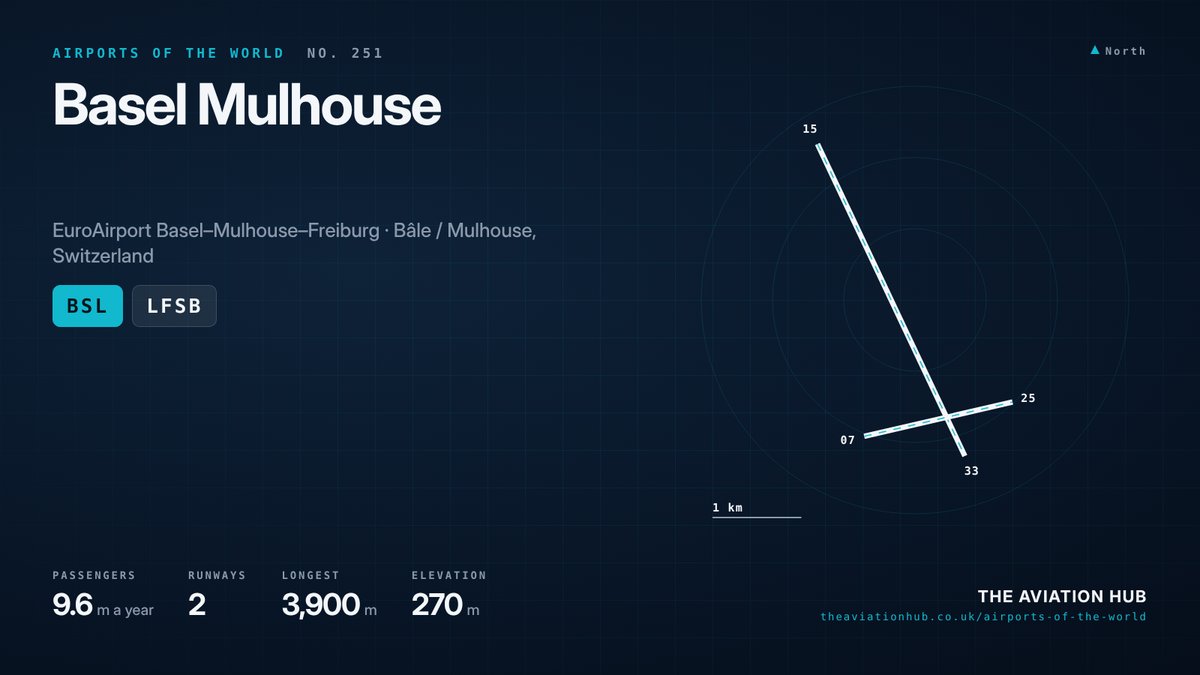
Basel Mulhouse Airport has two concrete runways, both 60 metres wide. The main runway, 15/33, is 3,900 metres (12,795 feet) long and handles all airline traffic. The crosswind runway, 07/25, is 1,715 metres (5,626 feet) long and suits general aviation and smaller aircraft.
The length of 15/33 is generous for a regional airport. It lets fully loaded freighters and the heavy VIP wide bodies being completed on site operate without restriction. Runway 07/25 sees much lighter use, mainly by business jets and light aircraft.
Noise rules shape operations. Landings normally use runway 15, with aircraft approaching from the north over Alsace. Approaches to runway 33 cross the dense western suburbs of Basel, so they are generally kept for days when a northerly wind gives runway 15 a tailwind of 5 knots or more. Night flights are tightly restricted.
Terminals and Airlines
All passenger flights use one terminal, split inside into a French sector and a Swiss sector, each with its own exit. Since Switzerland joined Schengen in 2009, the airside has been divided between Schengen gates and a non Schengen area at gates 22 to 32. Only six gates have jet bridges, so walking or a bus ride to the aircraft is common.
easyJet dominates, flying Airbus A319, A320 and A320neo aircraft from its Basel base, which opened in 2004. Swiss International Air Lines no longer flies from the airport, having ended its Basel operations in 2015, although its head office remains on the Swiss side. Network carriers link Basel Mulhouse Airport with their hubs, including KLM, Air France, British Airways and Turkish Airlines.
Wizz Air, Ryanair, Pegasus and SunExpress add low cost and leisure options. Several of these serve the large Balkan, Turkish and Portuguese communities in the region, which gives the schedule a strong visiting friends and relatives flavour.
Routes and Destinations
London is a leading market, served at several airports, and Amsterdam, Berlin, Porto, Lisbon, Istanbul and Pristina are among the important international links. There is no domestic network in the usual sense, since the airport serves both France and Switzerland. Paris is reached by air, but the TGV now carries much of that traffic.
Summer brings a wave of leisure flying to Spain, Greece, Turkey and the Balearic Islands. In winter the schedule shifts towards city breaks, the Canary Islands and Egypt. Air Transat has flown seasonally to Montreal in past years, but long haul service remains limited.
Cargo is a real strength. Basel’s pharmaceutical industry relies on fast air freight, and express integrators fly regular freighter services, mostly in the evening and early morning. Annual cargo volumes now exceed 100,000 tonnes.
Getting to and from Basel Mulhouse Airport
There is no railway station at the terminal yet. On the Swiss side, bus 50 runs to Basel SBB station about every 7 to 8 minutes on weekdays and takes around 20 minutes. It is the cheapest sensible option for Basel, costing a few Swiss francs.
On the French side, bus 11 links the terminal with Saint Louis railway station in about 10 minutes, from where regional trains run to Mulhouse and Strasbourg. FlixBus coaches serve the airport from Zurich, Basel and Freiburg. Taxis wait at both exits, and a ride to central Basel takes 15 to 20 minutes.
Drivers reach Basel Mulhouse Airport from Switzerland by the customs free road off the A3, and from France by the A35 motorway. Car parks sit on both sides of the border, and travellers should pick the sector that matches where they are heading, especially when hiring a car.
Spotting and Photography
The big draw at Basel Mulhouse Airport is the VIP completion trade. Jet Aviation and AMAC Aerospace fit out private Boeing and Airbus jets here, so green or freshly painted wide bodies appear alongside easyJet A320s and cargo aircraft. Watching a newly completed private jet leave on a test flight is the highlight for many visitors.
There is no public viewing terrace. Spotters use public roads and fields on the French side, especially near the northern end, where aircraft cross open farmland on short final to runway 15. The runway runs north to south, so mornings favour the eastern side and afternoons the western side for light.
Respect the fences and the border. French gendarmes and Swiss police both patrol, and the completion hangars are private premises. Stay on public land and do not block roads or field access.
What Comes Next
A rail link has been planned for years, with a new station on the line from Basel to Mulhouse and a short branch to the terminal. The earliest opening date has slipped to around 2035, and the project still faces funding and planning hurdles.
Environmental issues are rising up the agenda. In 2025 residents of about 11 nearby communes learned that their tap water contained PFAS chemicals linked to firefighting foam used before 2017, and the clean up bill could reach €20 million. Noise limits and night restrictions also cap how fast traffic can grow at Basel Mulhouse Airport.
The verdict is a quirky, well connected regional airport whose binational status remains its biggest asset and its biggest complication. Compare it with other airports in the Rhine region on the Airports of the World map.
Continue to follow The Aviation Hub for more analysis and insight.
Advertise with us Your brand, in front of an aviation audience Home page and in-article placements, sold directly, one advertiser per slot. From £250 a year. See the rates

