
Batam Airport Guide: A Giant Runway Beside Singapore
Batam Airport explained: Hang Nadim's huge runway, the terminal, Lion Air and its maintenance base, domestic routes, ferries to Singapore and new plans.
 By The Aviation Hub
5 min read
Updated October 20, 2026
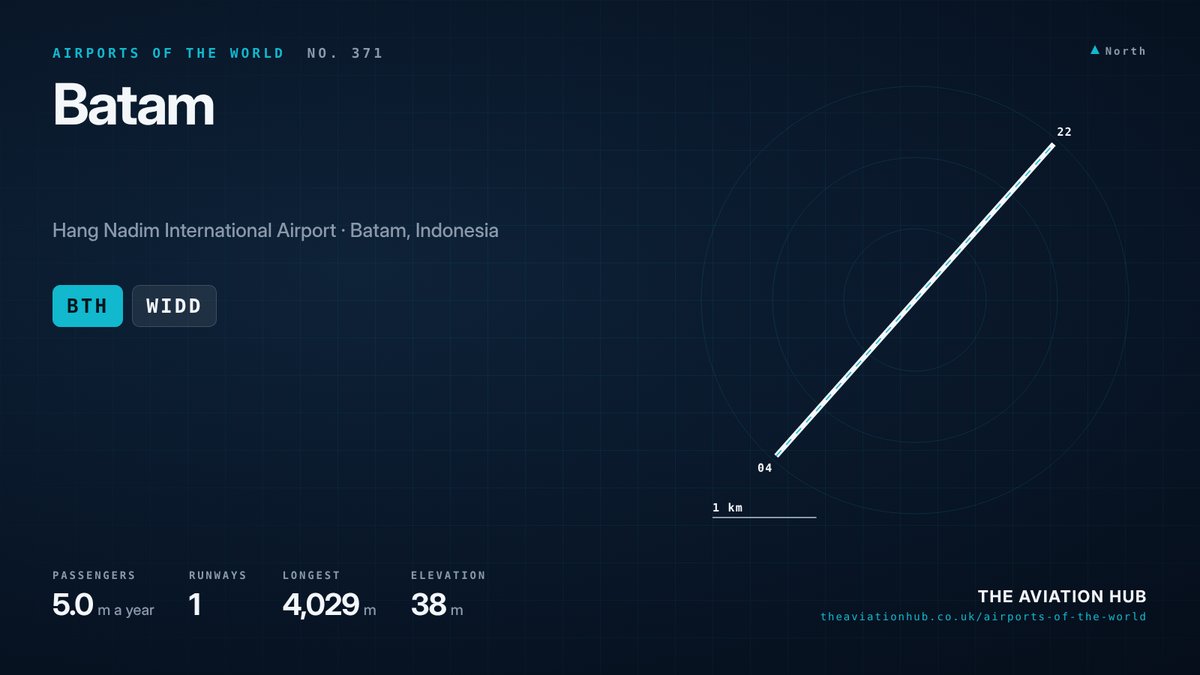
Batam Airport, officially Hang Nadim International, serves the Indonesian island of Batam, a short ferry ride south of Singapore. It handles more than four million passengers a year, mostly on domestic flights across the Indonesian archipelago. Its runway is far longer than its traffic demands, a legacy of ambitious planning in the 1970s and 1980s. A major expansion backed by Incheon Airport is planned, though building work has stalled.
Batam Airport at a Glance
The airport carries the IATA code BTH and the ICAO code WIDD. It sits at Batu Besar in the east of the island, a short drive from Nagoya, Batam’s main commercial district. The elevation is 126 feet (38 m). There is one runway and one passenger terminal of about 30,000 square metres.
BP Batam, the island’s development authority, owns the airport. Since 2021 a consortium of Angkasa Pura I, Incheon International Airport Corporation and PT Wijaya Karya has held a 25 year concession to run and develop it. In 2024 Batam Airport handled about 4.17 million passengers, around 30,300 aircraft movements and almost 36,000 tonnes of cargo. Schedules and services are listed on the airport’s official website.
How Batam’s Airport Came to Be
Work on an airport began in the early 1970s under the state oil company Pertamina. The first site, at Tanjung Uncang, was dropped after Singapore objected to conflicts with airspace around its Paya Lebar airport. Batu Besar was chosen around 1976, and charter and special flights began around 1978 on a runway just 850 metres long.
B.J. Habibie, then head of the Batam Authority and later Indonesia’s president, pushed for a name rooted in Malay heritage. The airport honours Laksamana Hang Nadim, a legendary Malay warrior. Some residents questioned the choice, since local folklore casts Hang Nadim as a boy who helped Singapura in a story from the Malay Annals.
The airport gained international status in 1995. Its runway was extended far beyond local needs, as planners hoped Batam could rival Singapore Changi, only about 19 miles (30 km) away. That hub ambition never came true.
Runways at Batam Airport
The single runway, 04/22, measures 4,029 metres (13,218 feet) long and 45 metres wide, with an asphalt surface. It is described as the largest in Indonesia and can handle the Boeing 747 and Airbus A380. Daily traffic is mainly Boeing 737s, Airbus A320s and ATR turboprops, so the runway has vast spare capacity.
The monsoons decide the direction of operations. Northeasterly winds from December to March favour runway 04, while the southwest monsoon in the middle of the year brings more use of runway 22. Tropical thunderstorms can cause short delays, especially in the afternoon.
Batam Airport has had its scares. On 10 March 2008 Adam Air Flight 292 skidded off the runway on landing. Everyone survived, but the troubled airline collapsed eight days later. Ground collapses opened holes on the airfield in 2010 and 2017, the second a taxiway hole about 2 metres deep.
Terminals and Airlines
All flights at Batam Airport use the single terminal, which combines domestic and international areas. It is functional rather than polished, and the coming expansion aims to add jet bridges and space. Check in and security queues build during holiday peaks.
Lion Air Group dominates, with Lion Air, Batik Air, Wings Air and Super Air Jet carrying a large share of passengers. Citilink and Garuda Indonesia also serve the island. Most flights use 737s and A320 family jets, while Wings Air ATR 72s handle short regional hops.
Maintenance is a big part of the airport’s identity. Batam Aero Technic, a Lion Group company, runs a large MRO complex with 19 maintenance lines. In 2019 GMF AeroAsia signed a joint venture with the company for airframe maintenance work.
Routes and Destinations
Jakarta is the dominant route, with many daily flights to Soekarno Hatta. Surabaya, Medan, Balikpapan and other Indonesian cities follow, connecting Batam’s industrial workforce with home. Domestic fares from Batam Airport are often cheaper than flying from Singapore, so some travellers cross by ferry to catch a flight here.
International service is limited, with links to Malaysia and seasonal Hajj flights to Saudi Arabia. Batam Airport’s main international role is indirect, since Singapore is so close by sea. Peak periods follow Indonesian holidays, especially the end of Ramadan and the year end break.
Cargo is significant for a field of this size. Electronics and manufacturing in the island’s free trade zone generate steady demand for air freight.
Getting to and from Batam Airport
There is no rail link, so road transport covers every journey. Taxis and ride hailing apps such as Grab and Gojek wait outside arrivals. Journeys to Nagoya or Batam Centre usually take 20 to 30 minutes, depending on traffic.
Ride hailing is generally the cheapest sensible option for visitors, with fares agreed in the app. Local buses serve parts of the island, though routes and frequencies are limited. Many hotels and resorts in Nongsa run their own transfers.
Ferries are the other key link. Terminals at Batam Centre, Harbour Bay and Nongsa Pura connect with Singapore in around an hour. Allow plenty of time between a ferry and a flight, as queues at immigration can be long.
Spotting and Photography
The huge runway and the Batam Aero Technic hangars make Batam Airport interesting for enthusiasts. Lion Group aircraft in several liveries come and go for maintenance, sometimes including types rarely seen elsewhere in the region. Wide body visitors appear for heavy checks.
Viewing spots are informal, mostly roadsides near the runway ends. Morning light suits much of the airfield. Traffic is steady through the day, with peaks in the morning and early evening.
Indonesian authorities treat airports as sensitive sites. Stay well clear of fences, avoid drones and follow any instructions from security staff.
What Comes Next
The concession holders plan a project worth about US$448 million (around £335 million). It includes a second terminal, expansion of the existing building and 14 jet bridges, raising capacity to about 16 million passengers a year. Work on the new terminal began in May 2024 but stalled when contractor Wijaya Karya withdrew in September 2025, and a replacement is being sought.
An aerocity with business, logistics and leisure facilities is part of the wider vision, alongside further growth in maintenance work. Batam Airport has the runway to support much bigger traffic, and Incheon’s involvement adds experience in large scale development. Compare it with its neighbour Singapore on the Airports of the World map. The verdict: an oversized runway finally getting the terminal and business plan to match.
Continue to follow The Aviation Hub for more analysis and insight.
Advertise with us Your brand, in front of an aviation audience Home page and in-article placements, sold directly, one advertiser per slot. From £250 a year. See the rates

