
Belgrade Airport Guide: Air Serbia’s Hub on the Danube Plain
Belgrade Airport is Serbia's gateway and the home of Air Serbia. Read about its two runways, Vinci's rebuild, routes, access and where to spot.
 By The Aviation Hub
6 min read
Updated October 20, 2026
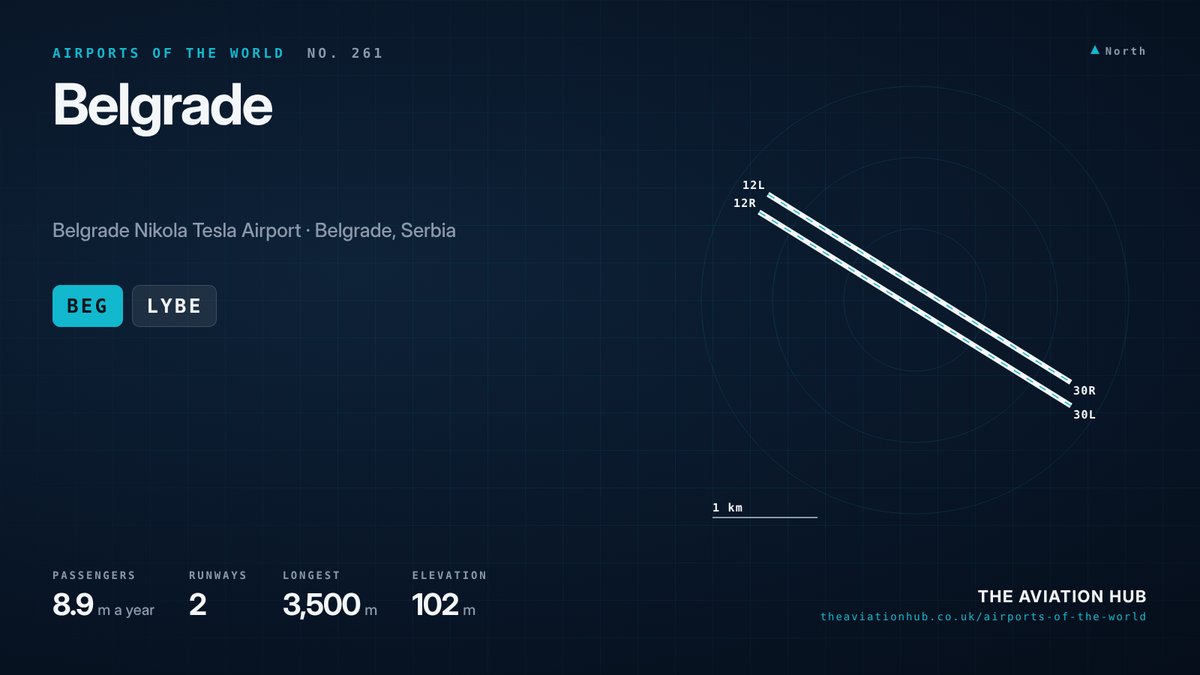
Belgrade Nikola Tesla Airport sits on flat farmland at Surcin, west of the Serbian capital, and handles close to nine million passengers a year. It is the home of Air Serbia, a base for Wizz Air and the largest and busiest airport in the country. Since 2018 the French group Vinci has run it under a long concession and has rebuilt much of it. Belgrade Airport now has two parallel runways, an enlarged terminal and a route map that reaches New York, Chicago and Shanghai as well as most of Europe.
Belgrade Airport at a Glance
The codes are BEG for IATA and LYBE for ICAO. The field lies around 11 miles (18 km) west of the city centre, beside the A3 motorway. Elevation is 102 metres (335 feet). There are two runways and one terminal complex, split into the older Terminal 1 and the larger Terminal 2 under one roof.
Belgrade Airport handled roughly 8.9 million passengers in 2025, up about six per cent, with close to 90,000 aircraft movements. The first seven months of 2026 ran seven per cent ahead. Air Serbia is the hub carrier and Wizz Air keeps a base of several aircraft. Air Pink and Prince Aviation run business jets from the general aviation apron. Vinci Airports operates the field under a concession that runs to July 2044, and the timetable is on the airport’s official website.
How Belgrade’s Airport Came to Be
Belgrade had several earlier airfields, at Banjica in 1910, Kalemegdan in 1911 and Pancevo in 1923. A civil airport opened at Novi Beograd in 1927 and served the city through the years of Aeroput, the Yugoslav national airline. By the 1950s that site was hemmed in by the new city district and could not take jets.
Work on the present field began in 1958. President Tito opened it on 28 April 1962 with a single runway and a glass terminal that is now Terminal 1. JAT Yugoslav Airlines made it the hub of a network that stretched to North America and Australia. Terminal 2 followed in 1979, built for five million passengers.
Sanctions in the 1990s and the 1999 bombing emptied the airport, and recovery was slow. It was renamed for Nikola Tesla in 2006, honouring the Serbian inventor. Etihad bought into JAT in 2013 and relaunched it as Air Serbia. In January 2018 the government awarded Vinci a 25 year concession for 501 million euros, and the company took over that December.
Runways at Belgrade Airport
Belgrade Airport has two parallel runways aligned northwest to southeast. Runway 12L/30R is the original 1962 strip, 3,400 metres (11,155 feet) long. Runway 12R/30L is the new one, 3,500 metres (11,483 feet) long. Vinci built it as the centrepiece of its investment programme and opened it in June 2023, together with new taxiways and rebuilt aprons.
The two runways sit too close together for simultaneous use. The new strip carried traffic while the old one was rebuilt, and the original reopened in late 2024. The new runway now serves as a backup and is due to become a parallel taxiway. Both are long enough for any wide body, and Air Serbia’s Airbus A330 fleet uses them to New York. Runway 30 sees more use in summer. The strong southeasterly Kosava, most common in the colder months, brings operations onto runway 12.
The field made unwelcome headlines in February 2024. An Air Serbia Embraer E195 bound for Dusseldorf struck the localiser antenna on departure after starting its take off roll from an intersection that left too little runway. The crew returned safely and everyone walked off, but the aircraft was badly damaged.
Terminals and Airlines
The terminal at Belgrade Airport is one long building with two named halves. Terminal 1, the 1962 original, was refurbished in 2017 and now handles mostly low cost and charter flights, so Wizz Air, easyJet and the summer holiday carriers check in here. Terminal 2 houses Air Serbia and most full service airlines. A central security hall opened in 2021 and sends everyone through one checkpoint before the A and C gate piers.
Air Serbia is the dominant carrier. It flies the largest network from the airport, though it belongs to no global alliance. Lufthansa, Austrian, Swiss, Turkish Airlines, Qatar Airways and KLM fly in from their hubs, so all three alliances are represented. Flydubai and Pegasus add Gulf and Turkish capacity. Domestic flights to Nis use gate A11, and twenty passport eGates installed in late 2024 have eased arrivals queues.
Routes and Destinations
The busiest routes from Belgrade Airport by summer 2026 frequency are Tivat with more than 60 departures a week, then Istanbul, Zurich, Vienna, Podgorica and Frankfurt. The two Montenegrin routes show how much Serbian holiday traffic goes to the coast. Zurich and Vienna reflect large Serbian communities in Switzerland and Austria, which fill flights year round.
Long haul is Air Serbia’s growth story. New York JFK returned in 2016 after a 24 year gap, and Chicago followed in 2023. Guangzhou followed in September 2024 and Shanghai in January 2025. Air Serbia also flies to Baku, Tbilisi and five Russian cities, having kept Moscow when western carriers withdrew. Cargo is modest, carried mostly in Air Serbia bellies and on Turkish Cargo freighters.
Getting to and from Belgrade Airport
There is no rail link yet. Work on a line from the city began in 2024, and the government says it will be finished by the end of 2026. The cheapest sensible option is the A1 express bus, which runs to Slavija square every 20 minutes for around 400 dinars (roughly £3) and takes about 35 minutes outside the rush hour. City bus 72 is slower but cheaper and ends at Zeleni Venac near the old town.
Taxis are licensed and metered, and Belgrade Airport sells a fixed price voucher at the arrivals desk for trips to the centre. Agree nothing with touts in the hall. Driving takes 25 to 40 minutes via the A3 motorway. Parking beside the terminal has been banned since 2007, so cars use the multi storey garage or the long stay lots served by a shuttle.
Spotting and Photography
Spotting at Belgrade Airport is done from public roads and open fields around the perimeter. A popular location is the gravel area at the end of Periklova street, near the southeast end of the runway, with views of arrivals on runway 30 and aircraft lining up. The open fields west of the airport cover both directions. The roadside of Highway 266 suits runway 12 arrivals and runway 30 departures.
Light at Periklova is best from midday to sunset for arrivals on the 30s. The western fields work from late morning, though heat haze builds at midday. The fleet is varied for a field of this size, with Air Serbia A319s, ATR 72-600s and A330s, Wizz Air A321neos and visiting flydubai and Qatar Airways jets. Police patrol the perimeter, so carry identification, stay off service roads and never climb the fence.
What Comes Next
Vinci’s programme is largely complete, but more phases are planned before the concession ends in 2044. The next steps include a further 17,000 square metres of terminal space and four extra jetbridges at Terminal 2. A new control tower is also on the list, since the current one dates from 1962.
The strategic question is how fast Air Serbia can grow. The airline keeps adding long haul routes, which could make Belgrade Airport a credible transfer point between the Balkans and North America. Wizz Air competes hard on point to point routes. Belgrade Airport could reach ten million passengers by the end of the decade, and the rail link is the missing piece. See how it compares with its neighbours on our Airports of the World map.
Continue to follow The Aviation Hub for more analysis and insight.
Advertise with us Your brand, in front of an aviation audience Home page and in-article placements, sold directly, one advertiser per slot. From £250 a year. See the rates

