
Berlin Brandenburg Airport Guide: The Capital’s Late Arrival
Berlin Brandenburg Airport opened nine years late and billions over budget. Read how BER works today, from its two runways to its rail station and night ban.
 By The Aviation Hub
7 min read
Updated October 20, 2026
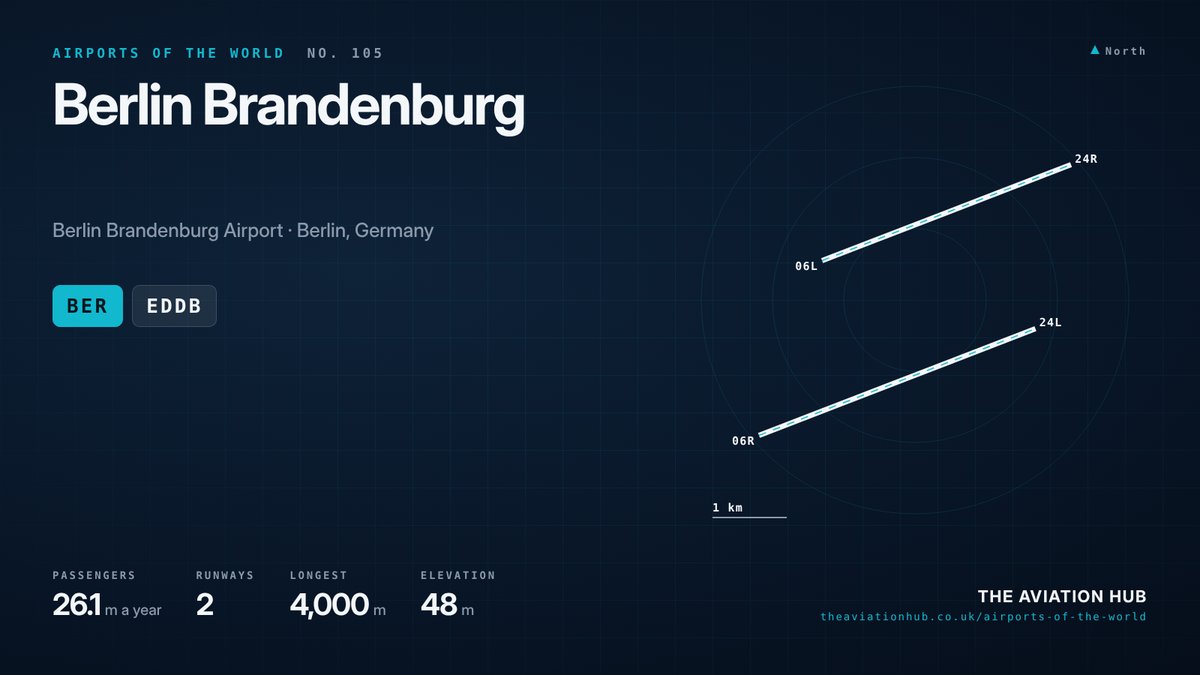
Berlin Brandenburg Airport, known everywhere by its code BER, is the single commercial airport serving the German capital. It opened in October 2020, nine years behind schedule and roughly three times over budget, after a saga that became a national embarrassment. Today Berlin Brandenburg Airport handles around 26 million passengers a year, which makes it the third busiest in Germany behind Frankfurt and Munich. It replaced Tegel, Schonefeld and Tempelhof and sits beside the old Schonefeld site in the state of Brandenburg, just outside the city boundary.
Berlin Brandenburg Airport at a Glance
The codes are BER and EDDB. The airport sits in Schonefeld, about 11 miles (18 km) southeast of central Berlin, at an elevation of 48 m (157 ft). Two parallel runways serve two active terminals, T1 and T2. The former Schonefeld buildings, briefly known as Terminal 5, closed in 2021 and have not reopened to passengers.
In 2025 Berlin Brandenburg Airport handled around 26 million passengers, up about two per cent on the year before. easyJet, Eurowings, Condor and Sundair all base aircraft here, Ryanair’s base closes in late October 2026, and no network carrier uses it as a hub. The operator is Flughafen Berlin Brandenburg GmbH, owned by the states of Berlin and Brandenburg and the federal government. Parking, transport and flight information are on the airport’s official website.
How Berlin’s Airport Came to Be
Reunification left Berlin with three airports and a plan to merge them into one. Official planning began in the early 1990s and settled on expanding Schonefeld, the old East German field. A privatisation attempt collapsed in 2003, a court cleared the way in 2006 and construction began that year with an opening date of October 2011.
The opening, by then reset for June 2012, was cancelled weeks before the first flight. The fire protection and smoke extraction system had failed its acceptance tests, and investigators found that its designer was not a qualified engineer. Cabling, cooling pipes and thousands of other defects followed. Managers came and went, corruption allegations surfaced and the budget climbed from EUR 2.83 billion in 2009 towards an eventual figure of close to EUR 10 billion.
Tempelhof had already closed in 2008. The airport finally opened on 31 October 2020, in the depths of the pandemic, and Tegel closed a week later. In December 2009 the airport had been named after Willy Brandt, the former mayor of West Berlin, chancellor and Nobel Peace Prize laureate. The Willy Brandt Foundation considered withdrawing the name during the scandals but never did.
Runways at Berlin Brandenburg Airport
Berlin Brandenburg Airport has two parallel runways spaced 1,900 m apart, far enough for independent simultaneous instrument approaches. The southern runway 06R/24L is 4,000 m (13,123 ft) long and 60 m wide, with a concrete surface, and it was built new for the project. The northern runway 06L/24R is the old Schonefeld runway, 3,600 m (11,811 ft) long and 45 m wide, with an asphalt surface.
In October 2024 the runways were renumbered because of magnetic drift. The old designations of 07L/25R and 07R/25L became 06L/24R and 06R/24L, which caused a flurry of chart and database updates. Westerly operations on the 24 runways are more common, bringing arrivals in from the east over the Brandenburg countryside.
A night flight ban applies from midnight to 05.00, with restrictions in the shoulder hours. The ban was a condition of planning consent and remains politically untouchable. The long southern runway gives plenty of margin for the heaviest departures, though few long haul services use it.
Terminals and Airlines
Terminal 1 is the main building, the one that took 14 years to open. It is divided into sections A to D and handles easyJet, the Lufthansa Group including Eurowings, Condor, Air France, KLM, British Airways, Turkish Airlines, United, Qatar Airways and most of the smaller full service carriers. The main hall is a large glazed box with an artwork hanging from the ceiling.
Terminal 2 opened on 24 March 2022 as a plain, functional building beside T1. Ryanair was the anchor tenant and Wizz Air joined in November 2022. The two terminals share the same airside area and the same rail station, so passengers can walk between them without leaving the building.
The airline picture at Berlin Brandenburg Airport is unusual for a capital city. Lufthansa flies in from its hubs but has never based long haul aircraft here. The collapse of Air Berlin in 2017 removed the one carrier that might have built a hub, and easyJet and Ryanair filled the gap. The result is a point to point airport with low cost carriers holding the majority of seats.
Routes and Destinations
The busiest routes in 2023 were a mix of European capitals and holiday spots. Amsterdam, Palma de Mallorca, Zurich, Paris Charles de Gaulle, Istanbul, Vienna, Barcelona, London Heathrow, Madrid and Copenhagen led the international table. Domestically, Frankfurt and Munich dominate as Lufthansa feeders, followed by Stuttgart, Dusseldorf and Cologne Bonn.
Beyond Europe the list is short. Antalya and Istanbul Sabiha Gokcen carry heavy leisure and diaspora traffic. Doha, Tel Aviv, Hurghada, Izmir and Cairo follow, and United and Delta have flown to New York. Singapore Airlines has served the city via Scoot. Cargo is small at around 44,000 tonnes a year, though a midfield freight centre has room to grow.
Getting to and from Berlin Brandenburg Airport
The rail station under Terminal 1 is the best way in. The Airport Express, branded FEX, runs to Berlin Hauptbahnhof in around 23 minutes with stops at Sudkreuz and Potsdamer Platz, and regional trains on the RE and RB lines serve Ostkreuz and other city stations. S-Bahn lines S9 and S45 are slower but frequent. All of these are covered by a standard public transport ticket for zones ABC, which costs a little over EUR 4 (about £3.50) and is the cheapest sensible option.
Long distance trains are thin, with an InterCity between Dresden and Rostock the main service. The U7 underground line does not reach the airport despite years of discussion. Express bus X7 links Berlin Brandenburg Airport to the U7 at Rudow, and the BER1 and BER2 buses run to Steglitz and Potsdam with a surcharge.
Drivers use the A113 motorway, which has its own airport exit and connects to the A100 city ring and the A10 orbital. The journey to Mitte takes around 30 to 40 minutes outside the peaks. A taxi costs around EUR 55 to 65 (about £47 to £56). Parking covers roughly 10,000 vehicles across several garages.
Spotting and Photography
BER has a visitor terrace on the roof of Terminal 1 that reopened after the pandemic. It faces the aprons and the northern runway and offers a wide view of movements, with the southern runway visible in the distance. Entry costs a few euros and the terrace closes in the evening.
Outside the fence, the best positions are at the ends of the northern runway. The old Schonefeld spotting mound near the threshold of 06L is a long standing favourite for arrivals in easterly winds. For the more common westerly flow, the fields east of the 24R threshold near Waltersdorf give good views of aircraft on short final. Morning light suits the eastern end and afternoon light the western end.
German police are relaxed about spotting as long as people stay on public paths and off farm tracks marked private. Do not use step ladders against the fence or stand on car roofs, both of which attract complaints.
What Comes Next
The airport was designed for 46 million passengers at opening and 58 million by 2035, so it has plenty of headroom. A Terminal 3 was pencilled in for around 2029 but has slipped as traffic recovered more slowly than hoped. Two satellite concourses are permitted and a third runway to the south is possible in theory, though nobody is pushing for it.
The real constraints are financial. The operator carries heavy debt and has needed repeated state support, and high German aviation taxes have driven Ryanair to cut capacity. The verdict is that Berlin Brandenburg Airport is a decent airport with an awful history, now searching for an airline willing to make it a hub. See how it ranks against other European capitals on the Airports of the World map.
Continue to follow The Aviation Hub for more analysis and insight.
Advertise with us Your brand, in front of an aviation audience Home page and in-article placements, sold directly, one advertiser per slot. From £250 a year. See the rates

