Beyond Sydney to London & New York, Where Else Could Qantas Go with Project Sunrise?
 By The Aviation Hub
7 min read
By The Aviation Hub
7 min read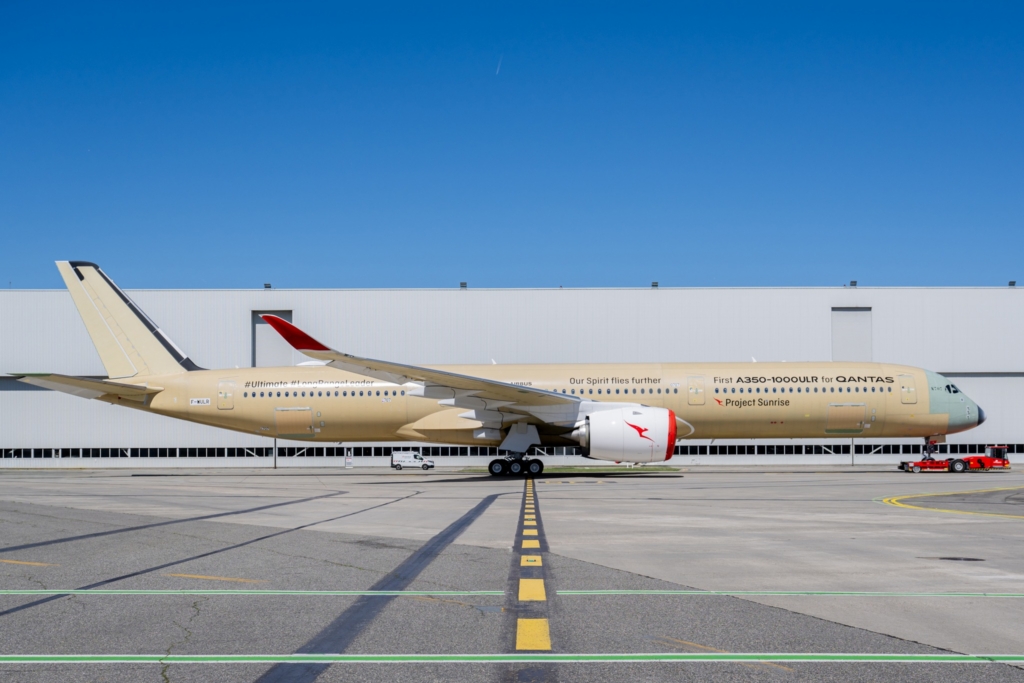
Beyond the planned Sydney to London & New York direct flights, where else could Qantas go when Project Sunrise is in full commercial operation?
Qantas has spent almost a decade chasing a single engineering target.
In August 2017 the airline challenged Airbus and Boeing to build an aircraft capable of flying non-stop from Australia’s east coast to London and New York, and only now has the answer started behaving like a real aeroplane rather than a slide in a fleet presentation.
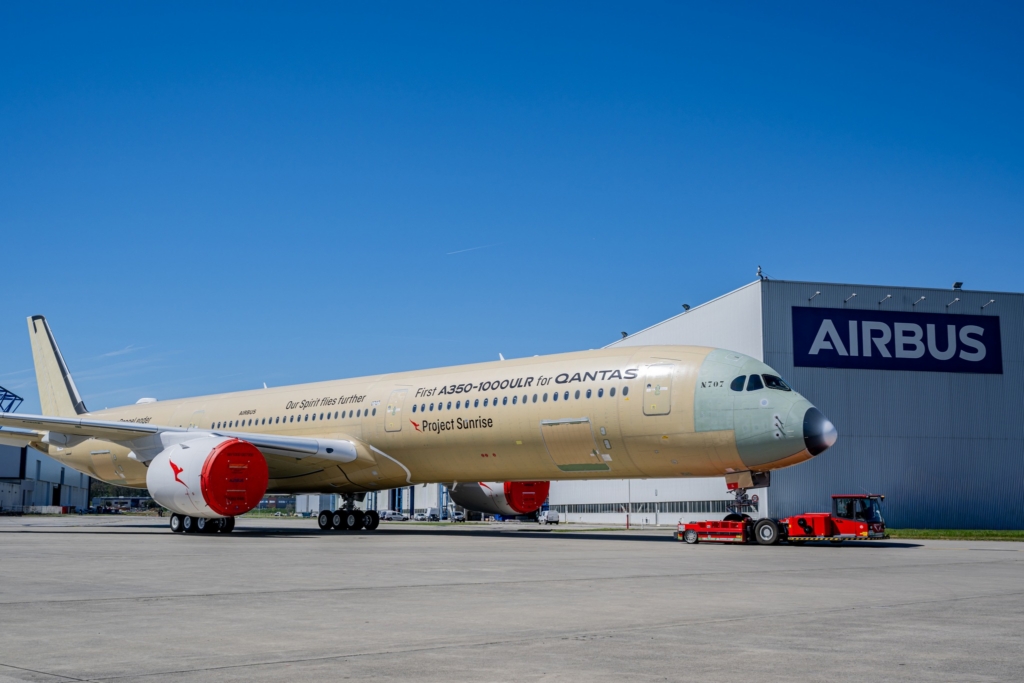
That answer, the Airbus A350-1000ULR, has now been to Australia and back.
With the first commercial service confirmed for October 2027, the interesting question is no longer whether the aircraft can do the job.
It is where else Qantas might point it once all twelve are on strength.
The Aircraft Built for One Problem
The A350-1000ULR is not a clean sheet design.
It is a standard A350-1000 with a 20,000 litre rear centre tank integrated into the airframe structure, a maximum take-off weight lifted to 324 tonnes, and a redesigned galley cooling system that Airbus intends to roll out across the wider A350 line.
The tank adds roughly 1,000 nautical miles to a type that already had a book range of around 9,100 nautical miles, and it supports commercial sectors of up to 22 hours.
The other half of the equation is the cabin.
Qantas has configured the aircraft with just 238 seats across four classes, comprising six First suites, 52 Business suites, 40 Premium Economy and 140 Economy, of which 42 are Economy Plus.
That is the lowest density of any A350 in service anywhere. A conventional operator would put more than 330 passengers into the same airframe.
Qantas is deliberately accepting a very high cost per available seat kilometre and betting that yield covers the difference.
Twelve aircraft have been ordered, with the first, named Vega, due in April 2027.
A separate order for twelve standard A350-1000s follows from FY28 under Project Fysh.
Why Sydney to London Sets the Ceiling
Sydney to London is the mission that defined the aircraft, and it is worth understanding just how extreme it is.
The great circle distance is roughly 17,020 kilometres, or 9,190 nautical miles.
Sydney’s antipodal point sits in the North Atlantic near the Azores, which means the Iberian peninsula and the western approaches to Europe are effectively the furthest inhabited places on earth from the Australian east coast.
Only a handful of commercially meaningful cities sit further from Sydney than London does.
Lisbon is 18,176 kilometres away, Madrid 17,673 kilometres and Dublin 17,215 kilometres. Manchester, at 17,011 kilometres, is almost identical to London.
This matters enormously for the question of future routes.
Once an airline has solved Sydney to London westbound, in winter, into a jet stream headwind, with 238 passengers and full reserves, it has effectively solved every other route on the planet from that hub.
The constraint stops being engineering and becomes economics.
Europe Beyond London from Sydney
The obvious candidates all sit inside the London benchmark rather than beyond it.
Paris is 16,945 kilometres from Sydney, Amsterdam 16,658 kilometres, Frankfurt 16,497 kilometres and Rome 16,344 kilometres.
Every one of those is an easier sector than the launch route by a margin of between 75 and 675 kilometres.
Paris and Frankfurt have been named in Qantas planning material going back years, and both carry genuine point-to-point demand alongside connecting traffic.
Rome is interesting for a different reason, given Qantas already serves it seasonally from Perth. Madrid and Lisbon are the two European cities that would genuinely stretch the aircraft, and neither has the corporate demand base to justify a 238 seat premium-heavy operation.
The more likely near-term move is not a new European country at all.
It is a second Australian gateway.
Melbourne to London is 16,908 kilometres and Brisbane to London only 16,543 kilometres, both comfortably inside the Sydney benchmark.
North America Beyond New York
North America is the easier half of the map. Sydney to New York is 16,014 kilometres, a full 1,000 kilometres shorter than Sydney to London, which is why New York was always going to be the second route rather than the harder first one.
Everything else in North America is easier still. Boston is 16,251 kilometres, Toronto 15,555 kilometres, Miami 15,022 kilometres and Chicago 14,862 kilometres.
Group CEO Vanessa Hudson has specifically flagged Chicago, a route Qantas has announced on several previous occasions without ever operating.
Toronto would open a market Australia has never had non-stop, and Miami would function as a Latin America gateway.
The one genuine outlier is Melbourne to New York at 16,696 kilometres, which is a materially harder sector than Sydney to New York and helps explain why Melbourne has quietly slipped down the priority list.
The Routes That Do Not Actually Need a ULR
Here is the part that often gets lost in Project Sunrise coverage.
Several destinations regularly floated as Sunrise routes do not require this aircraft at all.
Rio de Janeiro is 13,522 kilometres from Sydney and Sao Paulo 13,367 kilometres.
Cape Town is 10,989 kilometres and Johannesburg 11,024 kilometres. Every one of those sits well inside the range of a standard A350-1000, and the South African markets are within reach of aircraft Qantas already operates.
Even Chicago, at 8,025 nautical miles, fits inside the book range of the standard variant.
The A350-1000ULR’s exclusive territory is therefore narrow.
It covers northwest Europe and, with margin for winter headwinds and full payload, the northeastern corner of North America.
That is roughly it. The rest of Qantas’s ultra-long-haul ambitions can be delivered by the twelve conventional A350-1000s arriving from FY28.
Could Other Airlines Order the A350-1000ULR?
Airbus certainly hopes so.
Executive Vice President of Sales Benoît de Saint-Exupéry has said there are interested customers and that it is straightforward to guess who they are by looking at the geographies.
He also noted the earliest available delivery slots are in 2030.
The geography argument cuts both ways, though.
Very few hubs sit far enough from major demand centres to justify a ULR sub-fleet. Singapore Airlines is the most credible candidate, already operating seven A350-900ULRs to New York and Newark.
A -1000ULR would let it carry an economy cabin on those sectors for the first time and add meaningful capacity.
Air New Zealand is often mentioned, but the numbers do not support it.
Auckland to London is 18,364 kilometres, beyond even this aircraft, while Auckland to New York at 14,216 kilometres is already flown by the 787-9.
The precedent is not encouraging either.
The A350-900ULR attracted exactly one customer for seven aircraft.
Ultra-long-range variants are niche by definition, because they trade payload and seat count for range that only a handful of city pairs actually require.
Aviation Week’s assessment that Qantas may be the only operator able to justify a -1000ULR fleet at scale looks about right.
There is also no competing product to force the issue.
Boeing pitched a version of the 777-8 when Qantas ran the original evaluation, and the type has since slipped repeatedly, with entry into service no longer expected before 2029.
Any airline that wants this capability in the next five years has one option and one manufacturer, which is not usually how order books grow.
Where Airbus does win is in the trickle-down.
The higher maximum take-off weight and the new galley cooling architecture developed for this programme will benefit standard A350 customers, which is a more realistic return than a second ULR order book.
What Project Sunrise Means for Qantas from Sydney
The commercial logic rests on time.
Qantas already charges roughly 20 per cent above one-stop competitors on Perth to London, and more than 1.7 million passengers have flown its existing non-stop long-haul services since 2018, which record the highest satisfaction scores on the international network.
Project Sunrise scales that proposition to the routes that matter most.
The strategic prize is a competitive moat.
No other airline can match Sydney to London non-stop, and none will be able to before 2030 at the earliest given Airbus’s delivery position.
That is a rare thing in modern aviation, and it lets Qantas reduce its dependence on Middle Eastern and Asian hub partners for its most valuable traffic.
Fleet arithmetic explains the rest.
A daily rotation on a 20 hour sector needs three aircraft.
London and New York therefore absorb six of the twelve, with the remaining six earmarked for what Qantas calls network diversification, most obviously replacing 787-9s on Perth to London and Auckland to New York and freeing those aircraft for other markets.
The risks are real.
Twelve aircraft is a thin fleet, one unserviceable airframe can break a daily rotation, and 238 seats leaves little margin if premium demand softens or fuel prices move.
Supply chain problems have already pushed the launch back by about six months. But if the yields hold, Qantas ends up owning the last unclaimed frontier in commercial aviation, and owning it alone for several years.
Continue to follow The Aviation Hub for more analysis and insight!
Advertise with us Your brand, in front of an aviation audience Home page and in-article placements, sold directly, one advertiser per slot. From £250 a year. See the rates