
Billund Airport Guide: The Lego Town’s Gateway to Europe
Billund Airport grew from a Lego company airstrip into Denmark's second busiest airport. Runway, airlines, cargo, buses and what comes next.
 By The Aviation Hub
6 min read
Updated October 20, 2026
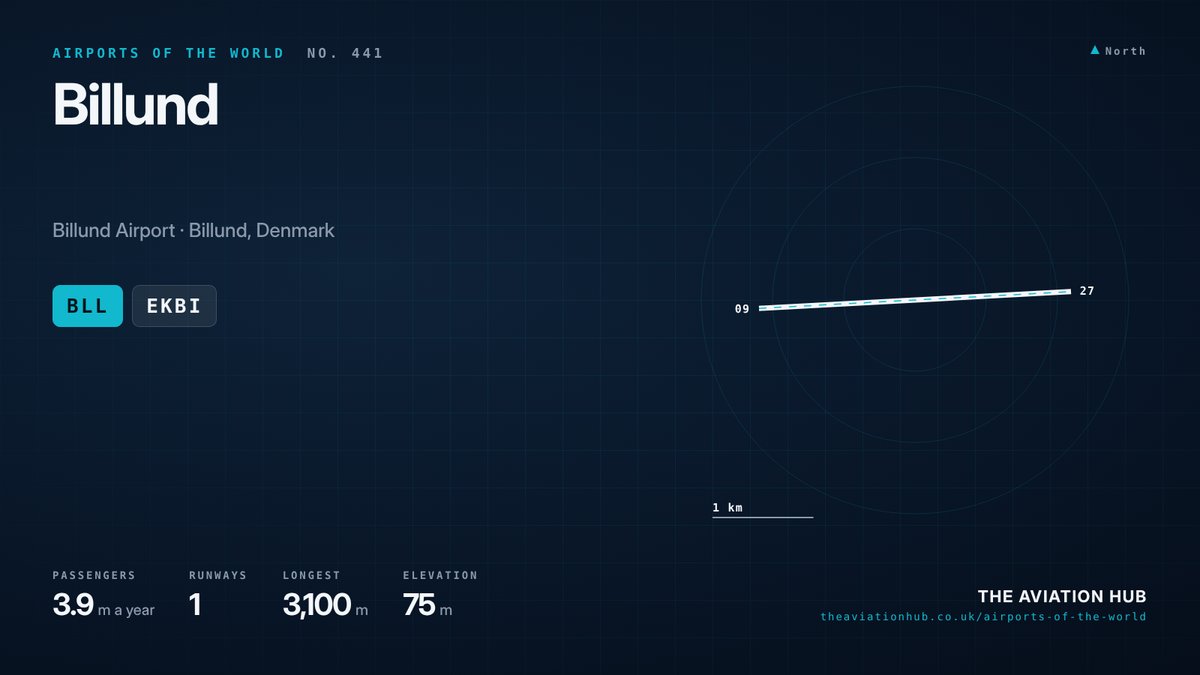
Billund Airport serves Jutland from a site beside the Lego factory town of Billund, in the heart of southern Denmark. It is Denmark’s second busiest airport, a role it owes to Lego’s founding family, who laid the first runway for their own aircraft in 1961. Around three million passengers used it in 2025, alongside a cargo operation far bigger than the town would suggest. For western Denmark it is the main gateway to Europe and the sun.
Billund Airport at a Glance
The IATA code is BLL and the ICAO code is EKBI. The field lies about 2 miles (3 km) by road from Billund town, about 17 miles (28 km) from Vejle and 61 miles (98 km) from Aarhus. It sits 247 feet (75 m) above sea level. There is one runway and one main passenger terminal. Billund Airport handled roughly 3.1 million passengers in 2025, down by more than a fifth on the previous year after Ryanair closed its base.
Norwegian, SAS and Wizz Air are among the main passenger carriers, while Lufthansa, KLM, Air France, British Airways and LOT feed their hubs from here. Maersk Air Cargo uses the field as its hub. The airport company is in local public ownership. Flight times, parking and bus details are on the airport’s official website.
How Lego Built Billund’s Airport
The airport began as a private project. In 1961 Godtfred Kirk Christiansen, son of Lego’s founder, built a runway and hangar north of the factory so the company could fly its own aircraft. Customers and staff soon wanted to use it, and the field opened to the public on 1 November 1964. The first runway measured 1,660 metres. Passengers were processed inside the Lego hangar until a proper terminal opened in spring 1966.
LEGOLAND opened next door in 1968 and brought a steady flow of family visitors. Holiday charters to the Mediterranean became the backbone of the schedule through the 1970s and 1980s, and Maersk Air built a large operation here. The present terminal opened at the end of May 2002. KHR Architects designed it with the engineers COWI to handle 3.5 million passengers a year.
Recent years have been bumpy. The collapse of Cimber Sterling in May 2012 cost an estimated 300,000 passengers that year. Ryanair closed its two aircraft base in March 2025, a decision expected to remove about 1.3 million annual passengers and some 25 routes. The same month Sun Air, the local British Airways franchise partner, ended scheduled flying after about 35 years. Billund Airport now leans more heavily on Norwegian and the network carriers.
Runways at Billund Airport
The single runway, 09/27, is asphalt and measures 3,100 metres (10,172 feet) long and 45 metres wide. That is generous for an airport of this size, and it comfortably handles long haul wide body freighters. The Boeing 747 appears regularly, almost always in cargo configuration. Westerly winds dominate in Jutland, so runway 27 sees most of the traffic, with arrivals approaching from the east over open farmland.
There is no crosswind runway. Strong gales sweeping in from the North Sea can challenge crews on lighter aircraft, especially in winter. The surrounding terrain is flat heath and farmland, which keeps the approaches simple. The runway has grown from its original 1,660 metres as charter jets and freighters became larger and heavier.
Terminals and Airlines
All scheduled passenger flights use the main terminal on the north side of the runway, a glass fronted building of about 40,000 square metres. It was designed as the first phase of a larger complex. A theatre opened inside the airport in late 2023, an unusual addition that shows how the building doubles as a regional venue.
Norwegian runs the largest network from Billund Airport, with flights to Oslo, London Gatwick, Alicante and Malaga plus a long list of summer routes. SAS, now part of SkyTeam, also serves the field, and Wizz Air adds links to Eastern Europe. The hub feeders are Lufthansa to Frankfurt, KLM to Amsterdam, Air France to Paris Charles de Gaulle, British Airways to London Heathrow and LOT to Warsaw. All three global alliances are therefore represented.
Routes and Destinations
Hub flights to Amsterdam, Frankfurt, Paris and London are central to the schedule. They carry much of the business traffic generated by Jutland’s export industries, with onward connections worldwide. Leisure dominates the rest of the network. Summer brings a wall of sun routes to Spain, Greece, Turkey and the Canary Islands, flown by Norwegian and by charter airlines working for Danish tour operators. Winter is quieter, built around the Canaries, city breaks and ski trips.
Cargo is the other big business. Billund Airport handles far more freight than its passenger numbers suggest, served by Maersk Air Cargo, Turkish Cargo and DHL Aviation. Maersk flies Boeing 767 and 777 freighters on routes tied to its global logistics network. New passenger services are still arriving, and TUI fly Belgium is due to start a Brussels route on 27 March 2027.
Getting to and from Billund Airport
There is no railway station at the field. Express buses connect Billund Airport with Vejle station in around 40 minutes, and from there trains run to Copenhagen, Aarhus and Fredericia. Direct coaches also serve Aarhus, Horsens, Skanderborg, Kolding and Esbjerg, with Aarhus about 90 minutes away. The bus to Vejle followed by a train is the cheapest sensible option for most travellers.
By car, the drive from Vejle takes about 35 minutes on primary route 28, which links to the E45 motorway. Parking sits close to the terminal, with cheaper long stay areas further out, and booking online usually saves money. Taxis to Vejle cost several hundred Danish kroner, so they suit groups rather than solo travellers. A rail connection to Billund has featured in national infrastructure planning, but trains remain some years away.
Spotting and Photography
Billund Airport is a relaxed place for spotters. The flat ground means the perimeter roads offer clear views, and the southern side puts the sun behind photographers for most of the day. Arrivals on runway 27 cross the eastern farmland at low altitude, giving good shots from minor roads beyond the threshold. The freighters are the stars, with Maersk 767s and 777s, Turkish Cargo wide bodies and the occasional 747.
Public viewing inside the terminal is limited, so most enthusiasts work from the car. Keep to public roads, never climb or lean equipment against the fence, and move on politely if security staff ask. Summer weekends add charter variety, while winter brings low light and the odd deicing scene.
What Comes Next
Rebuilding after the Ryanair exit is the immediate task. Billund Airport is working to win back lost routes, and new services such as the Brussels link point to gradual recovery. Cargo growth remains a priority, helped by Maersk’s investment in its hub here. The 2002 terminal leaves room for further phases north of the runway once passenger numbers return.
Denmark’s new passenger tax, phased in from 2025, adds pressure on price sensitive leisure demand. The verdict: Billund Airport will remain Jutland’s main gateway, but its next chapter depends on freight and on winning back low cost capacity. See how it compares with its neighbours on the Airports of the World map.
Continue to follow The Aviation Hub for more analysis and insight.
Advertise with us Your brand, in front of an aviation audience Home page and in-article placements, sold directly, one advertiser per slot. From £250 a year. See the rates

