Biman Bangladesh Orders Ten Airbus Jets: A350s and A321neos for Global Expansion
Biman Bangladesh Airlines has placed a firm order for ten Airbus aircraft, comprising four A350-900s and six A321neos, as part of a major fleet modernisation drive.
 By The Aviation Hub
4 min read
By The Aviation Hub
4 min read
Biman Bangladesh Airlines has placed a firm order for ten Airbus aircraft: four A350-900 widebody jets and six A321neo single-aisle aircraft. The order, announced on 7 October 2026, forms a central part of the Bangladeshi flag carrier’s fleet modernisation programme and international expansion plans.
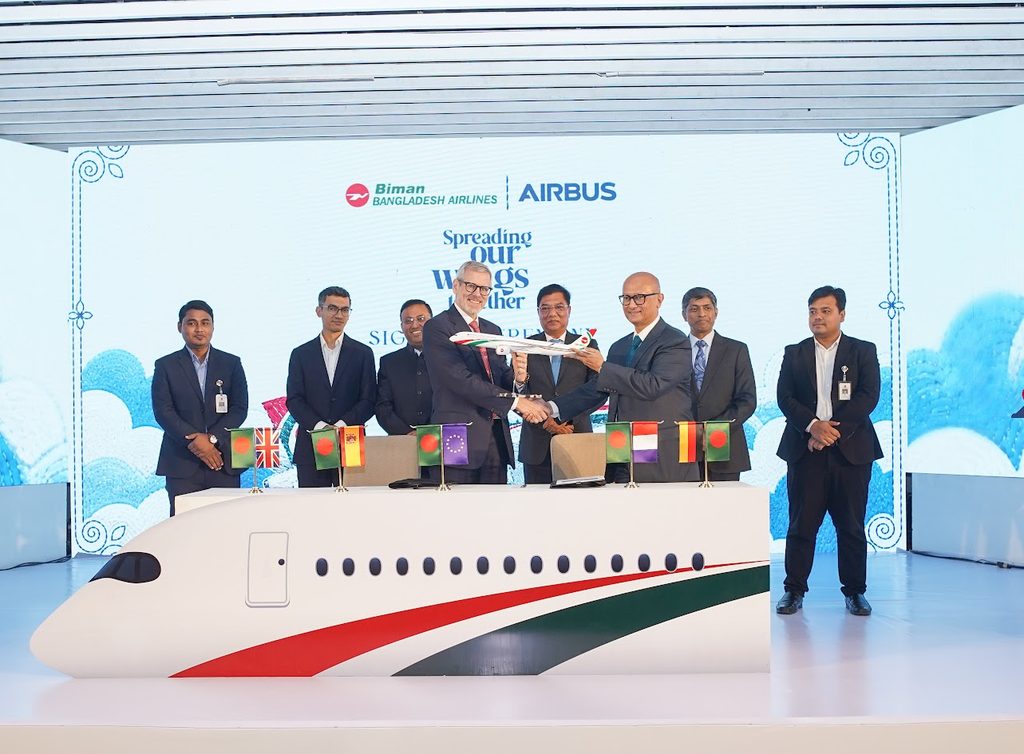
The announcement follows a separate firm order for 25 Boeing jets placed just a week earlier, as Aviation A2Z reports. Taken together, the two orders would nearly triple the airline’s current fleet of 19 aircraft.
What Biman Bangladesh Has Ordered
The Airbus order combines two aircraft types designed for very different roles. The four A350-900s will serve as the airline’s long-haul workhorse, while the six A321neos will cover regional and medium-haul markets.
Aviation24.be confirms that all ten aircraft will operate out of Dhaka (DAC), the airline’s main hub. No delivery timeline has been announced.
The Case for the Airbus A350-900
Airbus designed the A350-900 for intercontinental operations. According to Aviation A2Z, the type is capable of flying up to 9,700 nautical miles (approximately 18,000 kilometres) non-stop, and Airbus claims it delivers a 25% advantage in fuel burn, operating costs and CO₂ emissions compared with previous-generation competitor aircraft.
The A350-900 features the Airbus Airspace cabin, intended to improve comfort for both passengers and crew on long sectors.
The Role of the A321neo
The six A321neo aircraft will complement the widebodies on shorter and medium-haul international routes. Airbus states the type delivers at least 20% lower fuel consumption and CO₂ emissions than previous-generation aircraft, making it well suited to routes that do not require widebody capacity.
As One Mile at a Time notes, the A321neo is the largest member of the A320neo family and offers extended range alongside strong operating economics, giving Biman greater flexibility across its network.
A Rapidly Growing Order Book
Biman’s current fleet stands at 19 aircraft, including four Boeing 737-800s, four Boeing 777-300ERs, six Boeing 787s and five De Havilland Dash 8s, according to One Mile at a Time. The Boeing order placed the previous week comprises ten Boeing 737 MAX 8s, two Boeing 787-9s and thirteen Boeing 787-10s.
Adding all firm orders to the existing next-generation fleet would give Biman: six A321neos, four A350-900s, ten 737 MAX 8s, four 787-8s, four 787-9s and thirteen 787-10s. The breadth of types across both manufacturers raises questions about fleet commonality and training costs, a point One Mile at a Time raises directly.
You can explore Biman Bangladesh Airlines further using our Airline Search.
What the Airline Says
Rumee A. Hossain, chairman of Biman Bangladesh Airlines, framed the expansion in the context of Bangladesh’s broader economic and demographic position.
“Bangladesh is a dynamic nation of 200 million people, backed by a resilient economy and a rapidly growing travel market,” he said, as quoted by One Mile at a Time. “We are uniquely supported by a deeply connected global diaspora of 15 million people. In this context, our planned fleet expansion represents a measured and reasonable ambition.”
Benoît de Saint-Exupéry, Executive Vice President Sales of Airbus Commercial Aircraft, said the A350 and A321neo combination would give Biman the efficiency, range and versatility required to connect Bangladesh with key global markets, according to Aviation A2Z.
North America Ambitions and the FAA Hurdle
Biman has stated that the new aircraft will support services to North America, Europe and the Middle East. The North America ambition comes with a significant caveat, however.
As One Mile at a Time points out, Bangladesh does not currently hold a Category 1 rating from the Federal Aviation Administration (FAA), which means Bangladeshi carriers cannot launch flights to the United States under current rules. That rating would need to change before any transatlantic or transpacific services to North America could begin.
The Bottom Line
Biman Bangladesh’s order for ten Airbus aircraft, combined with its recent Boeing order, signals an airline with genuinely ambitious growth plans. The demand drivers are real: a population of 200 million, a large overseas diaspora, and growing trade flows all support long-term traffic growth.
The challenge will be executing an expansion of this scale while managing a fleet that will span multiple types from two manufacturers. The FAA Category 1 issue also means that North America routes, one of the headline ambitions, cannot launch until Bangladesh’s aviation safety rating improves. How quickly Biman can convert orders into profitable routes will be the story to watch.
Continue to follow The Aviation Hub for more analysis and insight.
Advertise with us Your brand, in front of an aviation audience Home page and in-article placements, sold directly, one advertiser per slot. From £250 a year. See the rates