
Birmingham Airport Guide: The Midlands’ Long Haul Gateway
Birmingham Airport is the UK's seventh busiest, with one 3,052 metre runway and daily Emirates flights. History, routes, access and spotting spots explained.
 By The Aviation Hub
6 min read
Updated October 20, 2026
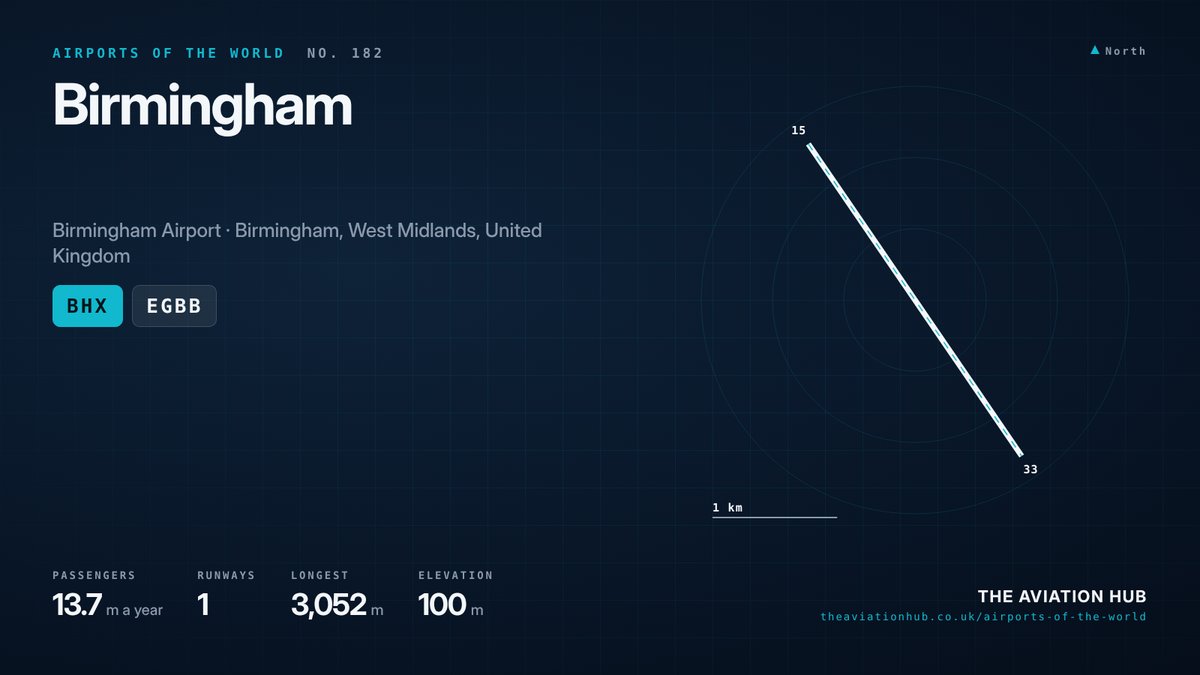
Birmingham Airport is the principal airport of the West Midlands and the seventh busiest in the United Kingdom. It sits at Elmdon, between Birmingham and Coventry, hard against the M42 and the West Coast Main Line. Around 13.7 million passengers used it in 2025, flying mainly to Europe but also to Dubai, Doha, Istanbul, the Indian subcontinent and North America. One long runway, one combined terminal and a railway station across the road make it an easy airport to understand and a useful one for the heart of England.
Birmingham Airport at a Glance
The IATA code is BHX and the ICAO code is EGBB. The terminal lies about 6 miles (10 km) east southeast of Birmingham city centre and a short distance from Solihull. Elevation is 104 metres (341 feet). There is a single runway, 15/33, and a single passenger terminal created in 2011 by joining the old Terminals 1 and 2. The original 1939 Art Deco terminal survives as a Grade II listed building used for private and official flights.
Passenger numbers in 2025 reached roughly 13.66 million on about 99,000 aircraft movements. Jet2.com, easyJet, Ryanair and TUI Airways all run bases here, and Emirates, Qatar Airways, Turkish Airlines, Saudia, KLM, Lufthansa and Aer Lingus bring in the connecting traffic. Birmingham Airport is owned by a consortium of the seven West Midlands councils, the Ontario Teachers’ Pension Plan and an employee share trust. Flight information and parking are on the airport’s official website.
From Elmdon to the Present Day
Birmingham City Council decided in 1928 that the city needed a municipal airport and chose a site at Elmdon. It opened on 8 July 1939, weeks before war broke out. The Air Ministry requisitioned it as RAF Elmdon, and it returned to civilian use on 8 July 1946. Through the 1950s and 1960s it grew on domestic and European services, and the runway was gradually lengthened for jets.
A new terminal opened in 1984 on the far side of the field, served by the world’s first commercial maglev shuttle to the railway station. The maglev ran until 1995 and was replaced by a cable hauled link in 2003. A second terminal, the Eurohub, followed in 1991. In January 2011 the two buildings were joined into one, and in 2010 the word International was dropped from the name.
The runway was extended by 400 metres in 2014 to allow non stop flights to the Far East and the US West Coast. A new control tower came into use in 2013. Concorde visited in 1980 and made its final appearance here in 2003, a memory many local spotters still treasure.
Runways at Birmingham Airport
Birmingham Airport operates one runway. Runway 15/33 is 3,052 metres (10,013 feet) long and 45 metres wide with an asphalt surface. The 2014 extension took it beyond 3,000 metres, enough for a fully loaded Boeing 777-300ER or Airbus A350-900 to reach the Gulf, Delhi or Toronto without restriction. Instrument landing systems serve both ends.
The old crosswind runway, 06/24, closed in 2008 and now serves as a taxiway and a helicopter strip. With no alternative, the airport is exposed to strong crosswinds from the west, and gusty autumn days produce diversions to East Midlands or Manchester. Runway 33, with approaches over the M42 and the National Exhibition Centre, is the busier direction. Runway 15 brings arrivals in over Sheldon and Marston Green.
The single runway is nowhere near capacity, which is why the airport has pushed back against calls for a second strip. Movements of around 100,000 a year sit well below the practical ceiling for a runway of this type.
Terminals and Airlines
Everything departs from the one terminal, which stretches between the former Terminal 2 at the northern end and the former Terminal 1 to the south. Gates 1 to 20 occupy the old Terminal 2 pier, and the higher numbered gates and the long haul stands are at the Terminal 1 end. A large new security hall opened in 2024 to speed up the morning rush, though its early months were marked by long queues and public criticism.
Jet2.com is the largest carrier by seats, with a big holiday network from the Midlands. Ryanair, easyJet and TUI Airways follow. Emirates runs the Dubai service, often with an Airbus A380, and Qatar Airways flies to Doha. Turkish Airlines, Saudia, Pegasus, Air India, Lufthansa, KLM, Air France, Aer Lingus and Loganair cover scheduled connections. Several lounges operate airside, including the Aspire and the Emirates lounge.
Routes and Destinations
Dublin was the busiest route in 2025 with more than 870,000 passengers, followed by Dubai at around 607,000 and Amsterdam at roughly 590,000. Palma de Mallorca and Alicante came next, each above 450,000. Those five tell the story of Birmingham Airport: a strong Irish and Dutch connecting trade, a big Gulf operation and a Spanish beach market that dominates the summer.
The long haul board includes Dubai, Doha, Jeddah, Riyadh, Delhi, Amritsar, Islamabad, Lahore and seasonal Caribbean flying with TUI. Transatlantic service has been intermittent, with Air India via Delhi offering onward connections. The longest regular sector is to the Indian subcontinent. Winter brings ski flights and Canary Islands services, while summer is dominated by the Mediterranean. Cargo is modest and mostly belly freight on the Gulf carriers.
Getting to and from Birmingham Airport
Rail is the obvious choice. Birmingham International station sits on the West Coast Main Line and is linked to the terminal by the free Air Rail Link people mover, a journey of under two minutes. Trains to Birmingham New Street take about ten minutes and run several times an hour. London Euston is roughly 70 minutes away, and Coventry under ten.
By road the airport is at Junction 6 of the M42, with the A45 running in from the city. National Express West Midlands buses X1, X12 and 96 serve the terminal, and National Express coaches call at the interchange. Taxis wait at a rank outside arrivals. Car parks range from a short stay deck beside the terminal to cheaper long stay compounds served by shuttle buses. The train is both the cheapest and the quickest way into the city.
Spotting and Photography
Birmingham Airport is a friendly place for enthusiasts. The best known spot is the car park and grass area off Sheldon Country Park near Old Rectory Farm, which looks straight down the approach to runway 15 and across to the threshold. Aircraft pass low over the fields with the terminal behind. Afternoon light suits this side for arrivals.
For runway 33 operations, the public footpath along the Bickenhill side and the bridge over the A45 give views of departures. The viewing area on the upper level of the terminal multi storey car park looks over the apron and is popular when an A380 or a Saudia Boeing 787-9 is on stand. Westerly winds generally mean runway 33 in use. Stay off private farmland, keep clear of the perimeter fence and the police are generally relaxed if you are sensible.
What Comes Next
The 2007 master plan, Towards 2030, floated a second runway, but that idea has faded and the current strategy is to grow within the single runway. The focus is on the terminal: the new security hall, more gates at the southern end and a rebuilt baggage system from the £100 million investment announced in 2016. Passenger forecasts target 18 million by the early 2030s.
The biggest change is HS2. The Birmingham Interchange station is being built next to the airport with an automated people mover linking it to the terminal and the NEC, promising London in under 40 minutes. A funded West Midlands Metro extension will also tie the airport into the city tram network. Birmingham Airport is heading for steady growth as a regional long haul gateway, not a megahub. See how it compares with its rivals on the Airports of the World map.
Continue to follow The Aviation Hub for more analysis and insight.
Advertise with us Your brand, in front of an aviation audience Home page and in-article placements, sold directly, one advertiser per slot. From £250 a year. See the rates

