
Bodrum Airport Guide: Gateway to the Turkish Aegean Riviera
Bodrum Airport handles over 4 million passengers a year, most of them in summer. Our guide covers its parallel runways, terminals, airlines and transfers.
 By The Aviation Hub
5 min read
Updated October 20, 2026
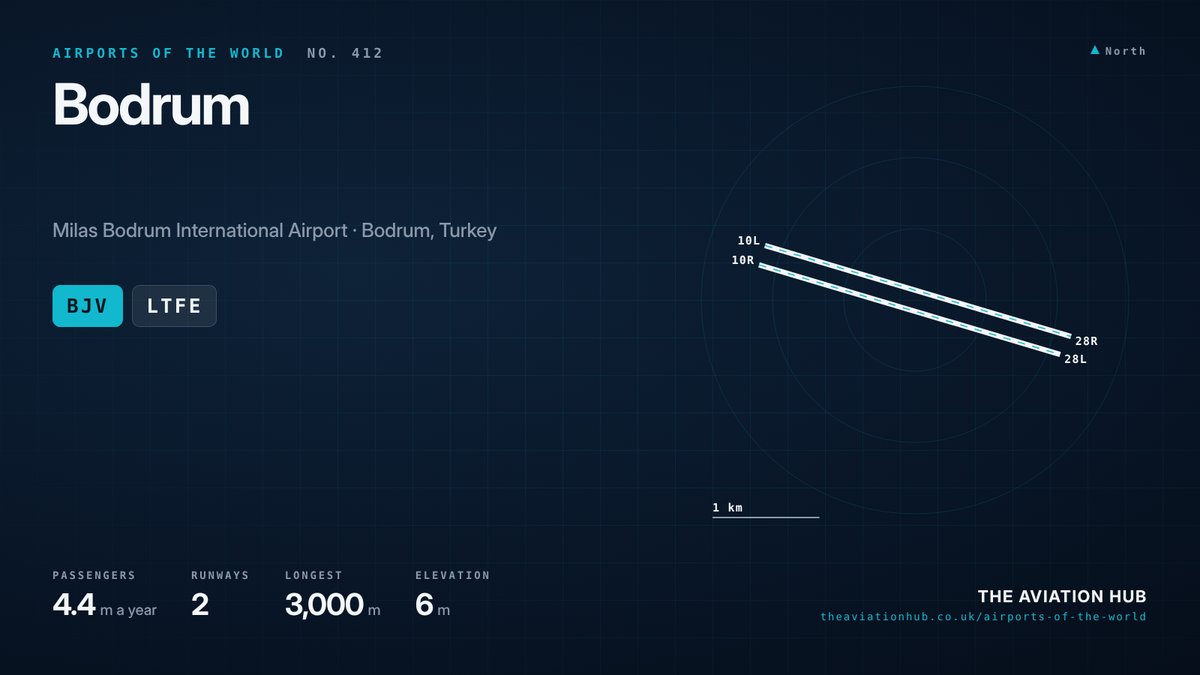
Milas Bodrum International Airport sits on the shores of Güllük Bay in southwest Turkey, inland from the glamorous Bodrum peninsula. Bodrum Airport handled a record 4.36 million passengers in 2025, the vast majority of them between May and October. It is the gateway to one of the Aegean’s busiest holiday coasts, with luxury resorts, yacht marinas and package hotels all within an hour or so. In summer, airliners and private jets crowd its aprons.
Bodrum Airport at a Glance
The IATA code is BJV and the ICAO code is LTFE. The airport lies about 22 miles (36 km) northeast of Bodrum town and 10 miles (16 km) south of Milas, at an elevation of 6 metres (21 feet). It has two parallel runways and separate domestic and international terminals. Bodrum Airport recorded around 4.36 million passengers in 2025, including roughly 2.54 million domestic and 1.82 million international travellers.
No airline runs a major hub here, though Pegasus keeps an operating base and Turkish Airlines, AJet and Pegasus dominate domestic flying. The terminals are run by TAV Airports under a concession from the state airports authority, DHMI. Annual capacity stands at around 7.6 million passengers. Flight and transfer details are on the airport’s official website.
How Bodrum’s Airport Came to Be
Bodrum grew from a sponge diving and fishing town into a fashionable resort from the 1970s onwards. For years, holidaymakers bound for the peninsula flew into Dalaman or Izmir and faced a long road transfer. A dedicated airport on the flat land near Milas changed that when it opened in 1997.
Growth followed quickly as European tour operators added the destination to their summer programmes. A larger international terminal opened in the early 2010s to cope with the rush. TAV Airports then took over operation of the terminals under a long concession that began in 2015, bringing the same model it uses at Izmir and Ankara.
The pandemic cut traffic to about 1.48 million passengers in 2020, but Bodrum Airport recovered faster than many Turkish resorts. Traffic rebounded to around 2.9 million in 2021 as domestic tourism surged. By 2025 it had nudged past its 2019 total of 4.34 million, setting a new record.
Runways at Bodrum Airport
Two parallel runways handle all traffic. Runway 10L/28R measures 3,000 metres (9,843 feet) long and 45 metres wide, with a concrete surface. Runway 10R/28L measures 2,940 metres (9,646 feet), also 45 metres wide and concrete. Both comfortably handle the Airbus A321neo and Boeing 737 MAX jets that make up most of the summer schedule, as well as occasional wide body charters.
The parallel layout gives useful resilience. If one runway is closed for maintenance or an incident, the other can keep the operation running on busy summer weekends. Prevailing northerly meltemi winds blow across the Aegean in summer, and approaches to Runway 10 cross the shallow waters of Güllük Bay. Turnaround times are tight, and peak summer Saturdays bring wave after wave of charter arrivals at Bodrum Airport.
Terminals and Airlines
The international terminal handles flights from Europe and beyond, while the domestic terminal serves routes within Turkey. Both are compact, but queues can build at passport control on summer weekends, so arrive early. Business jets use a separate general aviation apron, which fills up during the yachting season.
Domestically, Turkish Airlines, AJet, Pegasus and SunExpress fly from Istanbul, Ankara and other cities. Internationally, Jet2, easyJet, TUI and Corendon bring package and independent travellers from the UK, Germany and the Netherlands. Air Astana links Bodrum with Kazakhstan. Most foreign airlines operate only from spring to autumn, so the winter timetable at Bodrum Airport is almost entirely domestic.
Routes and Destinations
Istanbul is the backbone of the domestic network, served from both Istanbul Airport and Sabiha Gökçen. Ankara follows, with a handful of other Turkish cities adding seasonal flights. Domestic traffic rose by about 6 per cent in 2025 as more Turkish families chose the Aegean coast for summer breaks.
International traffic fell slightly in 2025, by around 6 per cent, but still accounted for well over a third of passengers. The UK is a key market, with flights from London, Manchester, Birmingham, Bristol and other regional airports. German, Dutch and Scandinavian cities also feature heavily in summer. Almaty, more than 2,500 miles (4,000 km) away, is among the longest routes. The season peaks in July and August, then fades sharply after October.
Getting to and from Bodrum Airport
Road is the only way in. A dual carriageway links the airport with Bodrum and the peninsula, and the drive to Bodrum town takes around 35 to 45 minutes. Resorts such as Yalıkavak, Türkbükü and Gümüşlük take longer, often an hour or more in summer traffic. Milas is around 20 minutes to the north.
Havaş airport shuttles run to Bodrum’s bus station in time with arrivals, the cheapest sensible option for independent travellers. Taxis wait outside both terminals, but fares to the peninsula are high, so many visitors pre book private transfers. Most package holidaymakers at Bodrum Airport travel on tour operator coaches. Car hire desks sit in the arrivals halls, and parking is available beside each terminal.
Spotting and Photography
Summer Saturdays are the highlight, with waves of Jet2, easyJet, TUI, Corendon and Pegasus jets arriving in quick succession. Business jets add variety, from light Citations to Gulfstreams and Global Expresses serving the yachting crowd. The shoreline of Güllük Bay gives open views of approaches over the water.
There is no official viewing area, and Turkish airport security is strict. Keep well away from fences, avoid photographing security installations and stop at once if police or gendarmerie ask. Bright Aegean sunshine is reliable from May to October, though midday heat haze can soften long lens shots. Early morning and late afternoon give the best light at Bodrum Airport.
What Comes Next
With capacity of around 7.6 million passengers and traffic near 4.4 million, the airport has room to grow. The bigger challenge is seasonality. Terminals, staff and transfers must cope with a summer peak several times larger than winter demand, and every busy weekend tests that balance.
Turkish tourism continues to attract strong investment, and the Bodrum peninsula is moving further upmarket. That should support more flights, more private aviation and a longer season. Expect steady growth with sharp summer peaks for years to come. Compare it with nearby Dalaman and other Aegean airports on our Airports of the World map.
Continue to follow The Aviation Hub for more analysis and insight.
Advertise with us Your brand, in front of an aviation audience Home page and in-article placements, sold directly, one advertiser per slot. From £250 a year. See the rates

