
Bogota Airport Guide: Avianca’s Hub High in the Andes
Bogota Airport sits 2,548 metres up and is Latin America's leading cargo hub as well as Avianca's home. Terminals, runways, routes, access and spotting.
 By The Aviation Hub
7 min read
Updated October 20, 2026
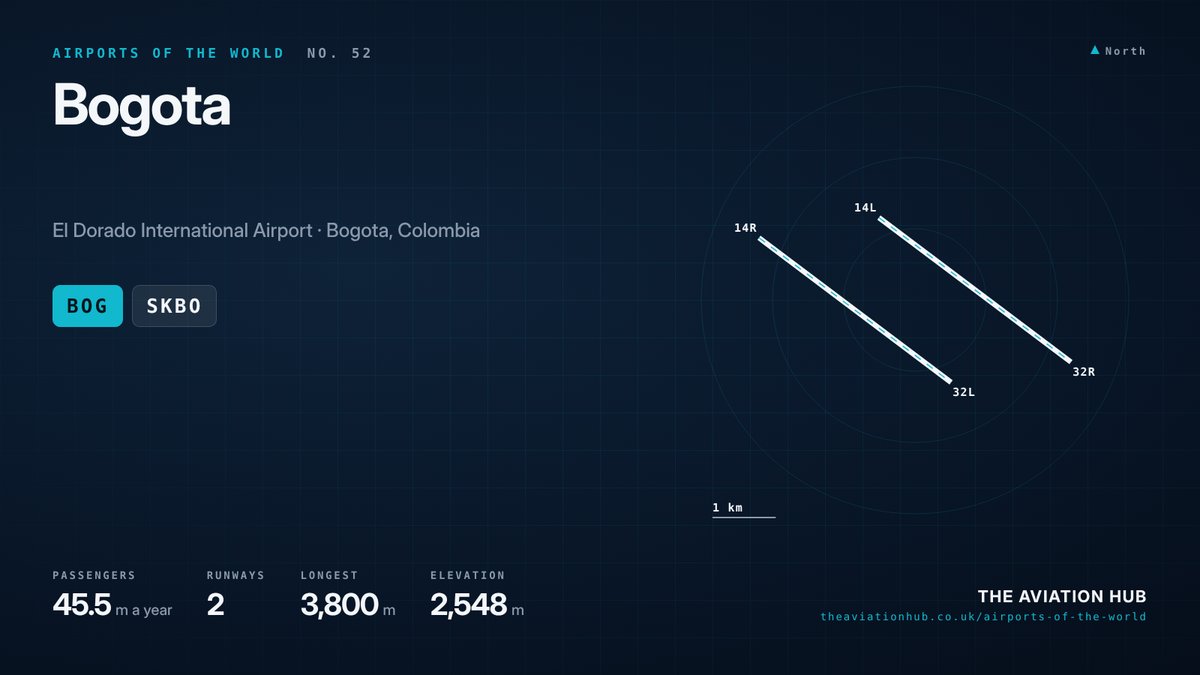
El Dorado International Airport serves Bogota, the capital of Colombia, from a site about 9 miles (15 km) west of the city centre in the Fontibon district. It handled roughly 45.5 million passengers in 2025 and ranks second in Latin America behind Sao Paulo Guarulhos. Bogota Airport is the main hub of Avianca and the most important cargo airport in the Spanish and Portuguese speaking Americas. Its altitude of more than 2,500 metres shapes everything about how it operates.
Bogota Airport at a Glance
The IATA code is BOG and the ICAO code is SKBO. The airport lies at 2,548 metres (8,361 feet) above sea level on the Bogota savannah, a high plateau in the Eastern Cordillera of the Andes. Two parallel asphalt runways serve a main terminal and a smaller domestic terminal. The Colombian state owns the field and OPAIN, a consortium of Colombian construction firms and Flughafen Zurich, has operated it under concession since 2007.
Traffic reached about 45.8 million passengers in 2024 on roughly 360,000 aircraft movements, with 2025 at a similar level. Cargo of around 800,000 tonnes a year makes it the leading freight airport in Latin America, driven by cut flowers bound for the United States and Europe. Avianca, Avianca Express and Avianca Cargo are based here, as are LATAM Colombia, Copa Airlines Colombia, Satena and the low cost carrier Wingo. Transport and parking details are on the airport’s official website.
How Bogota’s Airport Came to Be
Bogota’s first airport at Techo opened in 1930 and served the city for three decades. Under General Gustavo Rojas Pinilla, construction of a replacement on the savannah to the west began in 1955. El Dorado opened on 10 December 1959 with a single runway and a terminal that remained in use for more than 50 years. The name was chosen by decree after academic debate, intended to be short, easy to say and evocative of the indigenous legend of the golden king.
Avianca built the Puente Aereo, a dedicated domestic terminal, in 1981 to handle its shuttle flights to Medellin, Cali and Barranquilla. The second runway opened in 1998 and brought complaints from Fontibon residents about night noise that continue to this day. In 2012 Congress added the name of the assassinated politician Luis Carlos Galan Sarmiento, a decision criticised for its cost and tenuous connection to aviation.
OPAIN’s concession from 2007 transformed the airport. The old terminal was demolished and replaced in phases by the current Terminal 1, completed in 2014. The 1989 bombing of Avianca Flight 203 shortly after departure, blamed on Pablo Escobar, killed 110 people and remains the darkest chapter in the history of Bogota Airport.
Runways at Bogota Airport
Two parallel asphalt runways run northwest to southeast. Runway 14L/32R and Runway 14R/32L each measure 3,800 metres (12,467 feet) by 45 metres. Both are needed at full length, because the thin air at 2,548 metres cuts engine thrust and lift. A Boeing 787 departing for Europe uses most of the pavement on a warm afternoon, and payload restrictions apply on the longest routes.
The prevailing wind from the east favours operations on the 14 headings, so most arrivals approach from the northwest across the savannah. Night operations are restricted on the southern runway, closest to Fontibon, which pushes late evening traffic onto the northern strip.
Weather is generally benign for a tropical airport. Afternoon thunderstorms in the wet seasons of April to May and October to November cause the most disruption. Terrain to the east, where the Andes rise above 3,000 metres beyond the city, demands precise departure procedures.
Terminals and Airlines
Terminal 1 is shaped like a lowercase h, with an international pier to the north and a domestic pier to the south. Its 32 contact gates handle Avianca, LATAM, Copa, Wingo and every foreign carrier. Avianca’s Star Alliance partners, including United, Lufthansa and Turkish Airlines, use the international pier. LATAM, Avianca and Copa all operate lounges in the building.
Terminal 2 at Bogota Airport, the former Puente Aereo, sits a short distance west. Avianca moved its domestic shuttle flights into Terminal 1 in 2018, and the older building now serves the regional carriers Satena and Clic, formerly EasyFly. Their turboprop flights reach small towns across the Andes, the Amazon and the Pacific coast that no jet can serve.
Foreign airlines include American, Delta, United, Air Canada, Air France, KLM, Iberia, Air Europa, Lufthansa, Turkish Airlines, Aeromexico and Emirates. SkyTeam and oneworld carriers share the international pier with the Star Alliance majority. The cargo terminal handles a constant flow of Avianca Cargo, LATAM Cargo, UPS, FedEx and Atlas Air freighters.
Routes and Destinations
Domestic flying is intense in a country where mountains make road travel slow. Medellin, Cali, Cartagena, Barranquilla, Santa Marta, Bucaramanga and Pereira are the busiest routes, with departures every few minutes at peak times. Avianca, LATAM Colombia and Wingo compete fiercely, and the Bogota to Medellin corridor is one of the heaviest in the region.
Internationally, Miami, Madrid, Mexico City, Panama City, Lima, Quito and New York lead. Avianca flies nonstop to London Heathrow, Paris, Madrid, Barcelona and a long list of American cities. Air France, KLM, Iberia, Lufthansa and Turkish Airlines serve Europe, and Emirates reaches Dubai via Miami. Turkish Airlines stops in Panama City on the way to Istanbul, so the longest nonstop sector is Lufthansa’s Frankfurt service at around 5,650 miles (9,100 km).
Cargo defines Bogota Airport in a way few passenger hubs can match. Colombia is the second largest exporter of cut flowers in the world, and the weeks before Valentine’s Day and Mother’s Day see dozens of extra freighter departures to Miami each night.
Getting to and from Bogota Airport
TransMilenio, the city’s bus rapid transit system, serves the airport with the 16-14 Aeropuerto feeder and the KM86 route from Portal El Dorado, which connect to the main trunk lines. The journey to the centre takes 45 to 60 minutes for a fare of a few thousand pesos, which makes it the cheapest sensible option. SITP city buses also stop outside the terminals.
By road, Avenida El Dorado, also known as Calle 26, runs straight from the terminal to the historic centre in 30 to 60 minutes depending on traffic. Authorised taxis from the ranks outside arrivals cost roughly COP 35,000 to 45,000 (around £6 to £8) to the Chapinero and Zona Rosa districts. Ride share apps are widely used. A multi storey car park sits in front of Terminal 1, and the planned first metro line will not reach the airport directly.
Spotting and Photography
Bogota Airport offers some of the best spotting in South America. Terminal 1’s international pier has large windows facing the airfield. Outside the fence, arrivals in the usual easterly flow pass low over the northwestern end of the field. The Parque La Florida, north of the airport, is a popular viewing spot for arrivals.
The thin, clear air and the mountain backdrop produce exceptional light, especially in the dry months of December to March. Morning light favours the south side of the field and afternoon light the north. Security is more relaxed than at many airports, but spotters should carry identification, stay on public ground and avoid lingering near the cargo gates. The freighter traffic at dawn is the highlight.
What Comes Next
Capacity is the pressing issue. The government announced in 2023 a plan to double capacity to 60 million passengers, and in April 2025 it released a proposal called El Dorado Maximo Desarrollo, or EDMAX, which would expand Terminal 1 and add new piers. A second airport, El Dorado II at Facatativa to the west, has been planned for years but has no confirmed opening date.
The runway system cannot grow because the city surrounds it, so larger aircraft and better slot management are the realistic path. Avianca’s recovery from restructuring and the rise of low cost carriers both point to continued growth. Bogota Airport will remain the key connecting point between North and South America. See how it ranks on our Airports of the World map.
Continue to follow The Aviation Hub for more analysis and insight.
Advertise with us Your brand, in front of an aviation audience Home page and in-article placements, sold directly, one advertiser per slot. From £250 a year. See the rates

