
Boise Airport Guide: Gowen Field, A-10s and Alaska
Boise Airport explained: Gowen Field history, two long runways, the terminal and concourses, Alaska and Southwest routes, A-10s, air tankers and new gates.
 By The Aviation Hub
5 min read
Updated October 20, 2026
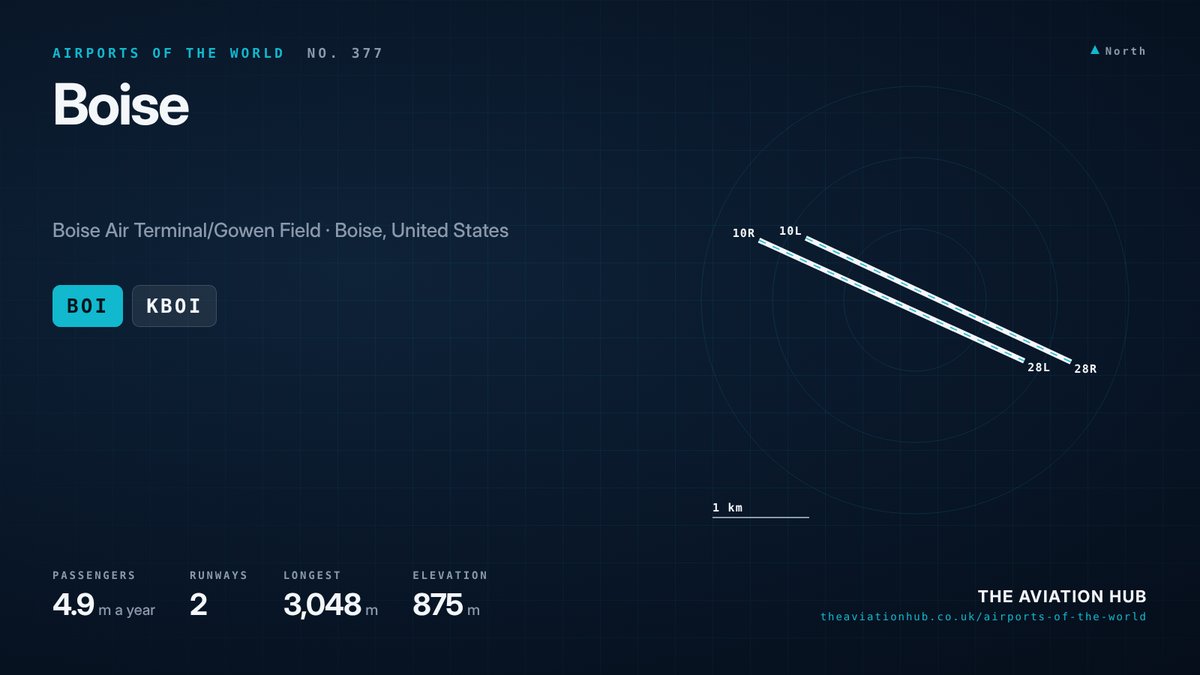
Boise Airport is the busiest airport in Idaho and the main gateway to one of the fastest growing metro areas in the American West. It sits just south of downtown Boise and set a record of more than five million passengers in 2025. Alaska Airlines has a strong focus here, and the military and firefighting presence makes the field unusually varied. A new concourse is next on the agenda.
Boise Airport at a Glance
The airport uses the IATA code BOI and the ICAO code KBOI. It lies about 3 miles (5 km) south of downtown Boise, at an elevation of 2,871 feet (875 m). There are two parallel runways and one three storey terminal with two concourses and 24 gates. The City of Boise Department of Aviation runs the field, overseen by an airport commission.
Traffic reached about 5.23 million passengers in 2025, a new annual record. Boise Airport handles several times as many passengers as Idaho Falls in the east of the state. Alaska Airlines, Southwest, Delta and United carry most travellers. Flight times, parking and security information are on the airport’s official website.
How Boise’s Airport Came to Be
Boise’s first municipal field, Booth Field, opened in 1926 on land now occupied by the Boise State University campus. Charles Lindbergh landed there in the Spirit of St. Louis in September 1927, less than four months after his transatlantic flight. The city began acquiring land for the current site in 1936, and a Works Progress Administration project had built an 8,800 foot runway by 1938.
On 23 July 1941 the field was named Gowen Field after 1st Lt. Paul R. Gowen, a Caldwell native and West Point graduate killed in a 1938 B-10 bomber crash in Panama. During the Second World War the Army Air Forces trained B-17 and B-24 crews there, with more than 6,000 personnel on the base.
Horizon Air built a hub at Boise Airport from the late 1980s to the early 2000s. In 2013 a new control tower and radar approach centre opened, with the tower rising 295 feet. The terminal has been expanded in stages as the region’s population boomed.
Runways at Boise Airport
Two parallel asphalt runways serve the field, both 46 metres wide. Runway 10L/28R is 3,048 metres (10,000 feet) long, and 10R/28L measures 2,976 metres (9,763 feet). The airport also has a small helipad.
The runways run east to west across the high desert plateau. Westerly winds favour runways 28L and 28R, with arrivals approaching from the east, while easterly flow brings traffic onto runways 10L and 10R. Summer heat at nearly 2,900 feet reduces aircraft performance, so the long runways matter for heavy departures.
The parallels let airline, military and firefighting traffic mix smoothly. In January 2024 a hangar under construction at the airport collapsed, killing three people. In 2025 a homebuilt Kitfox crashed short of runway 10L, and the pilot was later sentenced for flying under the influence.
Terminals and Airlines
Concourse B has 13 gates used by United, Southwest, Delta and American, with common use gates for Allegiant, Frontier and Sun Country. Concourse C has 11 gates dedicated to Alaska Airlines, though only two have jet bridges. Many Alaska passengers walk across the apron to board Horizon and SkyWest Embraer E175s.
Boise Airport is a focus city for Alaska, which operates mainline Boeing 737s alongside regional jets flown by Horizon Air and SkyWest. Southwest flies its 737 fleet, while Delta, United and American feed their hubs with mainline and regional aircraft. All three global alliances are represented through partner carriers.
The airport has levied a passenger facility charge since 1994. It now collects $4.50 per passenger to help fund capital projects.
Routes and Destinations
Seattle/Tacoma is the busiest route, with about 375,000 passengers in the year to March 2026. Denver follows closely at around 358,000, then Phoenix at about 206,000, Salt Lake City at roughly 168,000 and Las Vegas at about 167,000.
The network reaches most major western hubs, plus Dallas, Chicago, Atlanta and Minneapolis through the network carriers. Southwest adds point to point flights to California and the desert Southwest. Leisure demand peaks in winter, when Idaho residents head for sunshine, and in summer, when visitors arrive for outdoor recreation.
Firefighting logistics add a seasonal twist. The National Interagency Fire Center is based in Boise, and the US Forest Service uses the airport as an air tanker base during wildfire season.
Getting to and from Boise Airport
The airport sits beside Interstate 84, and downtown Boise is around 10 minutes away by car. Short term and long term parking garages sit next to the terminal, with economy lots served by shuttles. A seven storey consolidated rental car garage opened on 1 September 2026.
Valley Regional Transit buses link the terminal with downtown and are the cheapest sensible option for light travellers. Taxis and ride hailing services pick up outside baggage claim, and a trip downtown usually costs around $15 to $25.
Many hotels run free shuttles. Sun Valley and McCall ski areas are a few hours away by road, so most skiers hire a car at Boise Airport.
Spotting and Photography
Boise Airport offers excellent variety for enthusiasts. The Idaho Air National Guard’s 124th Fighter Wing flies A-10 Thunderbolt IIs from Gowen Field Air National Guard Base on the south side, though the Air Force plans to replace them with F-16s, and Army National Guard helicopters are also based there. In summer, large air tankers and support aircraft operate from the fire base.
Public roads around the perimeter and the cell phone lot offer views of the parallel runways. Clear desert air and long evening light make for sharp photographs, especially when traffic uses runway 28.
Respect the fences and the military areas, where photography rules can be strict. Stay on public land and cooperate with airport police.
What Comes Next
Growth is pushing the terminal to its limits. A new Concourse A with ten gates is planned, with the first phase of construction scheduled for 2027. The new rental car garage and additional parking structures free up space close to the terminal.
With record traffic and a booming regional economy, Boise Airport has every reason to keep expanding. Its two long runways give plenty of airside capacity. Compare it with other western fields on the Airports of the World map. The verdict: a confident, growing regional airport with an unusually varied mix of traffic.
Continue to follow The Aviation Hub for more analysis and insight.
Advertise with us Your brand, in front of an aviation audience Home page and in-article placements, sold directly, one advertiser per slot. From £250 a year. See the rates

