
Bologna Airport Guide: Marconi’s Field in the Heart of Italy
Bologna Airport links Emilia Romagna with Europe via one runway and a busy terminal. Read about its history, airlines, routes and the Marconi Express.
 By The Aviation Hub
5 min read
Updated October 20, 2026
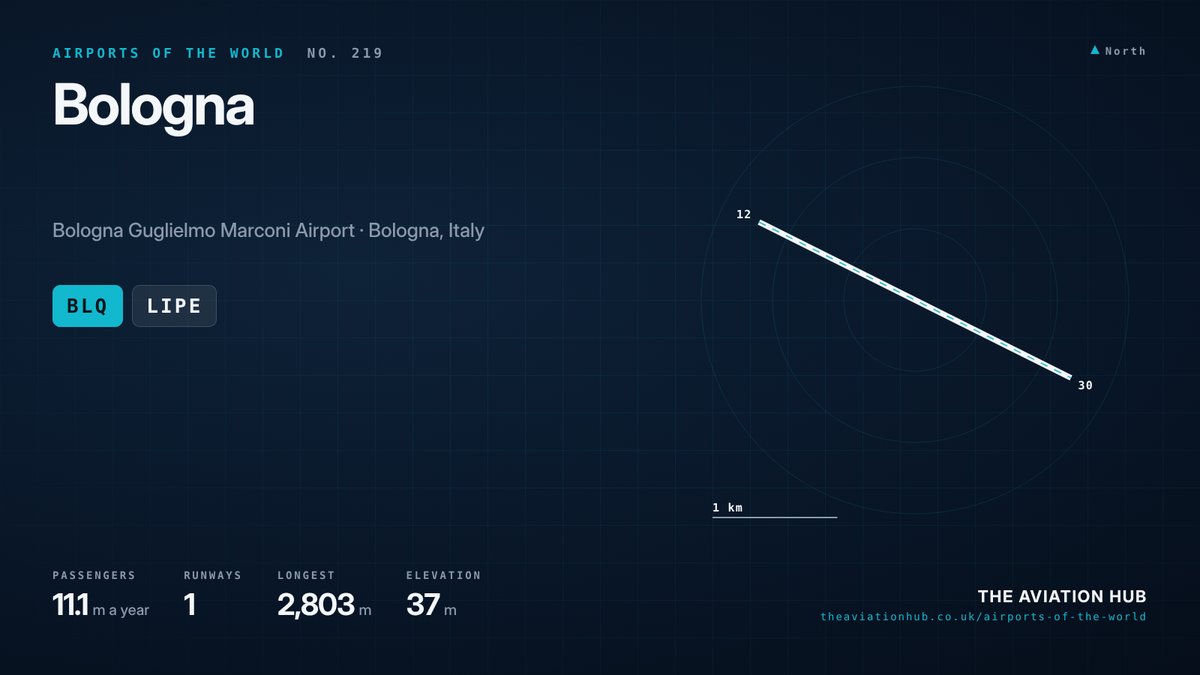
Bologna Guglielmo Marconi Airport serves the capital of Emilia Romagna, a wealthy region of food, motor manufacturing and historic cities. Bologna Airport carried around 11 million passengers in its latest year, a steady climb from about 8.5 million in 2018. It sits at a crossroads of Italy’s motorway and rail networks, which lets it draw passengers from Florence, Modena, Ferrara and the Adriatic coast. Ryanair’s large base and strong links to European hubs make it one of the busiest airports in northern Italy outside Milan and Venice.
Bologna Airport at a Glance
The IATA code is BLQ and the ICAO code is LIPE. The airport lies at Borgo Panigale, about 4 miles (6 km) north west of central Bologna. Elevation is 123 ft (37 m). There is one runway and one passenger terminal.
Traffic was roughly 10.8 million passengers in 2024 and has since passed 11 million. Ryanair is the largest airline and keeps a sizeable base, while Lufthansa, Air France, KLM and British Airways connect the city with their hubs. Aeroporto G. Marconi di Bologna, a company listed on the Milan stock exchange, operates the field. Timetables and parking are on the airport’s official website.
How Bologna’s Airport Came to Be
Bologna’s first airport opened in 1933, about 500 m west of the present terminal. It served the city for four decades, but by the 1970s it was far too small for growing passenger numbers. A new airport was built alongside it and took over the traffic.
The airport is named after Guglielmo Marconi, the radio pioneer and Nobel laureate born in Bologna in 1874. Its neighbours are fitting for a technology city. The Ducati motorcycle works stand nearby in Borgo Panigale.
Low cost airlines drove the big leap in traffic during the 2000s and 2010s. The terminal was expanded between 2011 and 2013 to about 36,100 square metres. In 2020 the Marconi Express people mover opened, giving the airport its first fixed link with the main railway station. Long haul ambitions have been mixed. Eurofly flew to New York with Airbus A330s from 2005 to 2008, and American Airlines dropped a seasonal Philadelphia route after 2019.
Runways at Bologna Airport
All flights use Runway 12/30, an asphalt strip 2,803 m (9,196 ft) long and 45 m wide. It suits the Boeing 737-800 and Airbus A320 family aircraft that make up most of the traffic, and it handles wide body types such as the Airbus A350 that Emirates flies to Dubai.
With a single runway, Bologna Airport has no parallel or crosswind options, and every movement shares one strip. Landings normally use Runway 12, with aircraft arriving from the north west, away from the city. When the wind blows from the west or north west, arrivals and departures switch to Runway 30.
Winter fog is the main operational hazard. Thick fog can settle across the Po Valley for days, and instrument landing systems keep arrivals moving when visibility drops.
Terminals and Airlines
The single terminal has 24 departure gates, and all of them are bus gates. There are no jet bridges at Bologna Airport, so passengers walk or take a bus to every aircraft. Check in, security and a large shopping area occupy the main building, with Schengen and non Schengen zones separated airside.
Ryanair is the dominant carrier, with routes across Europe, North Africa and southern Italy. Wizz Air, Vueling and Volotea add low cost capacity. Lufthansa flies to Frankfurt and Munich, Air France to Paris Charles de Gaulle, KLM to Amsterdam and British Airways to London Heathrow.
Turkish Airlines connects Bologna with Istanbul. Emirates provides the main long haul link through Dubai, which makes the Gulf an important gateway for Emilia Romagna’s business travellers.
Routes and Destinations
Southern Italy dominates the domestic map at Bologna Airport. Catania was the busiest route of all in 2024, and Palermo ranked fourth. Brindisi, Bari and Lamezia Terme are other strong markets, reflecting the many southern Italians who live and work in the north.
Tirana led the international markets in 2024, just ahead of Barcelona. Paris Charles de Gaulle, Madrid, Istanbul, London Heathrow, Bucharest and Frankfurt completed the top ten. Business traffic to the hubs mixes with heavy leisure demand to Spain, Greece and the Canary Islands.
Summer is the busiest season, but Bologna’s role as a trade fair city keeps traffic solid year round. Express cargo flights serve the region’s manufacturing base.
Getting to and from Bologna Airport
The Marconi Express people mover links Bologna Airport with Bologna Centrale station in about 7.5 minutes, with an intermediate stop at Lazzaretto. A single ticket costs 12.80 euros (about £11). From Bologna Centrale, high speed trains reach Florence in under 40 minutes and Milan in about an hour.
TPER local buses 54 and 944 serve the city, along with suburban routes 81 and 91. They are the cheapest sensible option for those with time. Regional coaches run daily to Ferrara, Florence, Modena, Ravenna, Cervia and Rimini.
By road, the airport sits beside the city ring road, with quick access to the A1 and A14 motorways. A taxi to the historic centre takes around 15 to 20 minutes and costs roughly 20 to 25 euros. Calderara Bargellino railway station is about 2.5 miles (4 km) away but has no public transport connection to the terminal.
Spotting and Photography
Bologna Airport is a friendly place for enthusiasts. Ryanair narrow bodies dominate, but Lufthansa, KLM and British Airways jets, Emirates wide bodies and the odd business jet add variety. Bus boarding means aircraft park out on open stands where they are easy to see.
Local spotters use roads and open ground around the runway ends and along the northern side of the field. Morning light favours the north east side of the runway, while afternoons suit the south west. Winter fog can wipe out a day, but crisp days after rain give excellent visibility towards the Apennines.
Respect the fence, avoid private land and follow any instruction from the Carabinieri or airport police. Drones are banned near the airport.
What Comes Next
The terminal is under pressure from steady growth and will need further enlargement. Airline expansion continues, with Ryanair committing more aircraft to its base and new routes announced for 2025 and 2026.
The constraints are local. Noise over Bologna’s western suburbs, a single runway and limited land around the site all cap how far the airport can grow. Long haul flying beyond Dubai remains the missing piece.
Bologna Airport is heading for continued growth as a regional hub for Emilia Romagna. Compare it with Venice and Milan Bergamo on the Airports of the World map.
Continue to follow The Aviation Hub for more analysis and insight.
Advertise with us Your brand, in front of an aviation audience Home page and in-article placements, sold directly, one advertiser per slot. From £250 a year. See the rates

