
Bordeaux Airport Guide: Wine Country’s Low Cost Gateway
Bordeaux Airport explained: two runways, the billi low cost terminal, easyJet and Volotea bases, the new tram link and the best places to watch aircraft.
 By The Aviation Hub
7 min read
Updated October 20, 2026
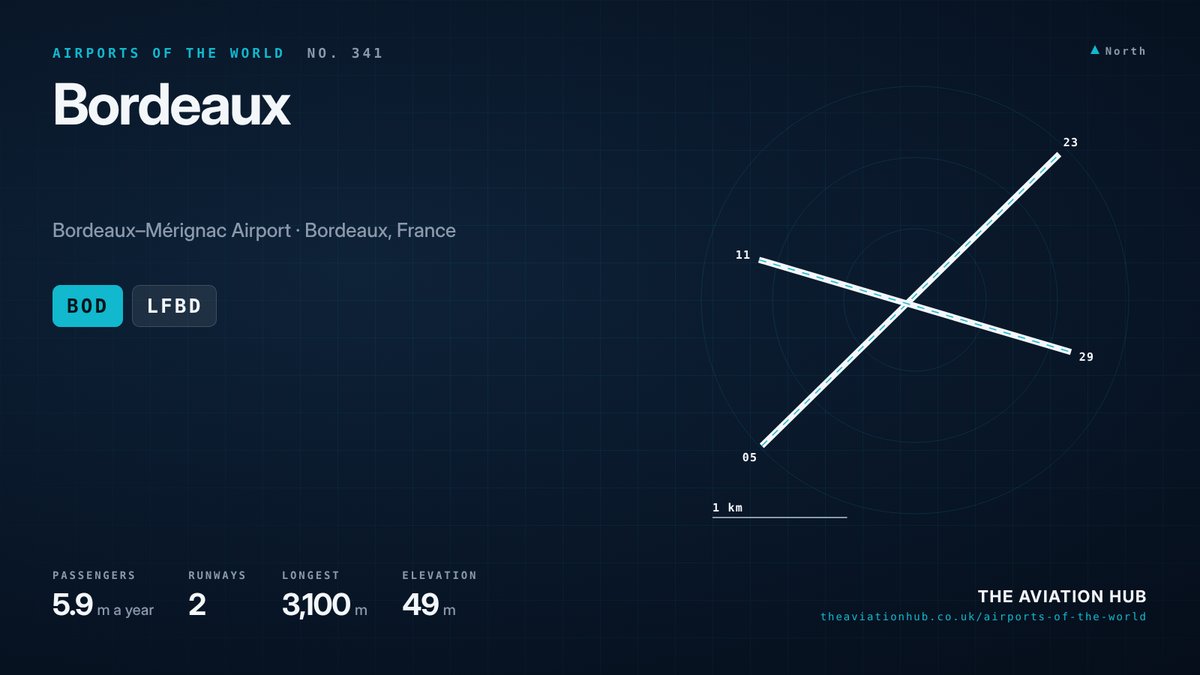
Bordeaux Airport sits in the commune of Mérignac, roughly 7 miles (12 km) west of the city centre, on the flat sandy plain that stretches towards the Atlantic. It is the main air gateway to the Nouvelle Aquitaine region and handles around 6 million passengers a year. The airport shares its site with a French Air Force base and the Dassault Aviation factory that assembles the Rafale fighter, which makes it one of the more varied fields in France for anyone who watches aircraft.
Bordeaux Airport at a Glance
The airport carries the IATA code BOD and the ICAO code LFBD. It lies at an elevation of 49 m (162 ft) and has two asphalt runways, 05/23 and 11/29. Passenger traffic peaked at about 7.7 million in 2019 and has been rebuilding since, with recent years running at roughly 6 million.
Three terminal areas serve passengers: Terminal A, Terminal B and the low cost building known as billi. easyJet, Volotea and Transavia all base aircraft here, and Air France is another major presence. The operator is a company owned by the French state, the local chamber of commerce and regional authorities, and practical details such as live departures and parking rates are on the airport’s official website.
A Short History of Mérignac
The French government bought a parcel of private land at Mérignac in 1912, and flying began there soon afterwards. The first permanent passenger terminal arrived in the early 1930s. During the German occupation the Luftwaffe used it as the main base for its KG 40 maritime patrol unit, whose long range Focke Wulf Condors hunted Allied shipping in the Atlantic.
Civil growth resumed after the war, and the 1960s brought a major expansion and refurbishment. By 1987 terminal extensions had pushed capacity to around 2 million passengers, and a new terminal, today’s Terminal B, was built between 1994 and 1996. A new control tower followed in 2000.
The biggest turning point came in 2010 with the opening of billi, a stripped back low cost terminal that gave easyJet and others a cheap base to grow from. It was expanded in 2015, and traffic passed 6 million for the first time in 2017. Bordeaux Airport had become one of the fastest growing regional airports in France by the end of that decade.
Runways at Bordeaux Airport
The main runway is 05/23, which measures 3,100 m (10,171 ft) and is 45 m wide with an asphalt surface. It handles the bulk of commercial traffic and is long enough for wide body aircraft such as the Airbus A330 and Boeing 777. The secondary runway, 11/29, is 2,415 m (7,923 ft) long and is also 45 m wide.
The two runways cross, so controllers cannot run them independently. Runway 23 is the usual choice when the prevailing westerly wind blows in from the ocean, with aircraft approaching from the north east over the city’s north western suburbs. Runway 11/29 comes into its own in strong crosswinds and when 05/23 is closed for maintenance. Dassault test flights and French Air Force movements share the same runways as the airlines, which is why a Rafale can sometimes be seen holding behind an A320.
Terminals and Airlines
Terminal A is the oldest of the three passenger buildings and handles most flights, including Volotea and the North African and Canadian services. Terminal B opened in 1996 over two levels and is largely the home of Air France and its regional partners, with the Paris Charles de Gaulle and Lyon shuttles running from here. Both terminals sit side by side, and a new central building linking them is due by the end of 2028.
billi, short for Bordeaux illico, is the low cost terminal. It is a deliberately simple hall with six aircraft stands, walk out boarding and minimal frills, which keeps airport charges down. easyJet is the anchor tenant. Ryanair was a major user until it fell out with the airport over fee increases, announced its withdrawal in May 2024 and had ended all flights by November that year.
Other carriers include Vueling, Transavia, KLM, British Airways, Lufthansa, Royal Air Maroc, Tunisair and Air Transat, the last of these now flying year round to Montreal. Bordeaux Airport has no dedicated alliance terminal, so SkyTeam, Star Alliance and oneworld members are spread across A and B.
Routes and Destinations
Paris remains a key domestic route, even though the high speed rail line that opened in 2017 cut the train journey to just over two hours and took a large share of the market. Lyon, Marseille, Nice, Lille and Strasbourg are the other main domestic links. Air France has trimmed its domestic network here, which has left easyJet and Volotea to fill the gaps.
International traffic is dominated by European city and leisure routes. London, Amsterdam, Brussels, Geneva, Madrid, Barcelona, Lisbon and Rome are all well served. Morocco and Tunisia are well served, and Air Transat’s Montreal service is the main transatlantic link, though Corsair’s seasonal flights to Martinique and Guadeloupe fly further. Summer is the clear peak, when the wine region and the Atlantic beaches draw holidaymakers, and schedules thin out noticeably between November and March.
Cargo is modest. The airport handles freight mainly in the bellies of passenger aircraft.
Getting to and from Bordeaux Airport
The newest option is the Bordeaux tramway, which has served the terminal since 29 April 2023. Line F now runs through the city centre to Bordeaux Saint Jean station, reaching the Hôtel de Ville in around 35 minutes and the station in about 45, for a single fare of €1.90. This is the cheapest sensible choice for most arriving passengers.
The 30’Direct shuttle bus links the airport with Bordeaux Saint Jean station, the main rail hub for TGV services to Paris, in roughly half an hour depending on traffic. City bus Line 1+ also runs to the centre. By road Bordeaux Airport sits just off the A630 ring road at exit 11b, and a taxi to the centre costs in the region of €35 to €50 and takes 20 to 30 minutes outside the rush hour.
Parking is split between short stay areas near the terminals and cheaper long stay car parks further out, with pre booked rates well below the drive up price. Car hire desks sit in the arrivals area, and the airport is a popular starting point for touring the Médoc and Saint Emilion vineyards.
Spotting and Photography
Bordeaux Airport rewards patience because of the mix of traffic. Alongside the usual A320 family and 737s there are Air Force movements, Dassault test flights of the Rafale and Falcon business jets, and the occasional transport aircraft. The roads around the perimeter on the Mérignac side give views of the 05/23 approach, and the threshold of runway 23 can be watched from public roads to the north east when westerlies are blowing.
Light is best in the afternoon for aircraft on 23, with the sun behind the photographer. Mornings favour arrivals on 05. There is no formal viewing terrace, though the boarding lounge in Terminal B looks straight out over the runways. The military and Dassault areas are sensitive, so stay on public roads, keep well back from fences and expect a polite check from gendarmes if you linger with a long lens near the base.
What Comes Next
The airport’s immediate task is rebuilding traffic to the 7.7 million seen in 2019 after the Ryanair withdrawal removed a chunk of capacity. The management has responded by courting other carriers, and several new routes are scheduled from late 2026. The tram link and the billi terminal help, and a €65 million investment programme for 2026 funds the new central building and solar canopies over a car park.
Longer term, Bordeaux Airport faces the same pressures as other French regional fields. Government restrictions on short domestic flights where a rail alternative exists limit growth on routes such as Paris, and local noise campaigns are active. The likely direction is steady growth in European leisure and low cost traffic rather than any leap into long haul. You can compare it with other European fields on our Airports of the World map.
Continue to follow The Aviation Hub for more analysis and insight.
Advertise with us Your brand, in front of an aviation audience Home page and in-article placements, sold directly, one advertiser per slot. From £250 a year. See the rates

