
Brisbane Airport Guide: Queensland’s Twin Runway Gateway
Brisbane Airport is Queensland's main gateway, with two parallel runways and a hub role for Qantas and Virgin Australia. Read about its terminals and routes.
 By The Aviation Hub
7 min read
Updated October 20, 2026
Brisbane Airport sits on reclaimed flats beside Moreton Bay, a short drive north east of the Queensland capital. It is the third busiest airport in Australia, a hub for Qantas and Virgin Australia, and since 2020 the owner of two long parallel runways with room to grow for decades. Around 23 million passengers used it in 2024. It handles the Sydney and Melbourne shuttles, a long haul network to Asia, the Gulf and North America, and the tourist traffic that feeds the Gold Coast and the Great Barrier Reef.
Brisbane Airport at a Glance
The codes are BNE and YBBN. Brisbane Airport lies about 8 miles (13 km) north east of the central business district on the former suburb of Cribb Island, at an elevation of just 4 m (13 ft). It has two parallel asphalt runways and two passenger terminals, International and Domestic, plus cargo sheds, general aviation hangars and a busy business jet terminal.
The airport handled roughly 23 million passengers in 2024 across a wide spread of domestic and international destinations. Qantas and Virgin Australia both run hubs here, Jetstar, Alliance Airlines and Rex have bases, and the Royal Flying Doctor Service flies its Queensland operations from the field. Brisbane Airport Corporation has run the site since 1997 under a 50 year lease from the federal government, with Queensland Investment Corporation, Igneo, Amsterdam Schiphol and IFM Investors as the main shareholders. Flight information, parking and the Skygate retail precinct are on the airport’s official website.
How Brisbane’s Airport Came to Be
Brisbane’s aviation history started at Eagle Farm, an aerodrome opened in 1925 and used by Charles Kingsford Smith at the end of his 1928 Pacific crossing. Eagle Farm grew into the city’s airport and served as a major American base during the Second World War, but by the 1970s it was cramped, prone to flooding and surrounded by suburbs. The federal government chose a site immediately to the north east on the tidal flats of Cribb Island, whose residents were moved out and whose streets were buried under sand pumped from Moreton Bay.
The new domestic terminal opened on 19 March 1988, and the last flight left Eagle Farm the following day. The international terminal followed in 1995 with 14 bays, four of them later enlarged for the Airbus A380. Privatisation came in 1997 when Brisbane Airport Corporation bought the lease for around AUD 1.4 billion. The international terminal has been refurbished in stages since, and the second runway opened in July 2020 after a decade of planning and reclamation.
The airport has an unusual recurring hazard. Mud wasps nest in pitot tubes, and in July 2018 a Malaysia Airlines Airbus A330 took off with its pitot covers still fitted after ground staff had installed them to keep the insects out. The crew returned safely. In July 2022 an Emirates A380 landed with a hole in its fuselage after a tyre failure on departure from Dubai, and the resulting investigation drew worldwide attention.
Runways at Brisbane Airport
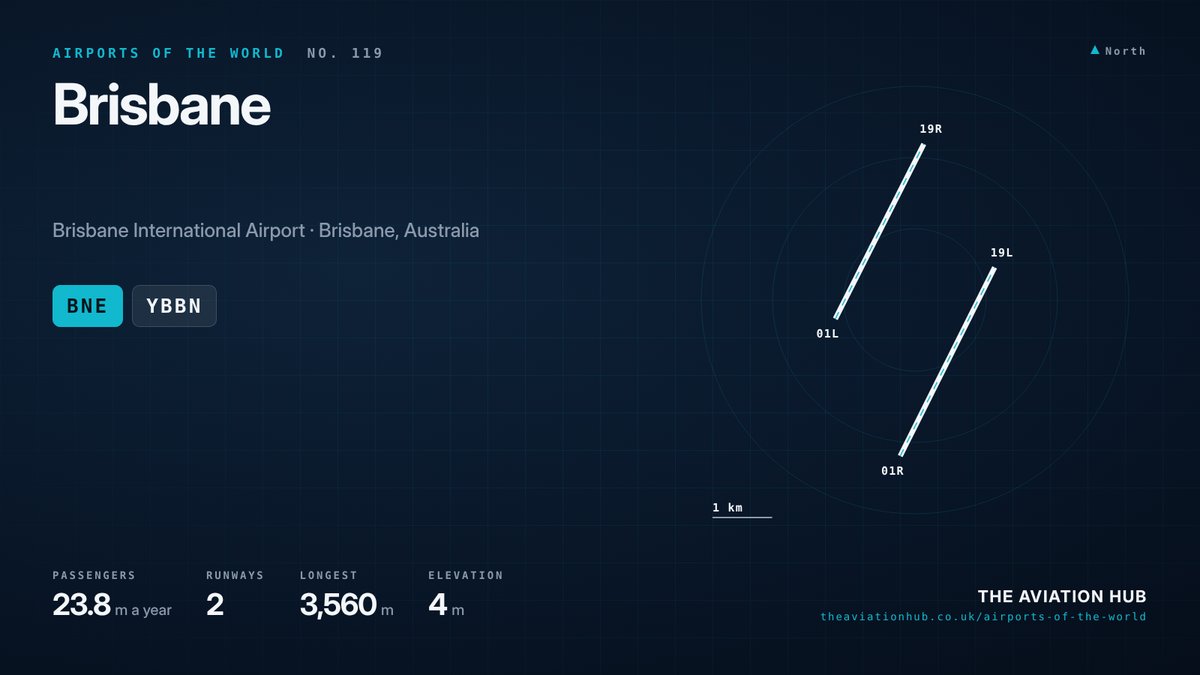
Brisbane Airport has two parallel asphalt runways aligned roughly north south. The original runway 01R/19L is 3,560 m (11,680 ft) long and 45 m wide. The new runway 01L/19R, completed in mid 2020, is 3,300 m (10,827 ft) long and 60 m wide. Its first commercial departure was a Virgin Australia flight to Cairns on 12 July 2020. The runways are more than 2 km apart, which allows fully independent simultaneous operations and gives the field capacity similar to Hong Kong or Singapore.
The old cross runway 14/32 was decommissioned in March 2020 and its surface turned into aircraft parking, which proved timely when the pandemic grounded fleets. Prevailing winds bring arrivals from the south onto the 01 runways in summer and from the north onto the 19 runways in winter. The new runway brought noise to suburbs that had not heard aircraft before, and Brisbane Airport has spent several years adjusting flight paths and mandating over the bay departures where possible.
Terminals and Airlines
The domestic terminal is a long curved two storey building. Qantas and QantasLink occupy the northern end with their own lounges, Virgin Australia the southern end, and Jetstar the middle. Alliance Airlines flies Embraer E190s on Qantas contract routes and its own mining charters, while Rex serves outback Queensland towns such as Birdsville and Charleville with Saab 340s. Qantas uses Boeing 737-800s, Airbus A321neos and A220s, with 787-9s and A330s on some trunk routes.
The international terminal stands a short bus ride away. Qantas, Virgin Australia, Air New Zealand, Singapore Airlines, Emirates, Qatar Airways, Cathay Pacific, Korean Air, EVA Air, Malaysia Airlines, Air Canada, United, Delta and American all operate from it. Emirates flies the A380 and keeps a lounge there with direct access to the aerobridges. The terminal has 14 bays, four of them able to take the A380. A free bus links the two terminals, the Skygate shops and the airport hotels.
Routes and Destinations
Sydney and Melbourne are by far the busiest routes, each flown dozens of times a day by Qantas, Virgin Australia and Jetstar. Cairns, Townsville and Perth follow, and the Queensland regional network to Mackay, Rockhampton, Gladstone, Mount Isa and the mining towns is a distinctive feature of the schedule. Brisbane Airport is the natural hub for the fly in fly out workforce of the coal and gas fields.
Internationally the leading routes in 2025 were Singapore, Auckland, Dubai, Denpasar and Tokyo Narita. Qantas and Delta fly non stop to Los Angeles, and American Airlines flies seasonally to Dallas Fort Worth, the longest route from the airport. Air Canada serves Vancouver and United flies to San Francisco. Fiji, Noumea and Port Moresby reflect the Pacific links. Cargo is substantial, with fresh produce and seafood leaving on belly freight and dedicated freighters.
Getting to and from Brisbane Airport
Airtrain runs from elevated stations at both terminals through the Queensland Rail network to Fortitude Valley and Central in about 20 minutes, and most trains continue to the Gold Coast. The fare is well above a standard suburban ticket, around AUD 20 (roughly £10) one way, but it is less than half a taxi fare and the cheapest sensible option for one or two people. Trains run every 15 to 30 minutes and stop in the evening, so late arrivals need a taxi.
By road the Airport Link tunnel, opened in 2012, connects the airport to the city and the Gateway Motorway, and a second entrance, the Northern Access Road, has served since 2009. Translink bus 590 runs from Skygate to the suburbs. A taxi or rideshare to the CBD costs around AUD 50 to 60 (roughly £25 to £30) and takes 20 to 30 minutes outside the peaks. Multi storey car parks face both terminals and cheaper long stay fields sit along the access roads.
Spotting and Photography
The most popular viewpoint is the Acacia Street area beyond the terminals, with views of both ends of runway 01R/19L, where the airport has built a new spotting area, Fellowship Place, around the tail of a retired Fokker F28. Da Vinci Boulevard suits arrivals on runway 01 from late morning, and the Kedron Brook bikeway off Nudgee Road covers arrivals on 01L and departures from 19R. The Novotel Brisbane Airport has rooms looking towards the 01L approach.
Queensland light is harsh in the middle of the day, so mornings on the eastern side and late afternoons on the west give the best results. The traffic is a lively mix of Qantas and Virgin narrow bodies, Emirates A380s, Asian wide bodies, Alliance E190s and regional turboprops, plus business jets at the Jet Aviation base. Keep off the perimeter roads marked as restricted, do not climb fences, and be aware that the Australian Federal Police patrol the airport boundary.
What Comes Next
The second runway gives Brisbane Airport more spare capacity than any other major Australian airport, and the corporation intends to use it. A new Terminal 3 between the runways, serving both domestic and international flights, is planned for the 2030s. The existing terminals are being refreshed in stages, and the Brisbane 2032 Olympic Games have set a deadline for upgrades to the international terminal, road access and public transport.
The verdict is that the field is positioned to overtake its rivals in growth, provided the airlines fill the new runway. Compare it with Sydney, Melbourne and Auckland on the Airports of the World map.
Continue to follow The Aviation Hub for more analysis and insight.
Advertise with us Your brand, in front of an aviation audience Home page and in-article placements, sold directly, one advertiser per slot. From £250 a year. See the rates

