
Bristol Airport Guide: The West Country’s Hilltop Hub
Bristol Airport sits on a hilltop at Lulsgate, eight miles from the city. Runway, airline bases, busiest routes, the Flyer bus and expansion plans.
 By The Aviation Hub
6 min read
Updated October 20, 2026
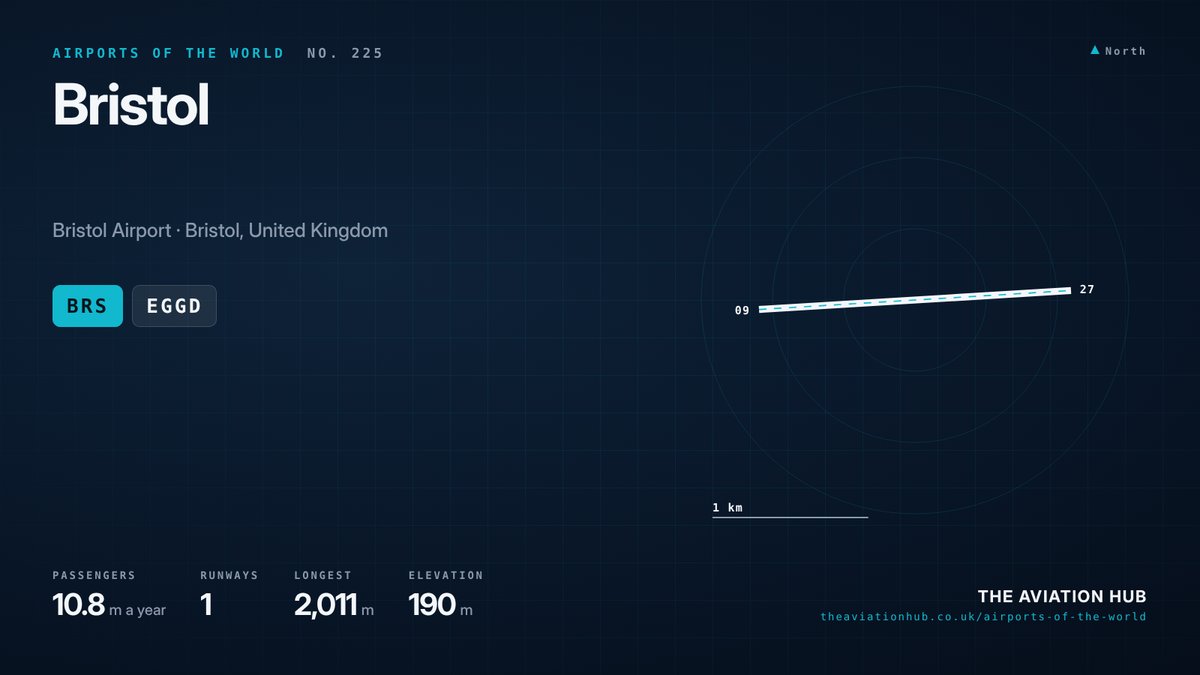
Bristol Airport stands on a plateau at Lulsgate in North Somerset, about 8 miles (13 km) south west of Bristol city centre. It is the main airport for the West of England and South Wales and handled close to 11 million passengers in 2025, which makes it the eighth busiest in the United Kingdom. Four airlines base aircraft here, the single runway is short by major airport standards, and there is still no rail link. The airport is nonetheless growing faster than most of its British rivals.
Bristol Airport at a Glance
The IATA code is BRS and the ICAO code is EGGD. The field sits at 622 feet (190 m), one of the highest commercial airports in England, with one runway and one terminal. The airport handled 10.48 million passengers in 2024 and 10.83 million in 2025, both record years. easyJet is the largest operator, with Ryanair, Jet2.com and TUI Airways also basing aircraft.
Ontario Teachers’ Pension Plan owned the airport outright from 2014. In November 2025 Macquarie Asset Management bought 55 per cent, with the balance held by the New South Wales Treasury Corporation, the Australian Retirement Trust and StepStone. Live flight information, parking bookings and bus timetables are on the airport’s official website.
From Whitchurch to Lulsgate
Bristol’s first airport opened at Whitchurch in 1930, on the southern edge of the city. It was an early municipal field and became a vital wartime link to Lisbon, which kept Britain connected to neutral Europe. After the war it was too small and too close to housing to expand. The city council bought the former RAF Lulsgate Bottom, a wartime fighter satellite abandoned in October 1946, and opened Bristol (Lulsgate) Airport on 1 May 1957.
The hilltop site had a peculiar advantage. Radiation fog that shut the lowland airfields of the Severn valley rarely reached it, though low cloud in warm fronts could be a problem instead. The field grew slowly through the holiday charter boom of the 1970s and 1980s. The council sold a majority stake in 1997, and the airport became Bristol International until it dropped the word in March 2010.
The present terminal opened in March 2000 at a cost of £27 million and has been extended several times since. The arrival of Go, later absorbed by easyJet, in 2001 transformed the schedule, and Ryanair followed. A £150 million development plan to reach 10 million passengers was approved in 2010, and that target was passed in 2024.
Runways at Bristol Airport
There is one runway, 09/27, an asphalt strip of 2,011 metres (6,598 feet) and 45 metres wide. That is short for an airport of this size. Runway 27 is used about 70 per cent of the time, with arrivals approaching from the east over the Chew Valley and departures climbing out over the Bristol Channel. Runway 09 comes into use with easterly winds, bringing arrivals in over the Somerset Levels.
Despite the length, the runway handles the Boeing 787 and Airbus A330 on charter and occasional long haul flights, though with payload limits. Boeing 737-800s and Airbus A320 and A321neo jets dominate. In January 2007 poor braking action caused two aircraft to leave the runway in separate incidents, and the strip was closed for grooving. The plateau position means strong crosswinds and low cloud occur more often than at sea level airports.
Terminals and Airlines
The single terminal at Bristol Airport handles all flights. It has no air bridges, so passengers walk across the apron or take a bus to their aircraft. The building has grown in stages, with a larger security hall, a new east pier and a central departure lounge added since 2010. A new public transport interchange with 16 bus and coach bays opened in front of it in July 2025.
easyJet has been the dominant airline since 2001 and bases a fleet of Airbus A320 family jets here for a network of around 70 routes. Ryanair’s base serves Ireland and the Mediterranean with Boeing 737-800 and 737 MAX 8 aircraft. Jet2.com opened its tenth UK base in July 2021 and TUI Airways runs holiday flights, including some with Boeing 787-8 jets. KLM to Amsterdam and Aer Lingus to Dublin provide hub connections, and Loganair links Aberdeen and Jersey.
Routes and Destinations
Amsterdam is the busiest route from Bristol Airport, with more than 500,000 passengers in 2024, thanks to KLM’s connecting traffic and easyJet’s point to point flights. Alicante, Palma de Mallorca, Dublin and Tenerife South follow. Domestically, Edinburgh leads with about 450,000 passengers, ahead of Glasgow and Belfast International. Newcastle, Aberdeen and Inverness complete the main UK links.
Long haul is limited by the runway. TUI flies seasonal services to Cancun and Orlando Melbourne, and the odd charter reaches the Caribbean. The network is heavily seasonal. Summer brings a wall of Mediterranean flights to Spain, Portugal, Greece and Italy, while winter concentrates on ski routes to Geneva, Innsbruck and Grenoble and sunshine routes to the Canaries. Cargo is minimal, with no scheduled freighters.
Getting to and from Bristol Airport
There is no rail link. In February 2026 the West of England Combined Authority described Bristol Airport as the only regional airport in the country without a fixed mass transit connection. The Airport Flyer bus runs every ten minutes at peak times to Bristol Temple Meads station and the city centre, taking around 30 minutes. Other Flyer routes serve Bath, Portishead and Weston super Mare. The bus is the cheapest sensible option.
By road, the airport sits on the A38 and is signposted from the M5 at junctions 18 and 22. The drive from the city centre takes about 25 minutes outside peak hours. Taxis cost around £30 to £35 to the centre. Parking is extensive but pricey, with short stay, long stay, meet and greet and a cheaper Silver Zone car park reached by shuttle bus. Pre booked rates are far below the walk up price.
Passengers from South Wales drive across the Severn bridge, which takes an hour from Cardiff. Coaches from Cardiff and Newport run several times a day.
Spotting and Photography
The plateau gives Bristol Airport better views than most single runway fields. The traditional spot is on Downside Road at the eastern end, where arrivals on runway 27 pass low overhead and the threshold is in clear view. Morning light favours this position. The western end, near the A38 and the Lulsgate roundabout, suits arrivals on runway 09 and departures off 27 in the afternoon.
The variety is mostly easyJet, Ryanair, Jet2 and TUI, but the 787s and the occasional diversion from Heathrow or Cardiff add interest. Biz jets use the Signature and Centreline terminals on the north side. Winter afternoons bring long low light across the Mendips.
Park sensibly on Downside Road, which is narrow and used by farm traffic. Do not use ladders against the fence and keep clear of the instrument landing system antennas at both ends of the runway. The airport runs a spotters’ code of conduct and police patrol the perimeter.
What Comes Next
Permission for Bristol Airport to grow to 12 million passengers a year came the hard way. North Somerset Council rejected the application in February 2020, the Planning Inspectorate allowed an appeal in February 2022, and the High Court and Court of Appeal both dismissed challenges in 2023. The works include a larger terminal, more aircraft stands and a multi storey car park.
In 2024 the airport opened a consultation on reaching 15 million passengers, including a 150 metre runway extension to allow limited long haul services. That proposal has not been submitted or approved and faces strong local and environmental opposition. Bristol Airport is heading for 12 million passengers with or without a train, and the fight over the next step will define the 2030s. Compare it with other UK regional airports on the Airports of the World map.
Continue to follow The Aviation Hub for more analysis and insight.
Advertise with us Your brand, in front of an aviation audience Home page and in-article placements, sold directly, one advertiser per slot. From £250 a year. See the rates

