
Brussels Airport Guide: Belgium’s Gateway at Zaventem
Brussels Airport is Belgium's main gateway and the home of Brussels Airlines. Read about its three runways, piers, routes, rail links and spotting spots.
 By The Aviation Hub
7 min read
Updated October 20, 2026
Brussels Airport sits at Zaventem, a few miles north east of the Belgian capital, and serves as the country’s principal international gateway. It is the home of Brussels Airlines and its African network, a major cargo port and a frequent stop for diplomats bound for the European institutions. The field handled around 24 million passengers in 2025 and well over 700,000 tonnes of freight. It shares its runways with a Belgian Air Force base and has lived through a bombing, a diamond heist and the loss of a national airline.
Brussels Airport at a Glance
The codes are BRU and EBBR. Brussels Airport lies about 7 miles (12 km) north east of the city centre in the Flemish municipality of Zaventem, at an elevation of 53 m (175 ft). Three asphalt runways serve one passenger terminal split into two piers, A and B, with a Connector building linking them. Locals still call it Zaventem or Brussels National.
In 2025 the airport handled roughly 24.4 million passengers and around 795,000 tonnes of cargo on about 200,000 movements. Brussels Airlines, part of the Lufthansa Group, is the dominant carrier. TUI fly Belgium is based here, Air Belgium used it as a hub before its collapse, and Singapore Airlines Cargo and other freight operators treat it as a European hub. Brussels Airport Company runs the site, with the Flemish government holding 39 per cent and the Belgian federal government 25 per cent. Timetables, parking and security waiting times are published on the airport’s official website.
How Zaventem’s Airport Came to Be
Flying at Zaventem goes back to the Second World War, when the occupying Luftwaffe built an airfield at Melsbroek on the northern side of the present site. After the war the Belgian state took it over and civil flights moved there from the old Haren field. The modern airport dates from July 1958, when a new terminal opened in time for the Expo 58 world fair in Brussels. The runways already existed and the 1956 strip was later lengthened.
Sabena, the Belgian national airline, made the airport its home and built it into a bridge between Europe and the former Belgian colonies in Africa. Tragedy struck on 15 February 1961 when a Sabena Boeing 707 crashed on approach, killing 73 people including the entire United States figure skating team. Sabena itself collapsed in November 2001, and its successor SN Brussels Airlines eventually became Brussels Airlines. The current Pier A opened in 2002 and the Connector building followed in 2015.
Two more events shaped the airport’s recent story. In February 2013 armed robbers drove onto the apron and stole diamonds worth tens of millions of euros from a Swiss bound aircraft. On 22 March 2016 two bombs exploded in the departures hall, killing 16 people and closing the airport until early April. The hall was rebuilt with new security arrangements and traffic recovered within two years.
Runways at Brussels Airport
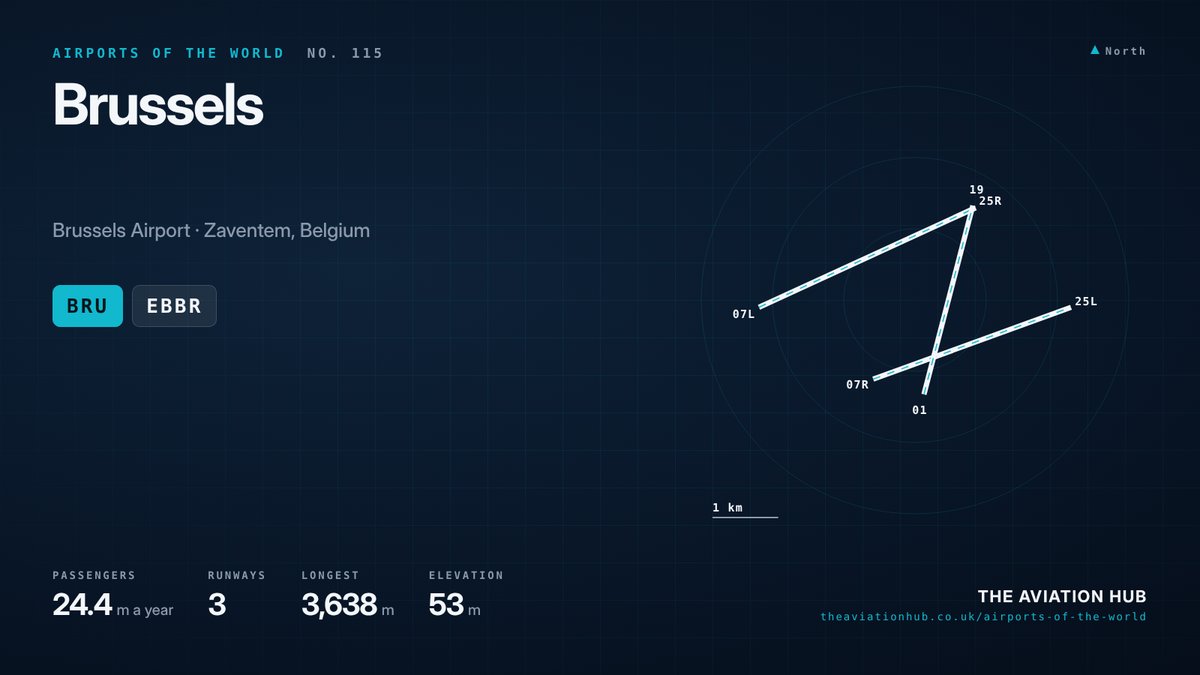
Brussels Airport has three runways. The main pair are parallel east west strips. Runway 07L/25R is 3,638 m (11,936 ft) long and 45 m wide, while 07R/25L is 3,211 m (10,535 ft) long and the same width. The third runway, 01/19, runs roughly north south at 2,987 m (9,800 ft) and 50 m wide. All three are asphalt and all are shared with the Belgian Air Force transport wing at Melsbroek, which flies Airbus A400Ms from the northern side of the field.
In the prevailing westerly wind the airport lands on 25L and 25R and departs from 25R, with 19 used for some departures at night and at weekends. Strong easterly winds force a switch to 07L, 07R and 01. Runway use is one of the most political subjects in Belgian aviation. Flight paths cross the boundary between Flanders and the Brussels Capital Region, and the two governments have argued for decades over which communities bear the noise. Court rulings and ministerial orders have repeatedly changed the preferential runway system.
Terminals and Airlines
The single terminal concept means every passenger passes through the same check in hall, the departures hall rebuilt after 2016, and a central security area before heading to one of two piers. Pier A handles Schengen flights and is the newer, brighter building with a long row of gates. Brussels Airlines also uses the far end of Pier A, where the gates carry a T prefix, for its flights to Kinshasa, Dakar, Abidjan and other West and Central African cities. Pier B is the older pier and serves non Schengen destinations including London, the United States and the Middle East.
Brussels Airlines operates an Airbus fleet of A319s, A320s and A320neos on short haul, with A330-300s on the African and North American routes. Lufthansa, Swiss, Austrian and United fill out the Star Alliance presence. Ryanair, easyJet, Vueling and TUI fly Belgium offer the low cost and leisure capacity, while Emirates, Qatar Airways and Etihad link Brussels Airport with the Gulf. Delta and United serve New York and Washington. Air Canada, Ethiopian Airlines and Hainan Airlines add to the long haul mix.
Routes and Destinations
The busiest European routes in 2024 were Madrid, Barcelona, Rome, Malaga and London Heathrow. Other well used routes include Lisbon, Milan, Vienna and Frankfurt, and the Spanish and Italian routes swell further in summer when the leisure airlines add capacity. Belgium is small enough that domestic flying does not exist, so the whole schedule is international.
On long haul the leading routes are Dubai, Newark, New York JFK, Washington Dulles and Doha. Brussels Airlines’ African network remains the airport’s signature, with daily services to Kinshasa and a web of West African points inherited from Sabena. Cargo is a major business. DHL moved its European hub to Leipzig after night flight limits, but freighters from Qatar, Singapore, Ethiopian and Turkish Cargo carry pharmaceuticals, flowers and high value goods. Brussels Airport markets itself as a specialist in temperature controlled pharma freight.
Getting to and from Brussels Airport
The railway station sits directly beneath the terminal. Trains run to Brussels Central in around 17 minutes and continue to Brussels Midi for Eurostar and other international connections. Direct services also reach Antwerp, Ghent, Leuven, Mechelen and other Belgian cities, and a train is the cheapest sensible option at a fare of a few euros plus the airport supplement. The Diabolo link, opened in 2012, lets trains run through the airport rather than terminating.
By road the A201 feeds into the Brussels Ring, and the airport has around 10,600 parking spaces across short and long stay car parks. STIB bus 12 runs to the European Quarter, De Lijn buses serve the Flemish suburbs, and the Ringtrambus has linked the airport with Vilvoorde and Heizel since 2020. Flibco coaches connect Brussels Airport with Lille and Luxembourg. A taxi to the city centre costs around EUR 45 to 55 (roughly £38 to £47) and takes 20 to 40 minutes depending on the ring road.
Spotting and Photography
Spotters gather at the eastern end of the field near the threshold of runway 25L, where a bank and a car park off the Leuvensesteenweg give clear views of arrivals in the usual westerly wind. The embankment near the 25R threshold at Steenokkerzeel is another well known spot, with arrivals passing overhead and departures lining up close by. On easterly days the village roads near the 07L and 07R thresholds at Zaventem itself come into their own.
The Sheraton, the only hotel on the airport grounds, has rooms overlooking the apron and the piers. Morning light suits the eastern viewpoints and the afternoon favours the western side. The Belgian Air Force A400Ms, the Brussels Airlines A330s and the steady stream of freighters give the field more variety than its size suggests. Security remains tight after 2016, so stay on public roads, keep away from the perimeter fence and move on politely if asked by the police or the airport’s security staff.
What Comes Next
A EUR 550 million investment programme announced in 2015 included a Pier A West extension that remains on hold. A separate low cost pier was also shelved. Growth is constrained instead by noise rules. The Flemish government granted a permit in 2024 with a cap on annual flights, but a disputes council annulled it in July 2025, and the airport now runs under its terms while a new one is prepared. The Airport Tram, a new light rail line from Brussels, is planned and expected to open by around 2031.
The verdict is that Brussels Airport will grow steadily rather than dramatically, hemmed in by politics and noise rules but anchored by a strong cargo business and a Lufthansa Group hub carrier. Compare it with Amsterdam, Paris and other European hubs on the Airports of the World map.
Continue to follow The Aviation Hub for more analysis and insight.
Advertise with us Your brand, in front of an aviation audience Home page and in-article placements, sold directly, one advertiser per slot. From £250 a year. See the rates

