
Budapest Airport Guide: Wizz Air’s Home on the Danube
Budapest Airport, still called Ferihegy by locals, is the home of Wizz Air and a fast growing central European gateway. Runways, terminals, routes and access.
 By The Aviation Hub
7 min read
Updated October 20, 2026
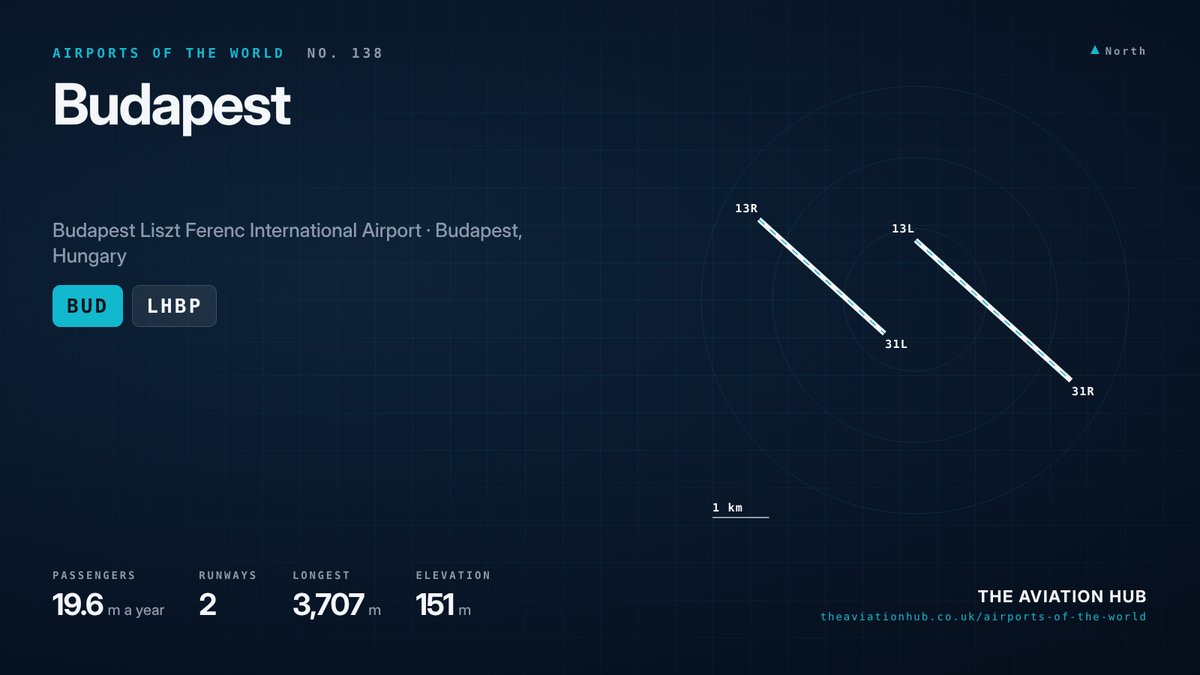
Budapest Ferenc Liszt International Airport lies about 10 miles (16 km) south east of the centre of the Hungarian capital, on the flat ground between the districts of Pestszentlorinc and Vecses. It is the largest airport in Hungary by a wide margin and one of the fastest growing in central Europe. Budapest Airport handled around 19.6 million passengers in 2025, up nearly 12 per cent in a year, almost all of it on point to point European routes. Two long parallel runways and the Terminal 2 complex serve a market built on Wizz Air, Ryanair and a growing roster of long haul carriers.
Budapest Airport at a Glance
The codes are BUD and LHBP. The field sits at 151 m (495 ft) above sea level on the edge of the Great Hungarian Plain. It has two runways, 13L/31R and 13R/31L, and one terminal in use, Terminal 2, which is divided into 2A for Schengen flights and 2B for the rest and joined by the SkyCourt hall. The old Terminal 1 closed to passengers in 2012.
Ownership returned to the Hungarian state in June 2024, when the government paid about €3.1 billion for an 80 per cent stake and Vinci Airports took 20 per cent and the operating role under a concession running to 2080. Wizz Air is headquartered at Budapest Airport and runs one of its largest bases here, and Ryanair also bases aircraft. The 2024 figure was about 17.6 million passengers, so the 2025 total of roughly 19.6 million set a new record. Live flight information is on the airport’s official website.
A Short History of Ferihegy
The name comes from Ferenc Xaver Mayerffy, a landowner who ran vineyards on the site in the nineteenth century, and from hegy, the Hungarian word for hill. The sandy hillock was levelled when construction began in 1942, after planning that started in 1938 for a joint civil and military airfield. Military flying began in 1943 but civil construction halted in 1944 as the war reached Hungary, and the Soviet army occupied the unfinished site.
Civil operations opened in May 1950 and the airport became the home of the state airline Malev, flying Soviet types from Ilyushin Il-14s to Tupolev Tu-154s. Two Malev crashes marked the era, a 1961 sightseeing flight that came down on a residential area killing 30 and a 1975 positioning flight lost in fog near the runway with nine aboard.
The second runway opened in 1983 and Terminal 2B followed in 1997. BAA bought 75 per cent in 2005 and sold to a Hochtief led consortium in 2007, which became AviAlliance. The airport was renamed for the composer Franz Liszt in 2011 to mark his 200th birthday. Malev collapsed in February 2012, costing the airport about 1.5 million transfer passengers a year, and Wizz Air and Ryanair filled the gap within two summers.
Runways at Budapest Airport
The longer runway, 13L/31R, is 3,707 m (12,162 ft) long and 45 m wide, surfaced in concrete. The parallel runway, 13R/31L, is 3,010 m (9,875 ft) long and also 45 m wide and concrete. The runways lie far enough apart for simultaneous operations, and the airport can take any aircraft in service, with the Airbus A380 having visited on special flights.
Runway 31 is the preferred direction whenever the wind allows, with arrivals on 31R from the south east over Vecses and departures from 31L towards the city. Early mornings and easterly winds bring the 13 direction, with arrivals on 13R over the outer districts of Pest. Fog is a regular hazard in late autumn, and both runways carry instrument landing systems.
Budapest Airport has no night curfew but applies noise rules after 11pm, and freighters and Wizz Air’s late rotations keep the field active around the clock.
Terminals and Airlines
Terminal 2A, refurbished in 2012, handles Schengen flights and 2B, extended in 2018, handles non Schengen including the United Kingdom, Turkey, Israel and the long haul services. The five level SkyCourt opened in March 2011 between them with the central security hall, shops, restaurants and the main lounges. A pier extension at 2B added more gates in 2018.
Wizz Air is the largest carrier at Budapest Airport by a wide margin, flying Airbus A320neo and A321neo aircraft on dozens of European routes and to Dubai and Abu Dhabi. Ryanair comes second with Boeing 737-800s and 737 MAX 8-200s. Lufthansa, Swiss, Austrian, KLM, Air France, British Airways, easyJet, Jet2, Turkish Airlines, Pegasus, LOT and Aegean cover the rest of Europe.
Long haul has rebuilt since Malev’s collapse. Emirates flies Boeing 777s from Dubai, Qatar Airways from Doha, Air China from Beijing, Shanghai Airlines from Shanghai and Korean Air from Seoul. Air Canada serves Toronto in summer, and El Al and Wizz Air carry heavy traffic to Tel Aviv.
Routes and Destinations
Istanbul was the busiest route in 2024 with about 518,000 passengers, followed by London Stansted at around 498,000, Frankfurt at about 483,000, Barcelona at roughly 482,000 and Tel Aviv at around 467,000. London across all its airports is the biggest city pair, with Stansted, Luton, Gatwick and Heathrow all served. London Luton, Amsterdam, Milan Malpensa, Dubai and Madrid complete the top ten.
There is no domestic traffic, Hungary being small enough for trains to cover every internal journey. The longest route is Hainan Airlines’ link to Shenzhen at about 5,300 miles (8,500 km), with Ningbo, Guangzhou and Shanghai close behind. Traffic peaks between June and September with a secondary bump at Christmas markets time. Cargo has grown fast since a dedicated cargo city opened in 2019, with Qatar Airways Cargo, Turkish Cargo, FedEx, UPS and Chinese e commerce freighters making Budapest a regional freight hub.
Getting to and from Budapest Airport
There is still no rail link to Terminal 2. The 100E airport express bus runs from the terminal to Deak Ferenc ter in the city centre every 10 to 20 minutes for a special fare of around 2,200 forints (roughly £5), taking 35 to 45 minutes. Bus 200E links the terminal with Kobanya Kispest, the end of metro line M3, in about 25 minutes and accepts normal city tickets, making bus plus metro the cheapest sensible option at under £2.
By road the airport sits beside the Ulloi ut arterial and the M0 ring motorway, with the centre 30 to 45 minutes away. Fotaxi holds the official taxi concession from the terminal at a fixed tariff, with a trip to the centre costing roughly 10,000 to 12,000 forints (£22 to £26). Bolt and Uber also operate. Several car parks and a Holiday Parking long stay area sit in front of the terminal, and a rail link from the city is planned.
Spotting and Photography
Budapest is friendly to spotters. The best known location is the Spotterdomb, a hill off the M4 at the Vecses exit near the 31R threshold, where arrivals pass low with good light from late morning. The fence by the general aviation terminal in front of the disused Terminal 1 covers 13R arrivals and 31L departures, and the visitor terrace on top of Terminal 2A overlooks the apron.
The fleet mix at Budapest Airport is strong. Wizz Air’s pink and purple A321neos dominate, but Emirates 777-300ERs, Qatar Airways A350s, Chinese A330s and 787s, Korean Air 787-9s and the overnight freighters add interest. The Aeropark open air museum beside the old Terminal 1, with its Malev Tu-154 and Il-18, is worth the walk.
Hungarian police are relaxed about photography on public land, but stay well back from the fence, do not block the narrow access roads and leave if asked.
What Comes Next
The new owners have promised a long delayed rail link, a third terminal and more stands, with a programme worth several hundred million euros. New cargo facilities are part of the plan, and Terminal 2 needs more gates as traffic grows. Vinci’s concession to 2080 gives a long horizon for investment.
Growth will be limited more by Wizz Air’s fleet plans and the A320neo engine problems than by concrete, and noise complaints from Vecses and the Pest suburbs are rising with the traffic.
Budapest Airport is heading past 20 million passengers with a rail link finally in sight and long haul rebuilding steadily. See how it compares with its neighbours on the Airports of the World map.
Continue to follow The Aviation Hub for more analysis and insight.
Advertise with us Your brand, in front of an aviation audience Home page and in-article placements, sold directly, one advertiser per slot. From £250 a year. See the rates

