
Buffalo Airport Guide: Snow, Canadians and Cheap Fares
Buffalo Airport explained: its 1926 origins, the two runways, the 1997 terminal, Southwest and JetBlue routes, the Canadian market and transport links.
 By The Aviation Hub
5 min read
Updated October 20, 2026
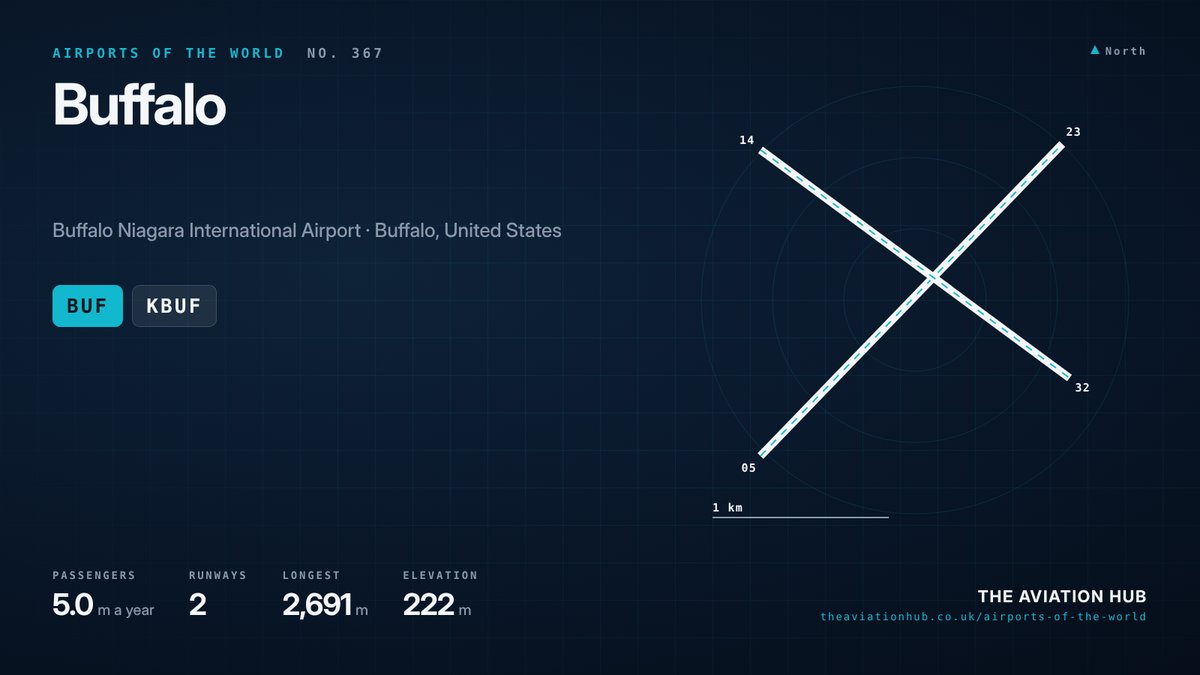
Buffalo Airport, formally Buffalo Niagara International, serves western New York and a large slice of southern Ontario. It sits in the suburb of Cheektowaga, east of downtown Buffalo, and handles about five million passengers a year. Low fares draw travellers from across the border, and Southwest and JetBlue keep competition lively. Buffalo Airport also copes with heavy lake effect snow as a matter of routine, keeping flights moving through winters that would close many other fields.
Buffalo Airport at a Glance
The airport carries the IATA code BUF and the ICAO code KBUF. It lies about 11 miles (18 km) east of downtown Buffalo, at an elevation of 728 feet (222 m). There are two runways and one terminal with 24 gates. The Niagara Frontier Transportation Authority, known as the NFTA, owns and runs it.
Traffic reached about 5.02 million passengers in 2025, up just over 1% on 2024, with nearly 73,000 aircraft movements. Southwest is the largest carrier, with around 28% of passengers, followed by JetBlue, American, Delta and Frontier. Buffalo Airport is a focus city for Southwest and JetBlue rather than a hub. Parking, flight status and security information are on the airport’s official website.
How Buffalo’s Airport Came to Be
The city opened Buffalo Municipal Airport on former farmland in 1926, making it one of the older public airports in the United States. Passenger and mail flights began in December 1927 with a service to Cleveland. During the Second World War the neighbouring Curtiss Wright plant built fighters, and in 1942 a P-40 crashed into the factory, killing 14 people.
The NFTA took over from the City of Buffalo in 1959 and renamed the field Greater Buffalo International Airport. Growth through the jet age eventually swamped the old buildings. The current terminal opened on 3 November 1997 with 15 gates, and the airport adopted the Buffalo Niagara name at the same time.
Demand quickly outstripped the new building. Expansion lifted the gate count to 24 in 2001, and an $80 million renovation completed in 2021 added more than 54,000 square feet of space. A new fire station opened in 2017.
Runways at Buffalo Airport
Two asphalt runways cross the airfield, both 46 metres wide. Runway 05/23 is the main strip, at 2,691 metres (8,829 feet), with instrument landing systems at both ends. Runway 14/32 measures 2,183 metres (7,161 feet), with an instrument approach on runway 32 only.
Southwesterly winds off Lake Erie make runway 23 the usual choice. Arrivals then approach from the northeast over the suburbs. Runway 14/32 earns its keep when strong northwesterlies blow or when crews clear snow from the main strip.
Winter defines the operation. Lake effect snow can drop huge totals in hours, and the airport relies on a large, practised snow clearing team. On 12 February 2009 Colgan Air Flight 3407, a Bombardier Dash 8 Q400 arriving from Newark, stalled and crashed in Clarence Center, about 6 miles from the field. All 49 people aboard and one person on the ground died, and the crash led to tougher US pilot training rules.
Terminals and Airlines
The single terminal splits into east and west concourses, with security at the centre and a short walk to every gate. Southwest and JetBlue anchor the schedule with Boeing 737s and Airbus A220s and A320s. American, Delta and United feed their hubs with mainline narrow bodies and regional jets such as the Embraer E175.
All three global alliances are present through American, Delta and United, alongside low cost carrier Frontier. Scheduled service is almost entirely narrow body. Wide body charters appear when the Buffalo Bills and visiting NFL teams fly in for games.
Buffalo Airport has long marketed itself across the border. About one passenger in three comes from Canada, down from 47% in 2012, drawn by lower US fares than those offered in the Toronto area.
Routes and Destinations
More than 100 daily departures serve over 30 airports in the US and Puerto Rico. Orlando was the busiest route in 2025, followed by New York JFK, Atlanta, Baltimore and Chicago O’Hare. Florida dominates winter demand, with Fort Myers, Tampa and Fort Lauderdale all strong.
Southwest adds West Palm Beach from January 2027 and Miami from February 2027, strengthening the Florida link further. Seasonal international flights head to the Dominican Republic and Mexico. The longest routes reach the western states, led by seasonal JetBlue flights to Los Angeles, with Las Vegas and Phoenix close behind.
Cargo at Buffalo Airport is modest, carried mainly by express operators. Summer brings extra frequencies to the East Coast and Chicago.
Getting to and from Buffalo Airport
The Kensington Expressway, New York Route 33, ends at the terminal and reaches downtown Buffalo in around 15 minutes. Niagara Falls is about 25 miles (40 km) away, roughly a 35 minute drive. Seven rental car brands operate on site, and short term and long term car parks sit beside the terminal.
NFTA Metro buses link the terminal with downtown and the suburbs, with the 204 Airport Express the quickest option for the city centre. At a few dollars, the bus is the cheapest sensible way in. Taxis, ride hailing cars and hotel shuttles wait outside baggage claim.
Greyhound coaches connect the airport with Toronto and New York City. Canadian travellers should allow time for the Peace Bridge or Lewiston crossings, where queues vary sharply by day and season.
Spotting and Photography
The flat terrain gives Buffalo Airport good sightlines. The cell phone waiting lot and the public roads around the perimeter offer views of arrivals and departures. With runway 23 in use, arrivals line up over the suburbs to the northeast.
Traffic is steady rather than intense. Southwest 737s and JetBlue A220s dominate, with regional jets from Delta, American and United. Bills charter days bring wide bodies, and winter storms produce dramatic snow clearing scenes.
Stay on public land, never block traffic and keep clear of the fence line. Airport police patrol regularly, and cooperation keeps access open for everyone.
What Comes Next
The NFTA’s master plan includes a new pier south of the east concourse to add gates as traffic grows. New Southwest routes in early 2027 point to continued airline confidence. The biggest unknown is the Canadian market, which shifts with exchange rates and cross border travel sentiment.
Buffalo Airport has room to grow on the airside, with two runways and spare capacity outside peak hours. Its main challenges are terminal space and keeping fares attractive to Ontario travellers. Explore how it compares with Toronto and other border fields on the Airports of the World map. The verdict: a steady, efficient regional airport that punches above its weight thanks to its neighbours.
Continue to follow The Aviation Hub for more analysis and insight.
Advertise with us Your brand, in front of an aviation audience Home page and in-article placements, sold directly, one advertiser per slot. From £250 a year. See the rates

