
Burbank Airport, branded Hollywood Burbank Airport since 2017, is the compact alternative to LAX for the San Fernando Valley, Glendale, Pasadena and the studio district. It handled about 6.3 million passengers in 2025, most of them on Southwest Airlines. Short walks, air stairs and quick security lines have made it a favourite with Los Angeles business travellers. It is also one of the most historic airfields in California, the birthplace of Lockheed’s most famous aircraft.
Burbank Airport at a Glance
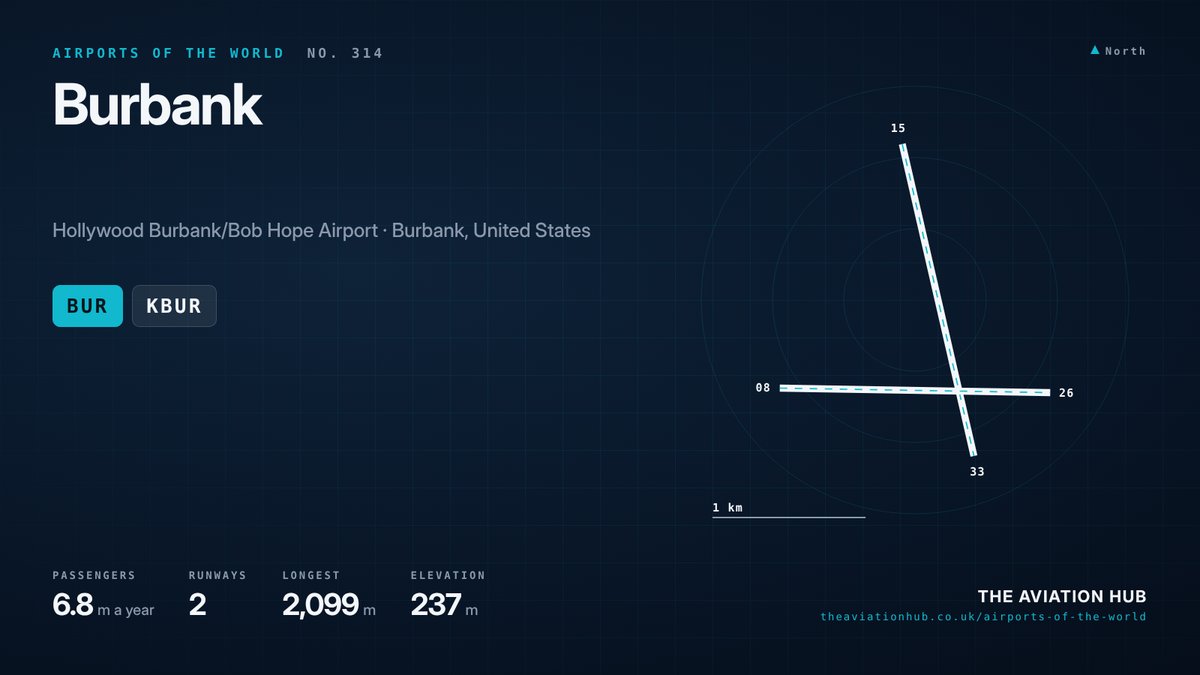
The IATA code is BUR and the ICAO code is KBUR. The terminal lies in the city of Burbank, about 12 miles (19 km) northwest of downtown Los Angeles. Elevation is 778 feet (237 m). There are two crossing runways and 14 gates in a replacement terminal that opened on 13 October 2026. The Burbank Glendale Pasadena Airport Authority, controlled by the three cities, has owned the site since 1978.
Burbank Airport carried 6,550,281 passengers in 2024 and roughly 6.3 million in 2025. Southwest dominates with about 56 per cent of passengers, followed by Alaska at 15 per cent and United at 10 per cent. Cargo is handled mainly by UPS and FedEx, and Ameriflight runs a base for its feeder freight network. JSX operates from its own facility. Parking, security and terminal updates are on the airport’s official website.
From United Airport to Hollywood Burbank
The airport opened on 30 May 1930 as United Airport, built by the United Aircraft and Transport Corporation, the holding company behind Boeing and United Air Lines. Until 1946 it was the largest commercial airport in the Los Angeles area. It became Union Air Terminal in 1934, and in 1940 Lockheed bought it and renamed it Lockheed Air Terminal.
Lockheed turned the area into a manufacturing powerhouse. During the Second World War its Burbank plant built P-38 Lightnings and Hudsons under elaborate camouflage netting. Later its Skunk Works designed the U-2 and SR-71 nearby. In 1973 the US Supreme Court ruling in City of Burbank v. Lockheed Air Terminal struck down the city’s night jet curfew, establishing that federal authority over aircraft noise overrides local bans.
Three cities bought the airport from Lockheed in 1978, renaming it Burbank Glendale Pasadena Airport. It became Bob Hope Airport in 2003, honouring the comedian. Because that name did not tell travellers where the airport was, the authority adopted the Hollywood Burbank Airport brand in 2017.
Runways at Burbank Airport
Burbank Airport has two asphalt runways, both 46 m wide. Runway 15/33 is 2,099 m (6,886 ft) long, and runway 08/26 is 1,768 m (5,802 ft). By the standards of a busy airline airport, both are short. Departures normally use runway 15 and arrivals normally land on runway 8, the only runway with an instrument landing system, though wind can change the pattern.
The short runways have produced famous overruns. On 5 March 2000 Southwest Flight 1455, a Boeing 737 from Las Vegas, ran off the end of runway 8, crashed through a blast wall and stopped on Hollywood Way, injuring 44 people. An engineered materials arresting system was later installed, and in December 2018 it stopped Southwest Flight 278 after a landing in heavy rain. The airspace is crowded too, and in January 2026 the NTSB chair warned about mid air collision risk around Burbank and Van Nuys.
Terminals and Airlines
Until 13 October 2026 passengers used Terminal A, with gates A1 to A9, and Terminal B, with gates B1 to B5, in a low building whose oldest parts dated from 1930 and which sat closer to the runways than modern safety standards allow. The replacement terminal, on the opposite side of the airfield, keeps 14 gates on one level. There are still no jet bridges, so passengers walk out and climb air stairs, which is part of the charm.
Southwest flies Boeing 737-700s, 737-800s and 737 MAX 8s across the western United States. Alaska serves Seattle, Portland, Boise and smaller Pacific Northwest points, and United and American connect with their Denver, San Francisco, Dallas and Phoenix operations. Delta flies to Atlanta and Salt Lake City. Allegiant, Breeze and Frontier add low cost leisure routes, and JetBlue flies seasonally to New York JFK.
Routes and Destinations
Las Vegas is the busiest route, with about 405,000 passengers in the year to January 2026. Oakland and San Francisco follow at around 293,000 and 278,000, then Phoenix at about 257,000. Denver and Sacramento each carried around 235,000, and Seattle and San Jose both passed 200,000. Much of this is short haul business traffic, with Southwest running shuttle style frequencies up and down California.
Honolulu, about 2,550 miles (4,100 km) away, is the longest route, served by Southwest and seasonally by Alaska. New York JFK is the longest domestic mainland flight from Burbank Airport at roughly 2,460 miles (3,960 km). There are no international scheduled services. Cargo is steady rather than large, with UPS moving about 41.6 million pounds and FedEx about 29.8 million pounds in 2024.
Getting to and from Burbank Airport
Rail access is a genuine advantage. Burbank Airport North station, on Metrolink’s Antelope Valley Line, links to the new terminal by a pedestrian path and an on demand shuttle. Burbank Airport South station on Empire Avenue, beside the old terminal site, is served by Metrolink’s Ventura County Line and by Amtrak Pacific Surfliner and Coast Starlight trains. Trains reach Los Angeles Union Station in roughly 20 to 25 minutes for a few dollars.
Metro bus 222 connects the airport with Universal City for the B Line subway, and the Burbank Bus Orange route runs to North Hollywood. Drivers reach the airport from Interstate 5, State Route 134, State Route 170 and US 101, and the main entrance is now at Winona Avenue and Hollywood Way. Rideshare is quick outside rush hour, but Valley traffic can turn a 20 minute trip into an hour. Parking is close to the terminal and cheaper than at LAX.
Spotting and Photography
The compact layout makes Burbank one of the easier Los Angeles airports for enthusiasts. Streets and shopping areas along Empire Avenue and Hollywood Way, south and east of the field, give close views of arrivals on runway 8 and departures from runway 15. The south side keeps the sun behind the photographer for most of the day, and the San Gabriel Mountains make a strong backdrop.
The traffic is mostly Southwest 737s, but Alaska, Delta, Allegiant and JSX’s Embraer ERJ 135 and ERJ 145 jets add variety, along with business jets and police helicopters. Park legally, stay off private property and keep away from the perimeter fence. The community is sensitive about noise and traffic, so be discreet.
What Comes Next
The replacement terminal, which cost nearly $1.3 billion, is the defining project. Voters approved Measure B in November 2016, groundbreaking came in January 2024 and the new 355,000 square foot, single level building opened on 13 October 2026, when an Alaska Airlines flight to Santa Rosa became its first departure. It keeps the same 14 gates but moves passengers further from the runways and into a modern building.
Growth will be limited by politics more than concrete. Noise complaints surged after NextGen flight path changes in the late 2010s, and neighbouring Los Angeles communities remain wary. A planned California high speed rail station beside the new terminal could transform access in the long term. The verdict: Burbank Airport will stay small, efficient and popular, with a far better building. See it alongside LAX and Long Beach on our Airports of the World map.
Continue to follow The Aviation Hub for more analysis and insight.
Advertise with us Your brand, in front of an aviation audience Home page and in-article placements, sold directly, one advertiser per slot. From £250 a year. See the rates

