
Burgas Airport Guide: Black Sea Charters and Summer Peaks
Burgas Airport is the summer gateway to Sunny Beach and Bulgaria's southern Black Sea coast. See how its runway, terminal, airlines and transfers work.
 By The Aviation Hub
5 min read
Updated October 20, 2026
Each summer, hundreds of thousands of holidaymakers pour onto Bulgaria’s southern Black Sea coast through one terminal at Sarafovo. Burgas Airport serves the port city of Burgas and the resorts of Sunny Beach, Nessebar and Pomorie. Traffic swings wildly with the seasons, from quiet winter weeks to packed summer weekends of charter and low cost flights from Poland, Britain and the Czech Republic. German group Fraport runs it under a long concession.
Burgas Airport at a Glance
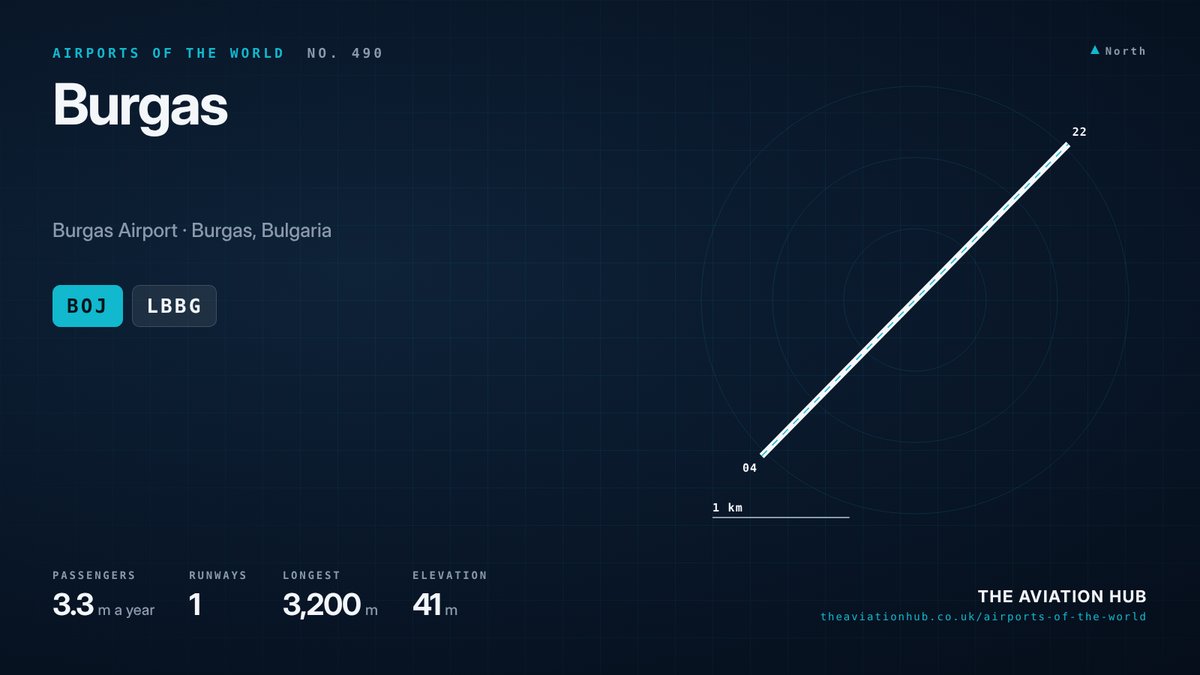
The codes are BOJ and LBBG. The airport lies about 6 miles (10 km) north east of central Burgas, close to the coast at Sarafovo, at an elevation of 135 ft (41 m). It has one runway and one passenger terminal, Terminal 2, opened in 2013.
Traffic reached around 1.8 million passengers in 2024, well below the record of almost 3.3 million set in 2018. Wizz Air ran a summer base at Burgas Airport in 2021 and 2022, but most flights today come from airlines based elsewhere. Fraport Twin Star Airport Management, a partnership between Fraport and the Bulgarian firm BM Star, operates both Burgas and Varna. Flight information is on the airport’s official website.
How Burgas Got Its Airport
The French airline CIDNA, a forerunner of Air France, chose the site for a radio station on its routes across the Balkans. Its contract with the Bulgarian government, signed on 27 June 1937, marks the start of Burgas Airport.
After the war, the state airline that later became Balkan Bulgarian Airlines began domestic flights in 1947 using Junkers Ju 52/3m aircraft. A terminal followed in the 1950s. By 1970 the airport was international, serving dozens of destinations as the Black Sea coast became a holiday playground for the Eastern Bloc.
The modern era began in 2006, when the government awarded Fraport a concession for Burgas and Varna in return for large investment commitments. The centrepiece was Terminal 2, built from December 2011 and opened in December 2013. The old Terminal 1, expanded in the early 1990s, no longer handles passengers.
Runways at Burgas Airport
Runway 04/22 is 3,200 m (10,499 ft) long and 45 m (148 ft) wide, with a concrete surface. That is more than enough for any narrow body and for wide bodies on medium haul charter flights.
The runway runs roughly south west to north east, a short distance inland from the sea. Coastal winds decide which end is in use. The field sits beside the salt pans and wetlands of Atanasovsko Lake, an important bird reserve. Bird activity is a constant consideration for the airport.
A taxiway reconstruction programme began in October 2016, covering taxiways H and A and replacing the airfield lighting control system at a cost of more than 6 million euros. The airport closed for around two months at the end of that year while the work was done, a quiet period that spared the summer season.
Terminals and Airlines
Terminal 2 covers 21,000 sq m and is designed for 2.7 million passengers a year. It has 31 check in counters, nine security lanes and eight departure gates. Arrivals has 12 passport booths and four baggage belts. Shops, cafes and an outdoor courtyard sit airside.
Most scheduled carriers at Burgas Airport fly only in summer. easyJet, Jet2, Ryanair, Eurowings and TUI bring British and German holidaymakers, typically on Airbus A320 family jets and Boeing 737s. Smartwings flies Czech and Polish charters, including Katowice and Gdansk.
A long list of charter airlines fill the peaks, including Avion Express, GetJet, Electra Airways and TUI fly Nordic. Scandinavian operators connect the Nordic countries. Many of these flights arrive on weekend rotations timed around package holiday stays.
Routes and Destinations
Poland is the biggest market, with almost 474,000 passengers in 2023, ahead of the United Kingdom at around 377,000. The Czech Republic, Germany and Israel follow. By city, London led with around 143,000 passengers, followed by Warsaw, Katowice, Prague and Tel Aviv.
Russia was once a major source of tourists, but European Union airspace restrictions since 2022 have cut those flights. That loss explains much of the gap between today’s traffic at Burgas Airport and the 2018 peak. Poland, Czechia and Israel have partly filled the space.
The season runs from May to October, with July and August the busiest months. Winter schedules are thin. Cargo is small, at around 650 tonnes in 2024.
Getting to and from Burgas Airport
There is no rail link. City bus line 15 connects the terminal with Burgas South bus station in the centre, and it is the cheapest way into town. A taxi takes around 15 minutes. Use the official taxi rank outside arrivals.
For the resorts, intercity buses to Pomorie, Aheloy, Ravda, Nessebar and Sunny Beach stop at a roundabout across from the terminal. Sunny Beach is about 20 miles (32 km) north, around 30 to 40 minutes by road. Most package holidaymakers ride tour operator coaches, which wait outside the terminal.
The 24 hour car park has 199 spaces, and rental car desks sit in arrivals. A hire car is useful for exploring the coast south towards Sozopol.
Spotting and Photography
Burgas Airport is a summer spotting venue. On peak Saturdays a parade of charter and low cost liveries from across Europe passes through, including airlines rarely seen in the United Kingdom. Winter, by contrast, can be very quiet.
The runway’s position near the coast and the wetlands means approaches can be watched from public land around the field. The salt pans of Atanasovsko Lake add an unusual foreground. Morning light favours the south eastern side, and summer heat haze softens long shots by midday.
Stay on public land, keep clear of fences and do not disturb wildlife in the protected wetlands. Bulgarian police may ask photographers to move on near the perimeter.
What Comes Next
Terminal 2 has spare capacity, so the challenge is demand rather than space. Fraport’s task is to rebuild traffic towards the 2018 level by adding new markets and stretching the season. New charters, including an Electra Airways link to Erfurt Weimar from July 2026, show the effort.
Bulgaria’s adoption of the euro in 2026 makes the coast simpler for many visitors. The verdict is a steady recovery, tied to European holiday trends and to how long the season can last. See the Black Sea region on the Airports of the World map.
Continue to follow The Aviation Hub for more analysis and insight.
Advertise with us Your brand, in front of an aviation audience Home page and in-article placements, sold directly, one advertiser per slot. From £250 a year. See the rates

