
Busan Gimhae Airport Guide: Korea’s Southern Air Gateway
Busan Gimhae Airport is South Korea's main southern gateway and the home of Air Busan. Runways, terminals, routes and the Gadeokdo replacement explained.
 By The Aviation Hub
7 min read
Updated October 20, 2026
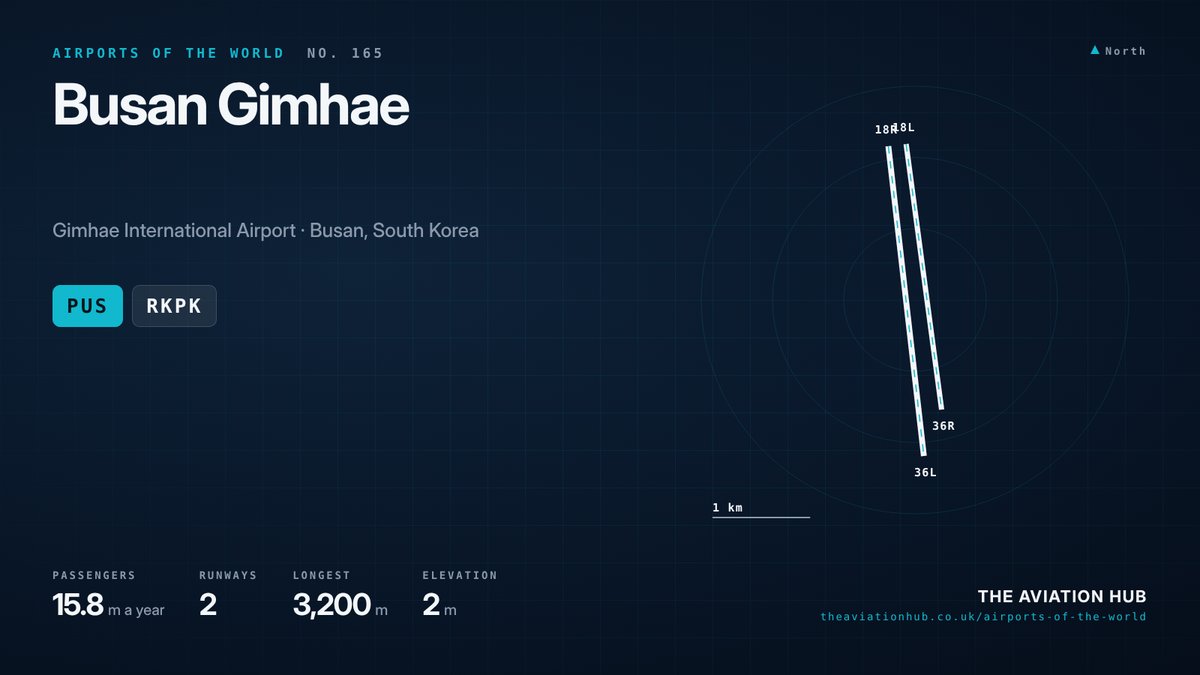
Busan Gimhae Airport is the air gateway to South Korea’s second city and its biggest port, a metropolis of 3.3 million people on the southeastern coast facing Japan across the Korea Strait. Formally Gimhae International Airport, it sits on the flat delta of the Nakdong River in Gangseo District, about 11 miles (17 km) west of the city centre. It handled around 15.8 million passengers in 2024 and shares its runways with a Republic of Korea Air Force base. Air Busan is headquartered here, and the Japanese and Southeast Asian routes make it the busiest international airport in Korea outside Seoul.
Busan Gimhae Airport at a Glance
The codes are PUS and RKPK, the IATA code a leftover from the old romanisation Pusan. The airport lies just 2 m (6 ft) above sea level, hemmed in by mountains to the north and east and by the river and housing on the other sides. There are two parallel runways and two passenger terminals, one domestic and one international. Just under 15.8 million passengers passed through in 2024, around 9 million of them international, against a 2018 peak of 17.1 million.
Air Busan, the Asiana subsidiary, is the home carrier and Korean Air, Jeju Air, Jin Air and Eastar Jet all keep bases at Busan Gimhae Airport. Korea Airports Corporation, the state operator of the country’s regional airports, runs the field. Flight status and transport details are on the airport’s official website.
A Short History of Gimhae
Busan’s first airport was Suyeong, a wartime Japanese airstrip on the eastern side of the city that became the main civil field after 1945 and a US air base during the Korean War. By the 1970s Suyeong was surrounded by housing and too short for jets. The government built a new airport on the Gimhae plain to the west, next to an existing air force base, and civil traffic moved there in August 1976.
The name comes from the neighbouring city of Gimhae, the ancient capital of the Gaya confederacy, although the airport site was absorbed into Busan when the city’s boundaries expanded in 1989. A domestic terminal opened in May 1983 and international flights grew through the 1990s, with Korean Air’s Honolulu service in 1992 marking the first long haul route.
The current international terminal opened on 31 October 2007 and has been extended since. Northwest Airlines flew Tokyo Narita from 2002 until its successor Delta withdrew in 2012, and Lufthansa’s Munich service via Seoul ran from 2007 to 2014 as a rare link to Europe. The low cost boom that began with Air Busan’s launch in 2008 reshaped the airport into what it is today.
Runways at Busan Gimhae Airport
Two parallel runways run north to south. Runway 18R/36L is the civil runway, a concrete strip of 3,200 m (10,499 ft) by 60 m with instrument approaches from the south. Runway 18L/36R, at 2,745 m (9,007 ft) and 46 m wide, belongs to the air force base and carries military aircraft rather than airliners.
The mountains to the north make the field famous among pilots. Straight in approaches to runway 18 are impossible because of the mountains north of the field, so aircraft landing to the south fly a circling approach, arriving from the south on the 36 instrument procedure before breaking off and turning back in a tight visual pattern. The procedure was at the centre of the Air China Flight 129 accident in April 2002, when a Boeing 767-200 flew into Mount Dotdae during the circling manoeuvre in rain and cloud, killing 129 people.
Runway 36L sees most of the arrivals, coming in over the Nakdong estuary. Busan Gimhae Airport also has a curfew from 23:00 to 06:00 that caps movements and shapes every airline schedule.
Terminals and Airlines
The domestic terminal is the smaller and older of the two buildings. Korean Air, Air Busan, Jeju Air, Jin Air and Eastar Jet run shuttles to Seoul Gimpo and flights to Jeju, with Jeju the dominant route by far. The building is efficient rather than memorable, and the stands sit close enough to watch boarding from the hall.
The international terminal opened in 2007 and handles everything else. Air Busan has the largest presence, with Jeju Air, Jin Air, T’way Air, Eastar Jet and Korean Air also prominent. Foreign carriers include Vietnam Airlines, VietJet, Philippine Airlines, Singapore Airlines, EVA Air, China Airlines, Starlux, HK Express, China Eastern, Air China and MIAT Mongolian Airlines. The two terminals connect by a walkway and a free shuttle, with the light rail station between them.
Routes and Destinations
Jeju is the busiest domestic route and one of the densest air corridors in the world, with departures every few minutes at peak times. Seoul Gimpo is the other domestic staple, although the KTX high speed train has taken much of that market. Domestic flying accounts for around 6.7 million passengers a year.
Japan dominates the international board at Busan Gimhae Airport. Osaka Kansai, Tokyo Narita, Fukuoka, Nagoya, Sapporo and Okinawa all have regular flights, with Fukuoka only 140 miles (225 km) away across the strait. Taipei, Hong Kong, Shanghai, Qingdao, Beijing and the Vietnamese resorts of Da Nang and Nha Trang follow, along with Bangkok, Manila, Cebu, Kuala Lumpur, Singapore and Ulaanbaatar. Air Busan’s Denpasar service is the longest scheduled route at around 3,200 miles (5,100 km), ahead of Singapore at 2,800 miles (4,600 km). Winter brings the Japanese ski markets and summer the Southeast Asian beach routes. Air Busan flies Airbus A321neo and A321 aircraft on almost everything, and wide body visits are rare.
Getting to and from Busan Gimhae Airport
The Busan Gimhae Light Rail Transit stops at Gimhae International Airport station between the two terminals. Trains run every few minutes to Sasang, where Busan Metro Line 2 continues into the city, and to Daejeo for Line 3. The journey to Seomyeon in the centre takes around 35 minutes for less than 3,000 won (around £1.70), which is the cheapest sensible option.
Limousine buses run to Haeundae and the beach hotels in 60 to 80 minutes and to Busan railway station in about 40. Intercity coaches leave for Ulsan, Changwon, Gyeongju and Daegu. A taxi to the city centre costs roughly 20,000 to 25,000 won (£11 to £14) and takes 30 to 45 minutes, considerably more to Haeundae. Parking is in multistorey and surface car parks in front of the terminals.
Spotting and Photography
Spotting at Busan Gimhae Airport demands care, because the field is a military base and photography of the apron, the runways and the military areas is prohibited. Terminal windows allow casual viewing but security may object to long lenses pointed at the air force side. The sensible approach is to watch from a distance.
The Nakdong estuary south of the field offers views of aircraft on final to 36L, with the wetlands and the river mouth in the frame and afternoon light from the west. The hills around Gimhae to the north give elevated views of departures off 36L and of the circling approach when 18 is in use. The traffic is mostly Air Busan and Jeju Air A321s and 737s with Japanese, Chinese and Southeast Asian variety. Respect the signs, keep well away from any fence and move on politely if asked.
The Move to Gadeokdo
Busan Gimhae Airport is beyond its design capacity, boxed in by terrain and housing and limited by its curfew and its shared runway. Plans to expand it were dropped in November 2020 after a government committee found them unworkable. Instead a special law passed in 2021 authorised Gadeokdo New Airport, a 24 hour field on reclaimed land off Gadeok Island to the southwest, but the main construction contract was still unsettled in 2026 and opening is now targeted for 2035.
Until Gadeokdo opens, Gimhae will keep squeezing more flights into its daytime window. Its future after that is likely to be domestic and military while the new airport takes the international traffic. See how it compares with Incheon and the rest of Korea on the Airports of the World map.
Continue to follow The Aviation Hub for more analysis and insight.
Advertise with us Your brand, in front of an aviation audience Home page and in-article placements, sold directly, one advertiser per slot. From £250 a year. See the rates

