
Cairo Airport Guide: Africa’s Busiest Hub Explained
Cairo Airport is the busiest in Africa and the home of EgyptAir. Read about its three runways, three terminals, routes, access and the best spotting.
 By The Aviation Hub
6 min read
Updated October 20, 2026
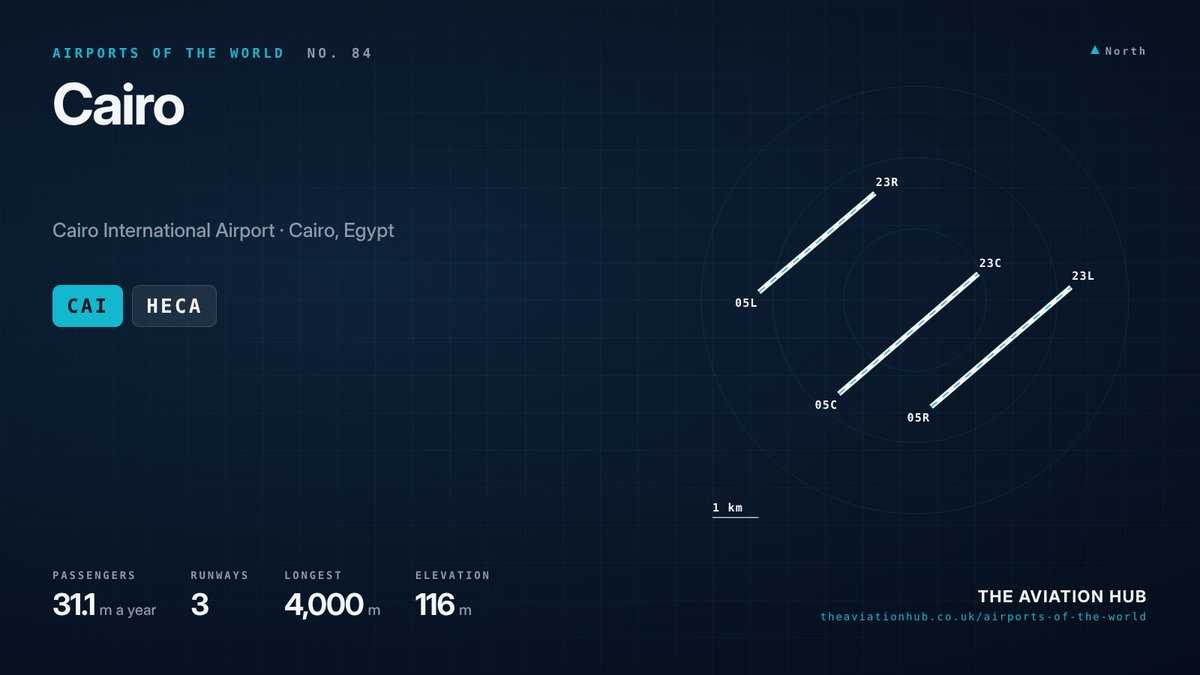
Cairo International Airport is the busiest airport in Africa and the main gateway to Egypt. It lies in Heliopolis, around 9 miles (15 km) north east of Tahrir Square, on the desert edge of the city. Close to 31 million passengers passed through Cairo Airport in 2025, a record, and the total keeps climbing as Egypt’s tourism recovers and EgyptAir expands. Three long runways, three main terminals and a Star Alliance hub make it the most important field between Istanbul and Johannesburg.
Cairo Airport at a Glance
The codes are CAI and HECA. The airfield sits at 382 ft (116 m) above sea level on the plateau that rises east of the Nile, 9 miles (15 km) from the city centre by the Oroba Road through Heliopolis. The Ring Road and the Suez Road interchange give a second approach that avoids the worst of the Heliopolis traffic.
Cairo Airport has three runways and three passenger terminals, plus a small seasonal terminal for charter and pilgrimage flights. The 2025 figure was around 30.9 million passengers, which makes it the busiest in Africa and ninth in the Middle East. EgyptAir is the flag carrier and dominant operator, with Nile Air, Air Cairo and Air Arabia Egypt also based here. Cairo Airport Company, part of the state Egyptian Holding Company for Airports and Air Navigation, runs the field. Flight information is on the airport’s official website.
How Cairo’s Airport Came to Be
The site began as John Payne Field, built by the United States Army Air Forces during the Second World War as an Air Transport Command base for cargo and personnel bound for the Middle East and Asia. When the Americans left, Egypt’s civil aviation authority took over the field. The old Heliopolis Airport, a few miles closer to the city, could not grow, so the government moved commercial flights to the new site.
Cairo International opened in 1963 with the building now known as Terminal 1. Expansions in the late 1970s and early 2000s kept it going through decades of growth. Terminal 2 opened in 1986 with seven gates and served for 24 years before closing for a complete rebuild.
The modern era began in April 2009 when Terminal 3 opened as the new EgyptAir hub. A new runway followed in 2010, replacing a crossing strip. Terminal 2 reopened in September 2016 with 14 gates, double its original count, after a rebuild part funded by a World Bank loan. The airport weathered the 2011 revolution and the 2015 Sinai crash, and traffic has since climbed to new highs.
Runways at Cairo Airport
Cairo Airport has three parallel runways on the 05/23 heading, all surfaced in asphalt and all 60 m (197 ft) wide. Runway 05R/23L is 4,000 m (13,123 ft) long and runway 05C/23C matches it at 4,000 m (13,123 ft). Runway 05L/23R is the shortest at 3,300 m (10,827 ft). The long pair comfortably handles the Boeing 777-300ER and Airbus A350 types of the Gulf carriers and EgyptAir’s long haul fleet, even in the heat of summer.
The 05R/23L runway is the newest, opened in 2010 on the southern side of the field to replace a crossing runway. Its arrival turned the airport into a true three runway parallel layout and lifted hourly capacity sharply. Operations normally land and depart to the north east on the 05 ends, with the terminals spread between the strips.
Sandstorms are the main hazard. The khamsin wind in spring can drop visibility to a few hundred metres, and a 1986 Air Sinai crash on approach in such conditions is remembered here. Heat is the other factor. Summer afternoons regularly pass 40C, which is why the long runways matter.
Terminals and Airlines
Terminal 3 is the flagship. Opened in 2009, it is the largest building at Cairo Airport and the hub for EgyptAir and its Star Alliance partners, including Lufthansa, Turkish Airlines, Austrian, Swiss and Ethiopian. It has a central hall with two gate piers, a transit hotel, and a 230 metre skyway linking it to the Le Meridien hotel across the forecourt.
Terminal 2 reopened in 2016 and works with Terminal 3 as one integrated complex, handling many of the foreign carriers. Terminal 1, the original 1963 building, was renovated in the early 2000s and remains in use for many other airlines.
A small Seasonal Flights Terminal, opened in 2011, deals with the Hajj and Umrah pilgrimage surges and charter traffic. A free shuttle bus connects all the passenger terminals.
Routes and Destinations
The Gulf dominates the international map. Jeddah, Riyadh, Dubai, Doha and Kuwait City carry enormous volumes of Egyptian workers and pilgrims, and the Saudi routes alone run many times a day. Istanbul, London Heathrow, Paris, Frankfurt and Rome lead the European routes. Domestically, Hurghada, Sharm el Sheikh, Luxor and Aswan are the busiest, feeding the Red Sea resorts and the Nile tourist circuit.
EgyptAir reaches New York, Washington, Chicago, Los Angeles, Toronto, Beijing, Shanghai, Tokyo and most of Africa from Cairo Airport. Los Angeles is the longest route at about 7,600 miles (12,200 km). Traffic peaks in summer, when expatriates return home, and again around Ramadan and the Hajj. Cargo is significant, with EgyptAir Cargo, Lufthansa Cargo and Turkish Cargo among the regular freighter visitors.
Getting to and from Cairo Airport
There is no metro or rail link yet. Line 3 of the Cairo Metro has been extended across Heliopolis, and a branch to the airport has long been planned. Until it opens, road is the only option.
Taxis and ride hailing are the practical choice for most visitors. Pre booked limousine services at each terminal charge fixed fares by vehicle class. White metered taxis and Uber cost around 200 to 300 EGP (£3 to £5) to the city centre, and the drive takes 30 minutes at night or well over an hour in daytime traffic. A toll of about 30 EGP applies on the airport access road.
The cheapest sensible option is the public bus. A shuttle links the terminals with the Cairo Airport Bus Terminal, where city buses run to Abbasia and Tahrir Square for a few pounds. Short and long stay parking sits in front of each terminal.
Spotting and Photography
Cairo Airport is not an easy place to spot. Photography near the perimeter is illegal under Egyptian security rules, and the fence is patrolled. The best views are from inside. Terminal 3’s departure piers have long glass walls facing the EgyptAir apron and the runways beyond, and Terminal 2 offers views of the Gulf wide bodies at the gates.
The Le Meridien hotel in front of Terminal 3 is the classic option. Upper floor rooms on the airfield side look across the taxiways and the 05C/23C runway, and the hotel has become the default base for visiting enthusiasts. Morning light favours arrivals on the 05 ends. Afternoon haze and dust can be severe, so winter months give the cleanest air.
Keep the camera inside the terminal or hotel and never photograph military aircraft, which share the field. Ask permission if challenged, be polite and be prepared to delete images. A friendly approach avoids trouble.
What Comes Next
Terminal 4 is the headline project. Planned at a cost of US$3.5 to 4.5 billion, it would add capacity for at least 30 million passengers a year and could open around 2030. As of 2026 it remains in planning, and the government has been exploring private operators for the whole airport under its wider privatisation drive.
In the shorter term, a metro branch would finally give the airport a rail link, and EgyptAir’s fleet growth will keep adding frequencies. Sphinx International Airport on the western edge of Cairo now takes some tourist charters, easing pressure.
Cairo Airport is growing fast and needs the new terminal sooner rather than later. See how it compares with the other African and Middle Eastern hubs on the Airports of the World map.
Continue to follow The Aviation Hub for more analysis and insight.
Advertise with us Your brand, in front of an aviation audience Home page and in-article placements, sold directly, one advertiser per slot. From £250 a year. See the rates

