
Calgary Airport Guide: WestJet’s Home in the Rockies
Calgary Airport is WestJet's headquarters hub and Canada's fourth busiest gateway. Runways, terminals, routes, access and spotting explained.
 By The Aviation Hub
6 min read
Updated October 20, 2026
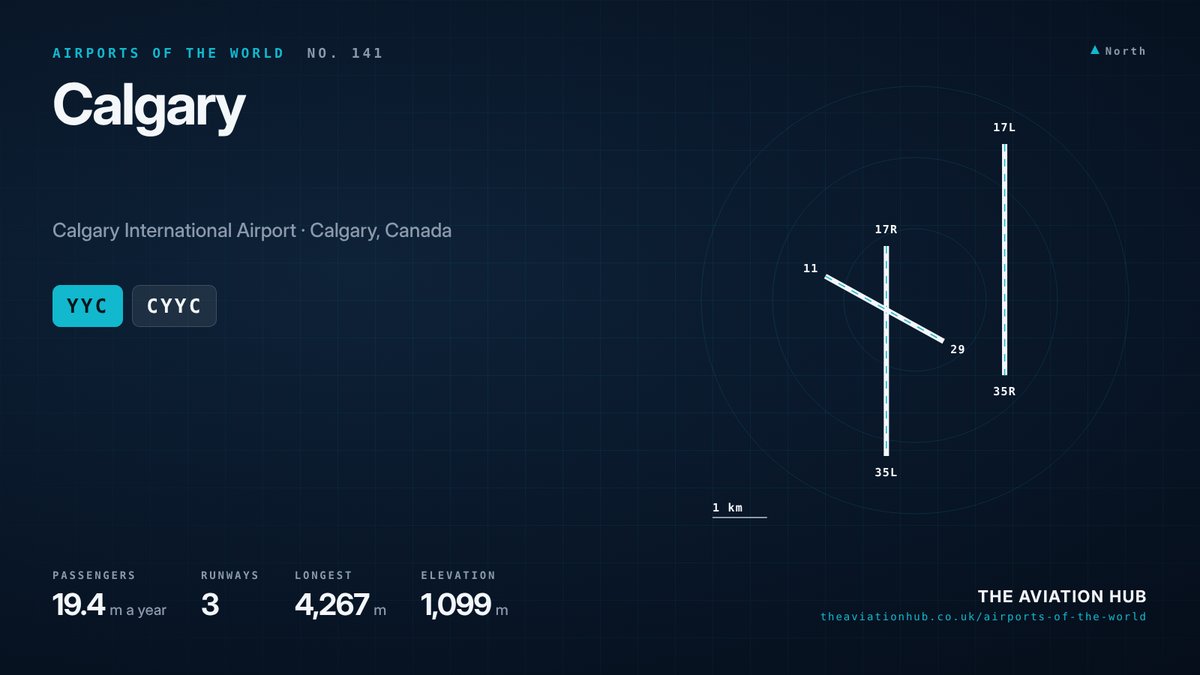
Calgary International Airport sits on the north east edge of Alberta’s largest city, with the Rocky Mountains on the horizon to the west. It is the fourth busiest airport in Canada and the busiest in the province, handling more than 19 million passengers a year. Calgary Airport matters because it is the home of WestJet, the country’s second largest airline, and because it is the main gateway to Banff and the mountain resorts. It also carries a surprising amount of long haul traffic for a city of 1.6 million people.
Calgary Airport at a Glance
The IATA code is YYC and the ICAO code is CYYC. The field lies about 10 miles (17 km) north east of downtown Calgary, at an elevation of 1,099 m (3,606 ft). That altitude matters on hot summer days, when thin air stretches take off runs. There are three runways and two passenger terminals, one domestic and one international, linked by a walkway and a small electric shuttle.
Calgary Airport handled roughly 19.4 million passengers in 2025, alongside around 205,000 aircraft movements. WestJet and its regional subsidiary WestJet Encore are headquartered and based here. Air Canada, Flair Airlines and Central Mountain Air also keep aircraft on the ground overnight. The Calgary Airport Authority, a not for profit body, operates the site under a long lease from the federal government. Live operational information is published on the airport’s official website.
How Calgary’s Airport Came to Be
Calgary’s first aerodrome opened in 1914 at Bowness, a grass strip with a hut beside it. Flying moved around the city through the 1920s before the municipality bought the present site in 1938 and opened its first runway that September. The field was named McCall Field after Fred McCall, a First World War flying ace and lifelong Calgarian. Older residents still use the name.
The federal government approved the title Calgary International Airport in 1962, and full international status followed in 1969. The current domestic terminal opened in 1977, with a Concorde landing to mark the occasion a day late after a technical delay. In 2001 the airport took in 13 diverted flights bound for the United States on the morning of the September 11 attacks.
The biggest turning point was the Airport Development Program of the 2010s. It delivered a 91 m control tower in 2013, a new 4,267 m runway in 2014 and a separate international terminal in 2016. In October 2016 Transport Canada added the YYC code to the airport’s official name, a nod to how Calgarians actually refer to the place.
Runways at Calgary Airport
Calgary Airport operates three runways. The newest and longest is 17L/35R, a concrete runway of 4,267 m (14,000 ft) and 61 m wide. It was the longest runway in Canada when it opened in 2014, built to let heavy wide body jets depart at full weight from a high altitude field in summer. The original parallel runway, 17R/35L, is asphalt and measures 3,863 m (12,675 ft).
The two parallels are far enough apart for simultaneous independent operations, which is what gives YYC its capacity headroom. The third runway, 11/29, is an asphalt strip of 2,438 m (8,000 ft) used mainly when strong westerly crosswinds sweep off the prairie. A former runway, 08/26, was downgraded to a taxiway in October 2024. The prevailing flow is to the north or south, so most arrivals come down the 17s or the 35s.
Terminals and Airlines
The Domestic Terminal dates from 1977 and contains concourses A, B and C. WestJet occupies most of the A gates, Air Canada works mostly from C and the B gates are shared. Concourse B took heavy hail damage in August 2024 and was closed for at least 18 months for repairs. Flair, Porter and the regional carriers use whatever gates are available in the domestic building.
The International Terminal at Calgary Airport opened in 2016 with gates numbered 70 to 97. Concourse D handles flights to Europe, Asia, Mexico and the Caribbean, plus some domestic departures. Concourse E is the United States pier, with full US preclearance so passengers arrive stateside as domestic travellers. The two terminals are joined by a 620 m walkway and the YYC Link shuttle, a distance WestJet has publicly criticised for connecting passengers.
Alliance wise, Air Canada and its Star Alliance partner United share the international building with KLM and Delta from SkyTeam and American and Alaska from oneworld. WestJet is not in a global alliance but has partnerships with Delta and others. Air Canada and WestJet both fly to London Heathrow, and WestJet’s own Boeing 787-9 fleet covers much of the European network.
Routes and Destinations
Domestic traffic dominates. Vancouver, Toronto Pearson and Edmonton are the three busiest routes, with the Calgary to Vancouver shuttle running many times a day on both WestJet and Air Canada. Transborder flying is strong too, led by Los Angeles, Las Vegas and Phoenix in 2024. Sun routes to Mexico and the Caribbean fill the winter schedule when Calgarians flee the cold.
Europe is served by London Heathrow, Frankfurt and Amsterdam, which were the three busiest transatlantic routes in 2024, alongside Paris and seasonal links to Rome, Edinburgh, Dublin and Zurich. Asia is covered by Tokyo and Seoul. Etihad flies to Abu Dhabi from 25 October 2026 and WestJet has added seasonal flights to Sao Paulo, giving the airport a Middle East connection and its first South American service. Summer is peak season for Rockies tourism, while winter brings skiers.
Getting to and from Calgary Airport
There is no rail link to Calgary Airport. Calgary Transit runs bus route 300 from the terminals to downtown, a journey of about 40 minutes, and route 100 to the McKnight Westwinds CTrain station for a train into the centre. The bus is the cheapest option at a standard transit fare of a few dollars. A dedicated rail line to the airport has been discussed for decades but is not funded.
By road the airport sits beside Deerfoot Trail and Stoney Trail, the two main freeways, with a tunnel under the runways linking Barlow Trail to 36th Street. A taxi or ride share to downtown takes 20 to 25 minutes and costs roughly C$40 to C$50 (about £23 to £29). Parking garages face both terminals, with cheaper economy lots served by shuttle. Rental cars are in a central facility across from the terminals.
Spotting and Photography
Calgary is a rewarding spotting location because of the big sky, the mountain backdrop and WestJet’s varied fleet. The classic spot is the Edward H. LaBorde Viewing Area beside McKnight Boulevard at the south end of 35L, the only official viewing area, where arrivals pass overhead from the afternoon. For northbound departures on 35R, the golf course along 36th Street NE gives a view of heavy jets lifting off the long concrete runway.
Winds decide everything. Northerly flow puts arrivals on the 35s from the south, while a southerly flow brings them over the north end onto the 17s. Chinook winds from the west can switch operations to 11/29 for a few hours. Light is best in the morning on the east side and in the evening on the west side, and winter sun stays low all day. Stay off airport service roads, do not block gates or fences, and expect polite questions from security if you linger near the cargo apron.
What Comes Next
The big infrastructure is already built. The 2014 runway and 2016 international terminal give Calgary Airport room to grow well beyond 20 million passengers without new concrete. The near term work is repairing hail damaged Concourse B and finding a better fix for the long walk between the two terminals. WestJet’s growth as a global carrier, with routes to Sao Paulo and Seoul, and newcomers such as Etihad will decide how quickly the international building fills up.
Calgary Airport is heading upwards, a hub with spare capacity in a growing city. You can compare it with every other gateway on our Airports of the World map.
Continue to follow The Aviation Hub for more analysis and insight.
Advertise with us Your brand, in front of an aviation audience Home page and in-article placements, sold directly, one advertiser per slot. From £250 a year. See the rates

