
Campinas Viracopos Airport, officially Viracopos International Airport, is the main hub of Azul Brazilian Airlines and one of the key cargo gateways in Brazil. It sits in the countryside southwest of Campinas, about 50 miles from Sao Paulo. Close to 12.8 million passengers used it in 2025, along with more than 270,000 tonnes of freight. For a field that once served as Sao Paulo’s international airport, it has reinvented itself twice.
Campinas Viracopos Airport at a Glance
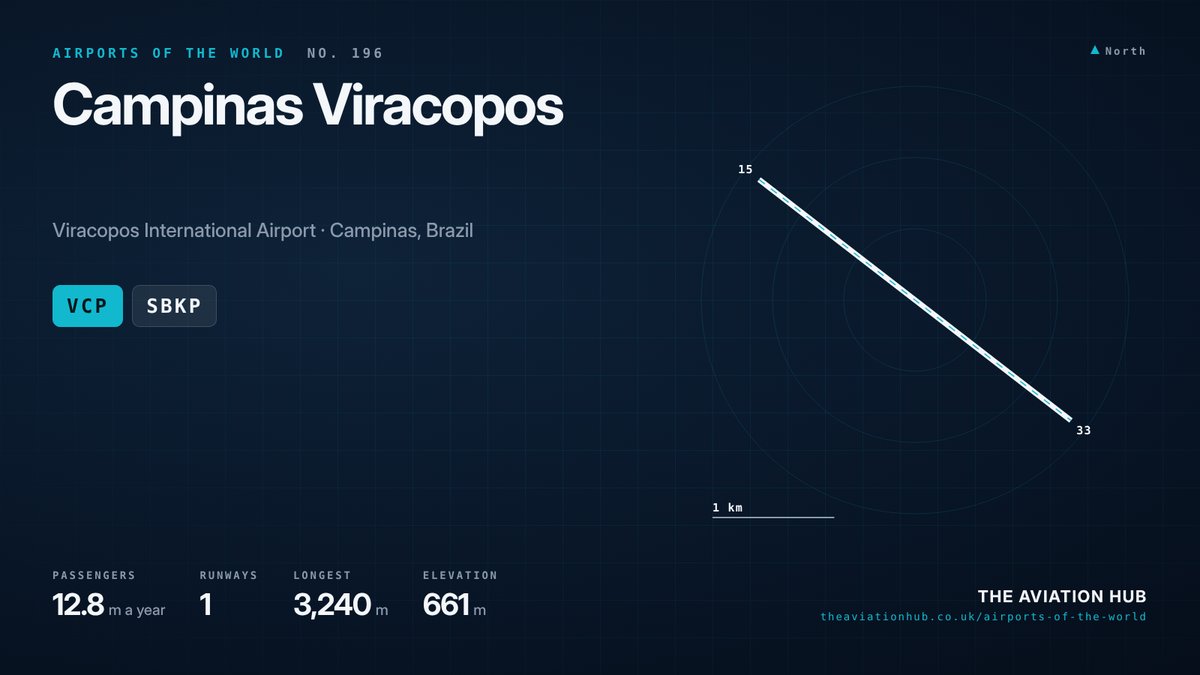
The IATA code is VCP and the ICAO code is SBKP. The airport lies about 12 miles (20 km) southwest of downtown Campinas and around 51 miles (82 km) northwest of central Sao Paulo. Elevation is 661 metres (2,170 feet). There is a single runway and one main passenger terminal, plus large cargo terminals on a site of 1,766 hectares.
Campinas Viracopos Airport handled 12,826,553 passengers and 124,613 aircraft movements in 2025. Cargo reached 271,711 tonnes, making it the second busiest cargo airport in Brazil. Azul dominates passenger traffic and runs its largest connecting operation here. Aeroportos Brasil Viracopos has operated the airport under a 30 year concession since 2012. Flight and parking details are on the airport’s official website.
How Campinas’ Airport Came to Be
The airfield began as a simple strip built during the Constitutionalist Revolution of 1932. The first paved runway followed in 1946, a hangar in 1948 and a small terminal in 1950. The airport was officially inaugurated on 19 October 1960, the same day it received its first international flight.
The name is a local curiosity. Viracopos roughly means “turn over the glasses” in Portuguese, a nod to heavy drinking. One story links it to a brawl at an early twentieth century fair, another to a bar where cattle drovers met. The name was first used for the district and was standardised for the airport on 6 January 1987.
Through the 1960s and 1970s, Viracopos handled much of the long haul jet traffic for Sao Paulo, since the city’s Congonhas airport was too small. It was once listed by Guinness as the airport furthest from the city it served. The opening of Guarulhos in 1985 drained away those flights. Revival came when Azul chose Campinas as its main base after launching in 2008.
Runways at Campinas Viracopos Airport
Campinas Viracopos Airport has one asphalt runway, 15/33, which is 3,240 metres (10,630 feet) long and 45 metres wide. It handles the full range of wide body passenger and cargo aircraft, from the Airbus A330 and A350 to the Boeing 777F and 747 freighters. The direction in use depends on the wind, and both ends see regular traffic.
Weather is the airport’s secret weapon. It closes for weather on only about five days a year on average, far fewer than the foggy airports of Sao Paulo and Rio de Janeiro. Airlines often file Viracopos as an alternate, and diversions arrive when Guarulhos or Congonhas shut. At 661 metres elevation, hot summer afternoons still trim payloads on the heaviest long haul departures.
A single runway leaves the airport exposed. On 13 October 2012 a Centurion Air Cargo MD-11 lost a landing gear on landing and the airport closed for 45 hours, the first non weather closure in 52 years. A second runway has been in the plans for more than a decade, but it has not been built.
Terminals and Airlines
The current passenger terminal opened its first phase in May 2015, replacing the cramped older building. It has air bridges along a long pier and is designed around Azul’s connecting banks. Cargo facilities cover 77,000 square metres, including space for animals and 1,480 cubic metres of refrigerated storage.
Azul is the overwhelming tenant at Campinas Viracopos Airport. It flies Embraer E195-E2 and E195 jets, Airbus A320neo and A321neo aircraft and ATR 72 turboprops on domestic routes, with Airbus A330 and A350 jets on long haul services. Other passenger airlines have only a small presence. Scheduled and charter freighters from Europe, North America and Asia call regularly.
Routes and Destinations
The domestic network is vast. Azul links Campinas with state capitals such as Rio de Janeiro, Belo Horizonte, Brasilia, Curitiba, Porto Alegre, Salvador, Recife and Fortaleza, and with dozens of interior cities that other hubs ignore. Rio de Janeiro Santos Dumont and Belo Horizonte Confins are among the busiest routes. Many passengers simply connect between flights without leaving the terminal.
Internationally, Azul flies to Lisbon, Porto, Madrid, Orlando and Fort Lauderdale, adds Paris Orly in the northern summer, and reaches neighbouring countries such as Uruguay. Paris is the longest route, at roughly 5,820 miles (9,370 km). Cargo is equally important. Electronics, pharmaceuticals and machine parts arrive for the industrial belt around Campinas, while perishables leave for Europe and North America.
Getting to and from Campinas Viracopos Airport
There is no rail link to Campinas Viracopos Airport, though a planned intercity train between Sao Paulo and Campinas could improve access later. The airport sits on the Santos Dumont highway, close to the Bandeirantes and Anhanguera motorways. Driving to central Campinas takes 25 to 35 minutes. Central Sao Paulo is around 90 minutes away, and often longer in traffic.
Azul has long run coaches for its own passengers between Viracopos and several points in Sao Paulo, which remain the most practical option for many travellers. Local buses connect the terminal with central Campinas and are the cheapest sensible option. Taxis and ride hailing apps such as Uber and 99 are widely available. Parking sits directly in front of the terminal.
Spotting and Photography
The open countryside around Campinas Viracopos Airport gives spotters room to work. Roads and open ground near both runway ends offer views of aircraft on short final, and the terminal departure lounges overlook the Azul apron. The cargo ramp is the real draw, with Boeing 777 and 747 freighters often parked in view.
Azul’s fleet is colourful, with many special liveries on Embraer and Airbus aircraft. Late afternoon light suits positions on the western side of the runway. Stay on public land, keep clear of fences and access roads, and follow instructions from airport security and police. Respect local rules at all times.
What Comes Next
The concession has been troubled. The operator entered court protected restructuring in 2018 and later sought to hand the contract back, which slowed investment and left the second runway unbuilt. Talks over the airport’s long term future have continued since, with a new auction among the options discussed.
Demand is not the problem. Azul’s hub keeps growing, cargo volumes are near record levels and the site has room for a far larger airport. Campinas Viracopos Airport is heading for growth once its ownership is settled and the delayed investment finally arrives. Compare it with other Brazilian gateways on the Airports of the World map.
Continue to follow The Aviation Hub for more analysis and insight.
Advertise with us Your brand, in front of an aviation audience Home page and in-article placements, sold directly, one advertiser per slot. From £250 a year. See the rates

