
The Climate Change Committee has finally put a number on the question that has hung over the Heathrow third runway for a generation: can Britain’s busiest airport grow and still meet its legal climate obligations?
The Committee’s answer, delivered to the Government this month in its Advice to the UK Government on Proposed Heathrow Airport Expansion, is a qualified yes, but only if ministers are prepared to force the aviation industry to pay the full cost of cleaning up after itself.
Read in full, the report is less a verdict on whether Heathrow should expand than a warning about what happens if it expands without a serious plan to decarbonise.
A Report With Teeth
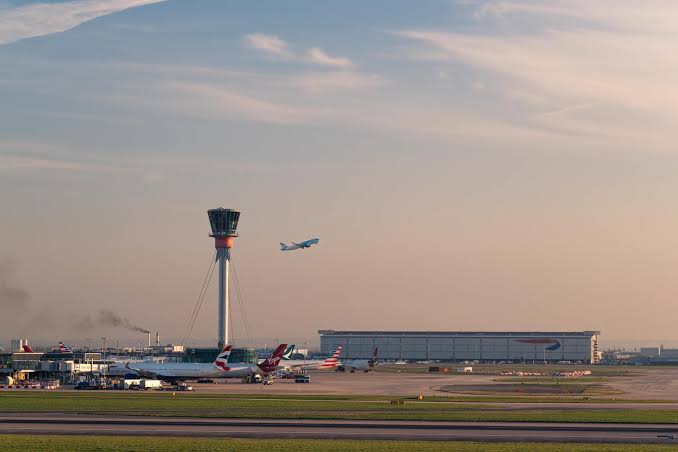
Heathrow already accounts for roughly a quarter of UK flights and around half of UK aviation emissions, so any judgment on its expansion inevitably becomes a judgment on the future of British flying as a whole.
The Committee’s core finding is stark. Before the Government grants development consent for a third runway, it should legislate policies requiring the aviation sector to abate all of its emissions by 2050, either directly or by purchasing permanent engineered removals.
Anything less, the Committee argues, and the expansion simply cannot be squared with the UK’s legally binding net zero target.
That framing matters because it shifts the debate away from a simple yes or no on the runway itself and towards the policy architecture sitting underneath it. The Committee is not saying Heathrow cannot grow.
It is saying growth without a credible decarbonisation framework is the one outcome that breaks the law.
The Numbers Behind The Warning For Heathrow…
The scale of the challenge is laid out in unusually blunt terms.
UK aviation emissions have more than doubled since 1990, even as every other major sector of the economy has cut its output, in some cases by more than half.
Aviation now sits as the fifth highest emitting sector in the country and, on current policy, its emissions are projected to still be higher in 2050 than they are today.
That is before a single extra runway slot at Heathrow is considered.
Layer the proposed expansion on top of that trajectory and the numbers get worse.
Under the Government’s own Current Trends scenario, which assumes existing policy such as the Sustainable Aviation Fuel Mandate and current carbon pricing but nothing more, the third runway would add 2.4 million tonnes of carbon dioxide equivalent to residual emissions in 2050.
That sounds like a rounding error against the economy as a whole until you see it expressed as a share of what is left once every other sector has decarbonised.
By the Committee’s calculation, the full scope of Heathrow expansion would account for 6.9 per cent of the UK’s entire residual carbon dioxide budget in 2050, a bigger single contribution than any other sector of the economy bar aviation itself.
Put simply, a bigger Heathrow, left unmanaged, would be the second largest source of emissions in Britain once everything else has been cleaned up.
Two Pathways For Aviation
Where the report becomes genuinely useful is in setting out what a credible alternative looks like. Could it work for Heathrow?
The Committee has modelled a Net Zero Aviation Pathway in which the sector reaches zero net emissions by 2050 through a combination of demand management, efficiency improvements, sustainable aviation fuel and permanent engineered removals such as direct air carbon capture.
Under this pathway, aviation emissions fall by 76 per cent by the Seventh Carbon Budget period compared with provisional 2025 levels, and critically, the impact of Heathrow expansion on the 2050 target effectively disappears.
Additional emissions generated by a bigger airport are fully offset by the additional sustainable fuel and removals that the same growth in demand helps to fund.
The contrast between the two scenarios is the real story here.
Under current policy, Heathrow expansion makes the climate problem measurably worse.
Under a properly funded net zero pathway, expansion becomes climate neutral.
The runway itself is almost incidental.
What determines the outcome is whether government legislates the sector’s full decarbonisation before the diggers arrive, or leaves it to catch up afterwards.
What The Polluter Pays Principle Actually Means For Heathrow Travellers…
The mechanism the Committee wants to see is what it calls a polluter pays approach, in which the aviation industry bears the full cost of sustainable aviation fuel and engineered removals rather than those costs being spread across taxpayers or left unfunded.
In practice this means higher ticket prices, particularly for travellers out of Heathrow.
The Committee estimates that under its Net Zero Aviation Pathway, a return trip to Alicante could cost around 150 pounds more by 2050, and a return trip to New York around 400 pounds more, in today’s prices.
That works out at roughly six to nine pence per mile, a level the report compares directly to existing fuel duty on petrol and diesel cars.
Crucially, the Committee argues this approach does double duty.
It raises the revenue needed to fund sustainable aviation fuel and removals at scale, and by passing costs through to ticket prices, it also moderates the growth in demand that would otherwise make the whole problem bigger.
The alternative of simply capping airport capacity would also raise prices for consumers, the report notes, but the resulting profits would flow to the aviation industry rather than towards funding the technologies needed to decarbonise it.
On that basis, the Committee views constrained capacity as a weaker policy tool than a properly designed charge on emissions.
The Airlines’ Perspective
Unsurprisingly, the industry has its own view of where that balance should sit, and Airlines UK has been vocal in response to the direction the Committee’s advice points towards Heathrow.
Tim Alderslade, the organisation’s chief executive, set out the case for a more moderate approach to the cost of decarbonisation.
“UK airlines back cost effective airport growth and net zero by 2050, but the transition has to be affordable.”
“Airlines are already investing billions in new aircraft, SAF and airspace upgrades and we have a plan to deliver it.”
“The CCC’s approach would add 600 pounds to a family’s trip to Europe and 1,600 pounds to New York by 2050, putting holidays out of reach for millions and turning the clock back to a time when flying was the preserve of the rich.”
“You can’t solve the climate crisis by pricing Britain out of the skies.”
“The answer is affordable SAF, already cutting emissions since the mandate began, airspace reform by 2035 for more direct routes and scaled up carbon removals.”
“Both SAF and GGRs are proven technically viable, as the CCC itself admits.”
“We should focus on delivering them, not pricing ordinary people out of the joys of travel.”
Alderslade’s figures sit noticeably higher than the Committee’s own central estimates, a gap that reflects genuine uncertainty in the report itself about how quickly sustainable fuel and removals technology can be deployed at the scale required, and at what cost.
The Committee acknowledges as much, running a range of sensitivity scenarios that show ticket price impacts could vary considerably depending on whether the cheapest available technology turns out to be synthetic fuel, engineered removals, or some mix of both.
What both sides agree on is that the underlying technologies, sustainable aviation fuel and greenhouse gas removals, are technically viable.
Where they diverge is on pace, cost and who ultimately picks up the bill.
The Draft Policy Statement Under Scrutiny
Beyond the headline numbers, the Committee has taken direct aim at the draft Heathrow Expansion National Policy Statement itself, the document that will govern how any development consent application is assessed.
Its current climate test asks only whether a proposed scheme would have a material impact on carbon budgets, a threshold the Committee considers too narrow given aviation’s outsized role in the UK’s remaining emissions by 2050.
The advice calls for that test to be strengthened to explicitly reference the 2050 net zero target, and for any assessment to cover the full scope of expansion through to its planned completion in 2054, not just the initial phase opening within the Seventh Carbon Budget period.
The Committee also wants tougher treatment of aviation’s non carbon dioxide effects, including contrail formation, an area where Heathrow’s route network across the North Atlantic and to East Asia makes it a disproportionate contributor relative to the rest of the UK fleet.
A qualitative assessment is currently all the draft policy statement requires. The Committee wants that upgraded to a quantitative one that properly reflects the scientific uncertainty involved.
What Happens Next For Heathrow…

The Government now has the Committee’s advice in hand as it finalises the Heathrow Expansion National Policy Statement and prepares the ground for a revised Jet Zero Strategy expected in 2027.
The central tension identified in this report, between an aviation sector that wants affordable growth and a climate target that leaves no room for slippage, is not going away, and Heathrow’s third runway has become the test case for how it gets resolved.
Whether ministers choose to legislate the polluter pays framework the Committee recommends, or lean towards the more gradual, technology led approach favoured by Airlines UK, will shape not just the future of Heathrow but the price and shape of flying from every UK airport for decades to come.
Continue to follow The Aviation Hub for more analysis and insight!