
Cape Town Airport Guide: Gateway to the Western Cape
Cape Town Airport explained: two runways, domestic and international terminals, the Johannesburg shuttle, airline bases and the planned R10 billion upgrade.
 By The Aviation Hub
7 min read
Updated October 20, 2026
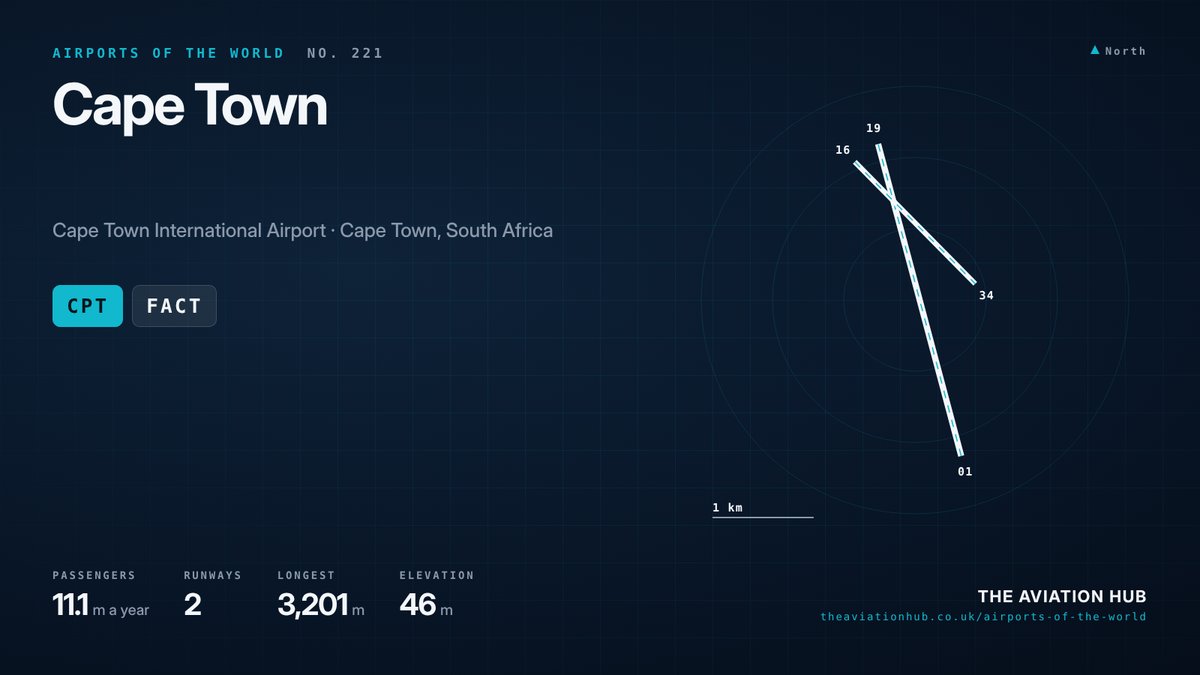
Cape Town International sits on the Cape Flats about 12 miles (20 km) east of the city centre, with Table Mountain filling the western horizon. It is South Africa’s second busiest airport after Johannesburg and handles more than 11 million passengers a year. Cape Town Airport carries the bulk of the Western Cape’s tourism traffic, feeds the country’s busiest domestic trunk route and hosts the bases of two of South Africa’s fastest growing airlines. For a visitor, it is usually the first and last thing they see of the Cape.
Cape Town Airport at a Glance
The IATA code is CPT and the ICAO code is FACT. The field lies at 151 feet (46 m) above sea level, between the suburbs of Matroosfontein and Belhar, roughly 20 minutes by road from the central business district. There are two runways and two passenger terminals joined by a central building. In the most recent reporting year the airport handled around 11.3 million passengers and close to 99,000 aircraft movements.
Airlink and FlySafair both run hubs here, and South African Airways treats the city as a focus point. Airports Company South Africa, known as ACSA, has owned and operated the airport since it took over from the state in the early 1990s. Timetables, parking rates and terminal maps are on the airport’s official website. The airport has been named Africa’s leading airport in the Skytrax rankings for more than a decade running.
How Cape Town’s Airport Came to Be
The airport opened in 1954 to replace Wingfield Aerodrome, roughly a year after Johannesburg’s Jan Smuts Airport. It started life as Bellville Airport, then took the name D.F. Malan Airport after the prime minister of the day. After the end of apartheid the government stripped the political name away and called it Cape Town International.
Later proposals to rename the field after Nelson Mandela, Winnie Madikizela Mandela or Krotoa all stalled. The Mandela idea was quietly dropped in 2021 and the plain geographic name has stuck. The transfer to ACSA in the early 1990s set up the commercial model that still runs the airport today.
The biggest physical change came ahead of the 2010 FIFA World Cup. ACSA built the Central Terminal Building to link the domestic and international halls, added 120 check in desks and reworked the forecourt. That project gave Cape Town Airport the layout passengers use now. A further R7.7 billion expansion announced in 2015 was shelved during the pandemic, and its successor is only now getting under way.
Runways at Cape Town Airport
The main runway is 01/19, an asphalt strip of 3,201 metres (10,502 feet) and 61 metres wide. It handles almost all commercial traffic and is long enough for a fully loaded Boeing 777-300ER or Airbus A350-900 heading to Europe or the Gulf. Runway 19 is the usual choice in the strong south easterly winds of the Cape summer, while 01 comes into play with the north westerly fronts of winter.
The second runway, 16/34, is 1,701 metres (5,581 feet) of asphalt and 46 metres wide. It serves light aircraft, training flights and the occasional turboprop. Both strips lie on flat ground, so there are no terrain restrictions on approach. The summer south easter can gust hard across 01/19, and crews regularly deal with crosswind landings and windshear warnings in the afternoon.
Terminals and Airlines
International passengers use the northern terminal and domestic passengers use the southern one. The Central Terminal Building between them holds the shared check in hall, security and the main retail area. Passengers walk a few hundred metres from one end to the other, which makes connections simple.
The domestic side of Cape Town Airport is dominated by FlySafair, Airlink and the budget operators Lift and CemAir, with South African Airways rebuilding its network after its restructuring. FlySafair operates a large Boeing 737-800 fleet, while Airlink flies Embraer regional jets on thinner regional and African routes. The international terminal brings in British Airways, Virgin Atlantic, KLM, Lufthansa, Emirates, Qatar Airways, Ethiopian Airlines, Turkish Airlines and Singapore Airlines, among others.
Cape Town has no dominant alliance. Star Alliance has a presence through Lufthansa, Ethiopian, Turkish, Singapore and Airlink’s codeshares, while Oneworld arrives through BA and Qatar. Several airlines operate seasonally, scaling up for the southern summer from November to March.
Routes and Destinations
The Johannesburg shuttle is the backbone of the Cape Town Airport schedule. Dozens of flights a day link the two cities, and the route once ranked among the ten busiest in the world with around 4.5 million passengers a year. Durban is the second domestic market, followed by Port Elizabeth (Gqeberha), East London and George.
Internationally, London is the biggest single market, with British Airways and Virgin Atlantic flying daily through the summer. Dubai, Doha and Addis Ababa connect the city to Asia, while Amsterdam, Frankfurt, Zurich and Istanbul serve Europe. Singapore Airlines links the city with Singapore via Johannesburg, and United Airlines operates to Newark and Washington Dulles. Airlink and Ethiopian serve regional African cities such as Windhoek, Victoria Falls, Harare and Nairobi.
Seasonality is extreme. The southern summer brings a wave of wide body flights that thin out in the winter months of June to August. Cargo is modest compared with Johannesburg, but perishable exports such as fruit, flowers and seafood fill the holds of passenger aircraft bound for Europe and the Middle East.
Getting to and from Cape Town Airport
There is no rail link. A 4 km rail spur proposed in 2013 was never built, and the nearest Metrorail stations are not within walking distance. The MyCiTi bus network runs an airport service to the Civic Centre in the city centre, taking around 30 to 40 minutes. It remains the cheapest sensible option for a solo traveller with light luggage.
Most people drive or take a car. The N2 freeway runs past the airport, and Airport Approach Road connects the terminals to it. The journey to the city centre takes about 20 minutes outside peak hours and up to 45 minutes in the morning rush. Metered taxis, Uber and Bolt all operate from the arrivals forecourt. Short and long stay parking sits directly opposite the terminals, with a cheaper shaded long stay car park a short walk away.
Driving to the Winelands or the Garden Route is straightforward from the N2. Car hire desks fill the ground floor of the central building, and hotels in the City Bowl, Camps Bay and Stellenbosch run shuttle buses. Hotel Verde, on the airport perimeter, bills itself as Africa’s greenest hotel.
Spotting and Photography
Cape Town Airport is one of the more rewarding fields in Africa for photography, mainly because of the backdrop. Table Mountain sits behind aircraft arriving on runway 19 in the summer south easter. The best known vantage is along the perimeter roads on the eastern side, where the morning sun lights aircraft on short final to 19.
In winter, with a north westerly blowing, the airport flips to runway 01. The approach then crosses the Cape Flats from the south, and the mountain sits behind departing traffic instead. Afternoon light favours the western side of the field. The viewing areas inside the terminal are limited, but the upper levels of the parking garage give a view over the domestic apron.
Take care on the perimeter roads. The surrounding neighbourhoods have a reputation for crime, so spotters should stay in groups, keep cameras out of sight when not shooting and avoid lingering after dark. Do not climb fences or park on the hard shoulder of the N2. Airport security will move on anyone with a step ladder.
What Comes Next
In February 2026 ACSA announced a R10.14 billion phased upgrade of Cape Town Airport. Terminal renovations begin in April 2027 and the plan includes a realigned main runway, revised taxiways and a larger apron. A solar plant of at least 2.5 MWp is already under construction to cut the airport’s reliance on the national grid during load shedding.
The strategic question is long haul. Cape Town Air Access, a partnership between the airport, the provincial government and the tourism industry, has steadily added direct routes to Europe, Asia and the United States. The pandemic erased much of that progress, but the network has largely recovered and continues to grow. Capacity is not yet a hard constraint, which puts Cape Town Airport in a better position than many of its rivals.
Expect steady growth rather than dramatic change, with the new terminal works defining the next decade. Compare the field with its African and global peers on the Airports of the World map.
Continue to follow The Aviation Hub for more analysis and insight.
Advertise with us Your brand, in front of an aviation audience Home page and in-article placements, sold directly, one advertiser per slot. From £250 a year. See the rates

