
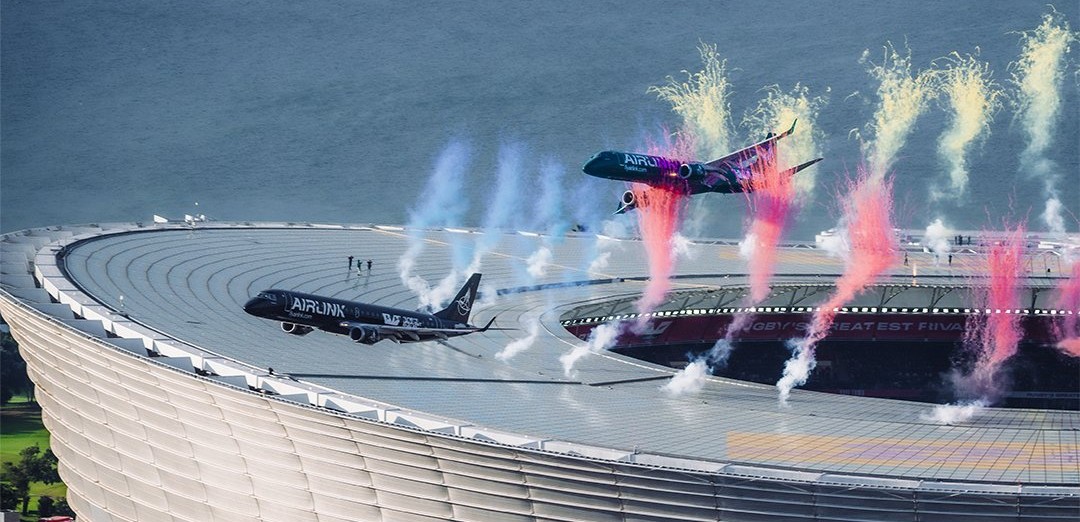
When two Airlink Embraer jets swept over DHL Stadium in Cape Town just before kickoff of the second Springboks versus All Blacks Test on 29 August 2026, the clip travelled around the world within hours.
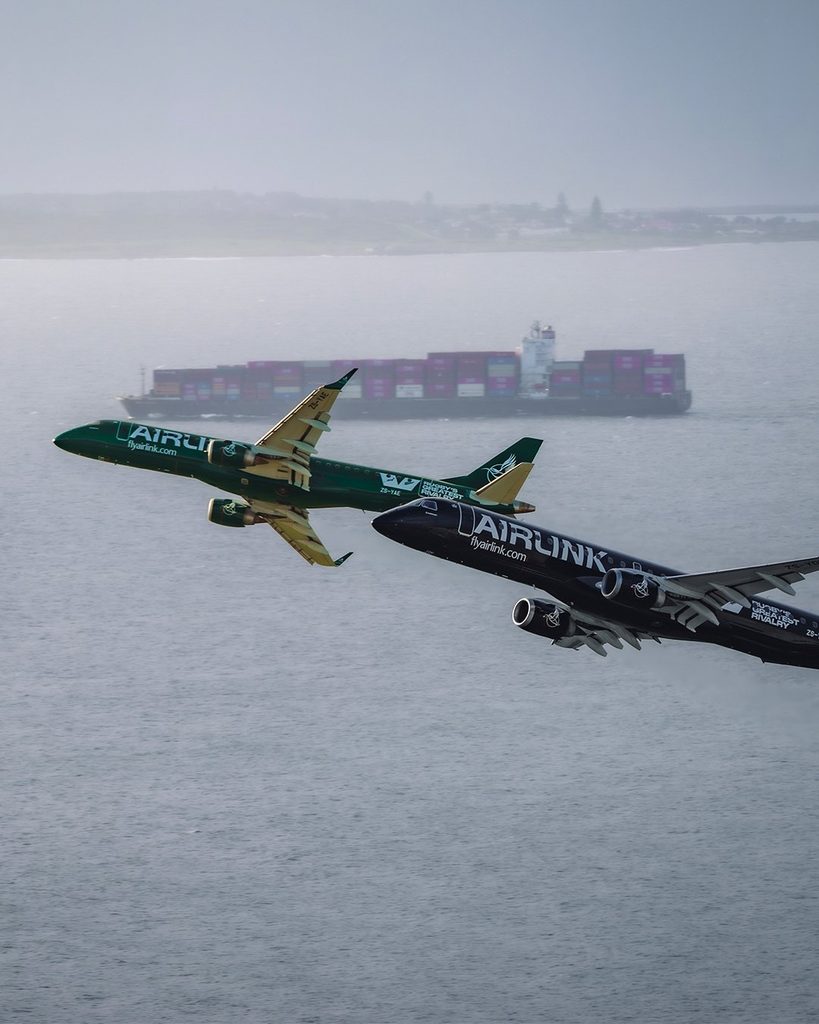
Viewers watched a green liveried E190 and a black liveried E195 skim the stadium roof in tight formation, trailing smoke, with 55,000 fans roaring below.
It looked spectacular. It also looked, to a great many people watching on a phone screen, alarmingly close to disaster.
Airlink insists the pass was planned, rehearsed and flown well within approved limits.
Flight tracking data tells a slightly different story about just how little room there actually was.
So which is it: a slick, professionally executed piece of airmanship, or a marketing stunt that leaned harder on spectacle than it should have?
What Happened Over The DHL Stadium in Cape Town
Airlink, serving as official domestic airline partner for the Rugby’s Greatest Rivalry series, sent two of its regional jets over the stadium roughly ten minutes ahead of kickoff.
The aircraft, registrations ZS-YAE and ZS-YDE, were painted in Springboks green and All Blacks black respectively for the occasion.
Each carried three senior captains rather than a standard two pilot crew, and the pair flew the pass in close formation at around 150 knots while pyrotechnics fired from the stadium roof beneath them.
Cape Town has hosted flyovers before.
A Qatar Airways 777 passed over the same stadium in 2025 to little comment, and South African Airways famously sent a Boeing 747 low over Ellis Park ahead of the 1995 Rugby World Cup final.
What made this one different was the altitude, and the fact that anyone with a phone could measure it.
The Numbers Behind the Pass in Cape Town
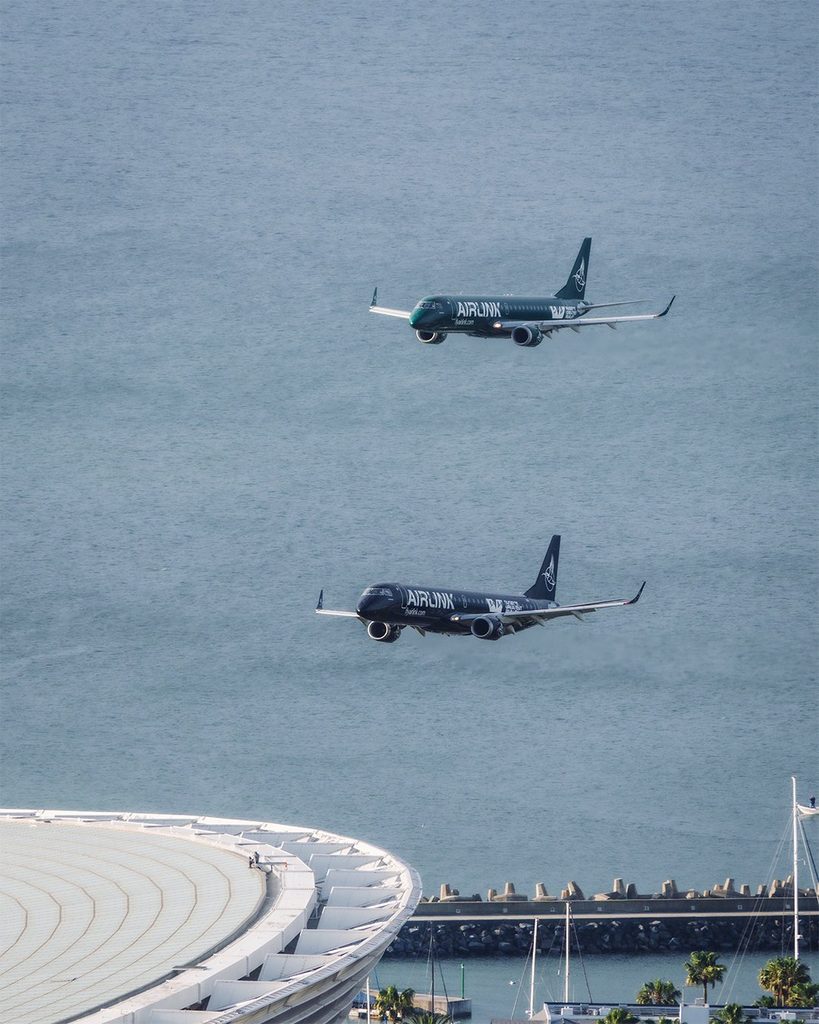
Flightradar24 pulled the raw transponder data from the lead aircraft and worked through the maths publicly.
The jet’s tracking signal recorded a lowest reading of 50 feet at standard pressure. Corrected for the local QNH of 1019 hectopascals, that translates to roughly 205 to 210 feet above mean sea level.
DHL Stadium stands about 164 feet tall.
Subtract one from the other and the aircraft cleared the roof by somewhere between 41 and 46 feet, or about 12.5 to 14 metres.
For an aircraft with a wingspan close to 29 metres, travelling at 150 knots, that is not a generous margin.
It is roughly the height of a four storey building between the belly of the jet and the stadium structure, closing at over 75 metres a second.
Airlink’s Defence
Airlink has been unambiguous in its response to criticism.
The airline says both aircraft “remained within approved and rehearsed safety altitude and speed limits” throughout, and that the manoeuvre was carried out by highly experienced crews who had trained for it in advance.
The South African Civil Aviation Authority and Air Traffic Navigation Services are both cited as having provided guidance, approval and support for the operation in Cape Town.
That is, on its face, a reasonable defence.
South African rules generally keep aircraft above 1,000 feet over congested areas, but regulators can and do grant special dispensation for approved displays, exactly as they do for air show routines around the world.
If SACAA signed off on the numbers Flightradar24 later calculated, then the flight was legal.
Where the Real Risk Actually Sits
Legal and safe are not always the same thing, and this is where the analysis gets more interesting.
A clearance of roughly 12 to 14 metres leaves very little buffer against anything unplanned.
A sudden gust, a downdraft rolling off the stadium’s own structure, a moment’s misjudged spacing between two aircraft flying formation, or smoke and pyrotechnic residue drifting into an engine intake could each eat into that margin in an instant.
None of those things happened on the day. But a safety margin exists precisely for the scenario where something does.
Formation flying adds a second layer of risk that a single aircraft pass does not carry.
Two jets close together in Cape Town, at low level, over a packed stadium, means any error by either crew has far less time and space to be corrected than it would at a normal operating altitude.
Aviation commentator Matthew Klint put it plainly in the days after the flyover: approval does not automatically make a manoeuvre prudent.
Regulators can authorise a plan and still leave open the question of whether the plan should have been proposed with such a tight tolerance in the first place.
There is also the optics problem working in the other direction.
Camera angles from ground level, especially wide angle phone footage, tend to compress distance and make low aircraft look even closer to structures than they truly are.
Some of the online reaction, including a spectator who called the moment potentially “catastrophic,” reflects that perception as much as the underlying numbers.
Marketing Machine or Genuine Airmanship
It is worth asking who benefits from a pass this dramatic.
Airlink built the Cape Town flyover directly into its Rugby’s Greatest Rivalry sponsorship campaign, matching liveries to each team, timing the run to the moment of peak crowd attention, and pairing it with pyrotechnics clearly designed for a shareable clip.
That is a marketing brief as much as a flying one, and the footage did exactly what such campaigns are built to do: it went viral within hours.
None of that automatically makes the flight unsafe.
Air forces and display teams fly far closer tolerances than this at air shows every year, with rigorous rehearsal and strict weather limits attached.
The professionalism Airlink points to, three senior captains per aircraft and a stated rehearsal programme, is a genuine mitigating factor rather than empty reassurance.
But a commercial airline chasing a viral moment for a sponsorship deal is operating under a different incentive structure to a dedicated display unit, and the margin chosen here, deliberately or not, sat close enough to the stadium roof that a routine display pass and a genuine near miss would have looked identical from the ground.
Was It Actually Safe
The honest answer sits between the two extremes the internet reached for.
This low pass in Cape Town was not reckless flying by an untrained crew, and nothing on the day suggests Airlink or its pilots cut corners on preparation.
It was also not a comfortable safety margin by the standards of everyday commercial aviation, where regulators keep aircraft well clear of obstacles precisely because unplanned variables do occur.
Calling the pass safe requires every variable, weather, spacing, pyrotechnic timing and pilot judgement, to have held exactly to plan, with almost nothing left in reserve if one of them had not.
That is a considerably higher bar than routine flying asks of any crew, and it is fair to ask whether SACAA should have approved a margin quite that tight for what was, at its core, a marketing exercise for Cape Town’s biggest rugby weekend of the year.
Continue to follow The Aviation Hub for more analysis and insight!
Advertise with us Your brand, in front of an aviation audience Home page and in-article placements, sold directly, one advertiser per slot. From £250 a year. See the rates