
Cartagena Airport Guide: Colombia’s Caribbean Gateway
Cartagena Airport sits minutes from the walled city on Colombia's Caribbean coast. Codes, runway, airlines, routes, transport and spotting spots explained.
 By The Aviation Hub
7 min read
Updated October 20, 2026
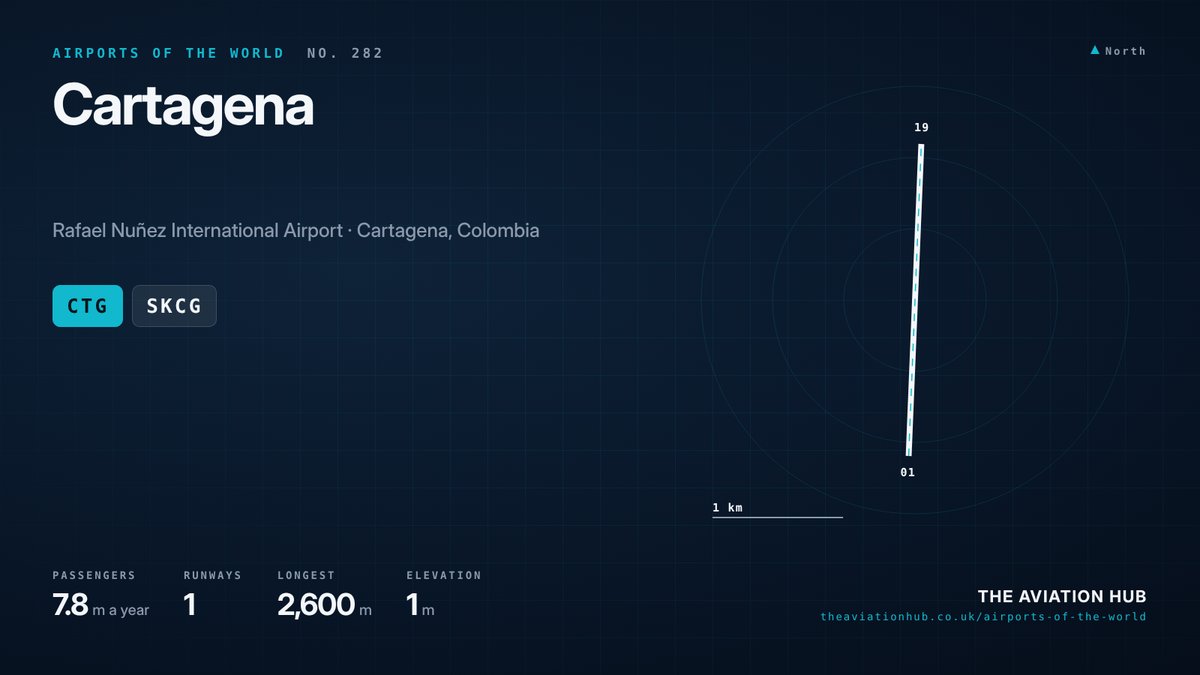
Rafael Nunez International Airport serves Cartagena, the walled colonial port on Colombia’s Caribbean coast and one of the most visited cities in South America. Cartagena Airport handles close to eight million passengers a year, a figure that has grown fast on the back of tourism and a widening spread of flights from North America and Europe. It lies in the Crespo district, squeezed between the sea and a coastal lagoon, barely 3 miles (5 km) from the old town. Few airports of its size sit so close to the places their passengers want to reach.
Cartagena Airport at a Glance
The IATA code is CTG and the ICAO code is SKCG. The field occupies a strip of land in the northern suburb of Crespo, with the Caribbean on one side and the Cienaga de la Virgen marsh on the other. The reference elevation is just 1 metre (4 ft), which makes it one of the lowest lying airports in the country. The centre of Cartagena is about 3 miles (5 km) away, and the beach hotels of Bocagrande are only a little further.
There is one runway and a single passenger terminal split into domestic and international halves. Traffic in recent years has climbed to around 7.8 million passengers, up from roughly 5.5 million in 2018. Avianca is the largest airline and treats the airport as a hub for its Caribbean coast network, with LATAM Colombia, Wingo and Copa Airlines also prominent. Since March 2024 the airport has been run by OINAC S.A. under a ten year concession that includes a programme of expansion. Live flight information is on the airport’s official website.
How Cartagena’s Airport Came to Be
Commercial flying in Cartagena dates back to the era of the flying boats, which used the harbour before a land airport existed. The current site at Crespo later took over as the city’s airport, and it has stayed there ever since despite decades of talk about relocating. The airport takes its name from Rafael Nunez, the Cartagena born lawyer and poet who served several terms as president of Colombia in the nineteenth century and wrote the words of the national anthem.
Growth was slow for much of the twentieth century, with Colombian aviation revolving around Bogota. The turning point came in the 1990s and 2000s, when the restored old town became a major tourist draw and international carriers started to arrive. A concession to the private operator SACSA in 1996 brought terminal upgrades. The 2024 handover to OINAC set the stage for the next phase of growth.
Runways at Cartagena Airport
Cartagena Airport has one runway, 01/19, which is 2,600 metres (8,530 ft) long with an asphalt surface. It runs roughly north to south along the coast. The length is adequate for Airbus A320 family and Boeing 737 operations to anywhere in the Americas, and it has handled Boeing 787s and Airbus A330s on flights to Europe, though wide bodies heading across the Atlantic can be weight limited on hot afternoons.
The site is tight. The runway is hemmed in by the sea to the west, housing to the south and marsh to the east, so there is no room for a parallel strip or a meaningful extension. The approach to runway 01 comes in from the south low over the buildings of Crespo, and only that end has an instrument landing system. Runway 19 arrivals come in from the north using satellite guidance. The airport’s worst accident came in January 1995, when an Intercontinental de Aviacion Douglas DC-9 crashed into marshland on approach from Bogota after a series of instrument failures and crew errors. Fifty one of the 52 people aboard died.
Terminals and Airlines
The terminal is one building with separate domestic and international wings linked by a central hall. The domestic side of Cartagena Airport is the busier of the two by a wide margin, handling the Avianca and LATAM shuttles to Bogota and Medellin alongside the low cost flights of Wingo and JetSmart. Clic is adding regional routes from December 2026.
The international wing serves a diverse list of carriers for an airport of this size. Copa Airlines links the city to its Panama City hub several times a day. From the United States come American Airlines, Delta and JetBlue, with United and Frontier joining in December 2026. Air Canada and Air Transat fly from Canada, KLM links Cartagena with Amsterdam on a route that also serves Bogota, and World2Fly serves Madrid. Avianca and Copa are both Star Alliance members, so the airport has a strong Star flavour.
Routes and Destinations
Bogota is the dominant route from Cartagena Airport by a long way, carrying well over two million passengers a year and served from early morning to late evening by Avianca, LATAM and the low cost carriers. Medellin is the second busiest domestic link, followed by Cali, the island of San Andres, Pereira and Bucaramanga. The domestic market is highly competitive.
Internationally, Panama City and Fort Lauderdale were the thickest routes in the last published figures, with New York JFK and Miami close behind. Atlanta, Houston, Washington Dulles and Orlando have joined or are joining the map, reflecting how many American tourists now choose Cartagena. The longest routes are the seasonal European services of Neos to Milan and Edelweiss to Zurich, at roughly 5,400 miles (8,700 km). KLM’s Amsterdam flight continues to Bogota but cannot carry local traffic between the two Colombian cities. Lima, Mexico City, Toronto and Montreal round out the schedule, and Buenos Aires is due in 2027. Cargo is minor at around 7,000 tonnes a year.
Getting to and from Cartagena Airport
The great advantage of Cartagena Airport is proximity. A taxi to the walled city takes around 15 minutes and costs a fixed rate set by the city, in the region of COP 15,000 to 20,000 (roughly £3 to £4). The fare to Bocagrande is a little more. Prices are posted at the rank and it pays to confirm the figure before setting off. Ride hailing apps operate in a legal grey area in Colombia but are widely used and pick up outside the terminal.
Public buses run along the coastal road past the airport entrance into the centre and are extremely cheap, though slow and awkward with luggage. There is no rail of any kind. Most visitors never need a hire car since the city is best explored on foot. Short and long stay parking sits in front of the terminal, but space is limited at peak holiday times.
Spotting and Photography
Cartagena Airport can reward spotters because the runway runs close to the coast, with the beach and the coastal road on its western side. At the southern end, aircraft on approach to runway 01 pass low over the houses of Crespo. The view from the seaward side is open and the light is good in the afternoon, when the sun is behind the camera.
Runway 01, the end with the instrument landing system, is often in use, with arrivals over Crespo and departures climbing out to the north. Expect a steady stream of A320 family and 737 traffic, with Copa 737 MAXs, JetBlue A321s and the occasional KLM or Neos wide body adding variety. The beach is public, but the airport fence is not, and police patrol the area. Keep a respectful distance and be ready to explain what you are doing in Spanish.
What Comes Next
The OINAC contract covers both running and expanding the airport, and more space is needed to relieve the congestion that builds up in the winter high season. Beyond that, the Colombian government has long discussed a brand new airport at Bayunca, north of the city, which would free the Crespo site for redevelopment. Progress on that project has been slow and no opening date is fixed.
In the meantime the runway, the coastal site and noise over Crespo set a ceiling on how much more Cartagena Airport can grow. The direction of travel is clear enough: more North American routes and a terminal that has to work harder every year. You can compare it with the rest of the continent on the Airports of the World map.
Continue to follow The Aviation Hub for more analysis and insight.
Advertise with us Your brand, in front of an aviation audience Home page and in-article placements, sold directly, one advertiser per slot. From £250 a year. See the rates

