
Casablanca Airport Guide: Royal Air Maroc’s African Hub
Casablanca Airport is Royal Air Maroc's hub and Morocco's main gateway. Read about its wartime origins, twin runways, airlines, rail link and expansion.
 By The Aviation Hub
6 min read
Updated October 20, 2026
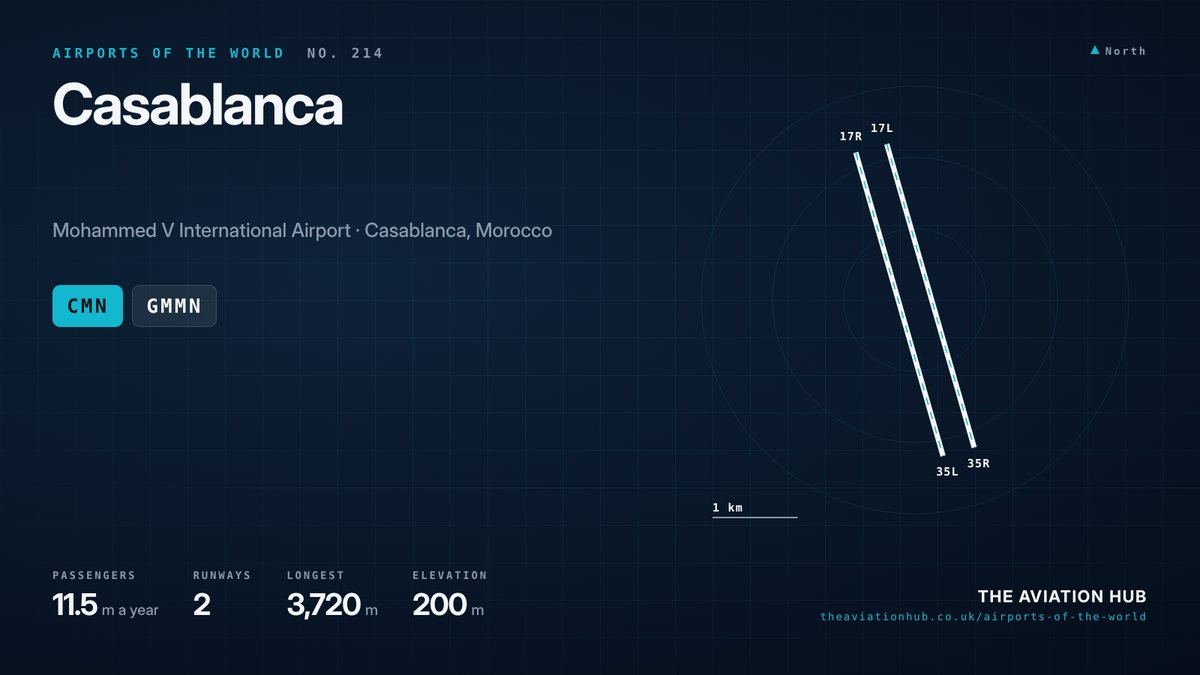
Mohammed V International Airport is Morocco’s main gateway and the hub that links much of West Africa with Europe and the Americas. Casablanca Airport handled around 11.5 million passengers in its latest year, recovering strongly from the pandemic. Royal Air Maroc runs its network from here, feeding flights from Dakar, Abidjan and Lagos onto services to Paris, New York and Sao Paulo. With the 2030 FIFA World Cup on the way, a major rebuild has already begun.
Casablanca Airport at a Glance
The IATA code is CMN and the ICAO code is GMMN. The airport sits near Nouasseur, about 19 miles (30 km) south of central Casablanca, on the flat Chaouia plain. Elevation is 656 ft (200 m). There are two parallel runways and two main passenger terminals, Terminal 1 and Terminal 2.
Traffic reached about 10.4 million passengers in 2024 and rose to roughly 11.5 million in the latest count. Royal Air Maroc, its regional arm Royal Air Maroc Express and the low cost carrier Air Arabia Maroc all have their hub here. The Office National des Aeroports, the state airport authority, operates the field. Flight information and terminal guides are on the airport’s official website.
How Casablanca’s Airport Came to Be
The United States Army built the airfield in early 1943, after the Allied landings of Operation Torch brought American forces to Morocco. It was first called Berrechid Airfield and served as an auxiliary to Casablanca’s Anfa airport. The site passed to the civil government in 1945.
The Americans returned in the 1950s. Nouasseur Air Base hosted Strategic Air Command Boeing B-47 bombers during the early Cold War, a strategic outpost on the edge of the Atlantic. After independence in 1956, Morocco asked the Americans to leave, and the military presence ended by 1963.
The airport then became the country’s civil gateway and took the name of King Mohammed V, who led Morocco to independence. Anfa, closer to the city, gradually lost its airline role. The worst accident came on 1 April 1970, when a Royal Air Maroc Caravelle broke up on approach, killing 61 of the 82 people aboard.
Runways at Casablanca Airport
The two parallel runways, 17L/35R and 17R/35L, are identical in length at 3,720 m (12,205 ft). Both are asphalt and 45 m wide. They give ample room for fully loaded Boeing 787-9 departures to North and South America.
The runways run roughly north to south, and the prevailing northerly winds off the Atlantic favour the 35 direction for much of the year. Arrivals then approach from the south over open farmland, while departures climb out towards the city. Winter storms from the west and south west occasionally reverse the flow.
Royal Air Maroc schedules its African and long haul flights in connecting banks, so traffic arrives in short, intense peaks rather than a steady flow. A third parallel runway of about 3,700 m is part of the expansion now under way at Casablanca Airport.
Terminals and Airlines
Terminal 1 and Terminal 2 at Casablanca Airport sit side by side. Together they offer capacity for roughly 15 million passengers a year, which the airport is approaching. Transfer passengers make up a large share of the traffic, so connection flows matter as much as check in.
Royal Air Maroc, a oneworld member since 2020, dominates the schedule. Its fleet includes Boeing 787-8s and 787-9s for long haul, Boeing 737-800s and 737 MAX 8s for Europe and Africa, and Embraer and ATR aircraft on regional routes. Air Arabia Maroc adds low cost flights to Europe.
Foreign carriers include Air France, Emirates, Lufthansa, Qatar Airways, Turkish Airlines, Saudia and several African airlines. The Gulf and Turkish carriers compete directly with Royal Air Maroc for traffic between Africa and the rest of the world.
Routes and Destinations
France is the largest market, with Paris served at both Orly and Charles de Gaulle. Spain, Italy, Belgium and the Netherlands follow, reflecting large Moroccan communities across Europe. Domestic links to Marrakech, Agadir, Tangier, Dakhla and Laayoune feed the hub.
The African network is the airport’s distinctive strength. Royal Air Maroc flies to dozens of cities across West and Central Africa, including Dakar, Abidjan, Bamako, Lagos and Libreville. Many passengers connect at Casablanca Airport onwards to Europe, the Gulf or North America.
Long haul routes reach New York JFK, Washington Dulles, Miami, Los Angeles, Montreal, Toronto and Sao Paulo. Royal Air Maroc’s Beijing Daxing service, at around 6,250 miles (10,100 km), is among the longest, and Shanghai Airlines links the city with Shanghai. Traffic peaks in summer, when Moroccans living abroad return home, and around Ramadan and Eid.
Getting to and from Casablanca Airport
The Al Bidaoui train, run by the national railway ONCF, leaves from a station beneath the terminals. Trains run hourly from about 04:00 to 23:00 and reach Casa Voyageurs and Casa Port in around 35 to 45 minutes. It is the cheapest sensible option, with a second class fare of around 50 dirhams (about £4).
By road, motorways link Casablanca Airport with the city centre, with Rabat to the north east and with Marrakech to the south. A grand taxi to the city costs roughly 300 dirhams (about £24) and takes 40 minutes or more depending on traffic. Agree the fare before departure. Car rental desks and parking are available beside both terminals.
Spotting and Photography
Casablanca Airport offers a traffic mix rarely seen together in Europe. Royal Air Maroc 787s and 737 MAX jets share the ramp with African carriers, Gulf wide bodies and the occasional charter from the Sahel. Morning arrivals from North America and late evening African departures give the busiest periods.
The terminal windows and the departure lounges provide the safest views. The surrounding farmland is open, but there are no formal viewing areas.
Morocco takes airport security very seriously. Photography near fences, gates and police posts can lead to questioning or confiscated cameras, so keep lenses inside the terminal and follow any instruction from staff.
What Comes Next
A transformation is under way. In May 2025 the airport authority launched a tender for a new H shaped hub terminal costing about 1.6 billion dollars. It will raise capacity from roughly 15 million to 35 million passengers a year. Completion is targeted for 2029, ahead of the 2030 World Cup that Morocco will co host with Spain and Portugal.
The project also includes the new parallel runway, longer taxiways, a 42 m control tower and a high speed rail station on the Al Boraq line. Earthworks began in mid 2025. Royal Air Maroc is planning a large fleet expansion to match.
Casablanca Airport is heading for a decisive decade as Morocco bids to become Africa’s main air crossroads. See it alongside other African hubs on the Airports of the World map.
Continue to follow The Aviation Hub for more analysis and insight.
Advertise with us Your brand, in front of an aviation audience Home page and in-article placements, sold directly, one advertiser per slot. From £250 a year. See the rates

