
Cebu Airport Guide: Mactan’s Gateway to the Visayas
Cebu Airport on Mactan Island is the gateway to the central Philippines. Discover its history, two runways, terminals, routes, transport and spotting.
 By The Aviation Hub
6 min read
Updated October 20, 2026
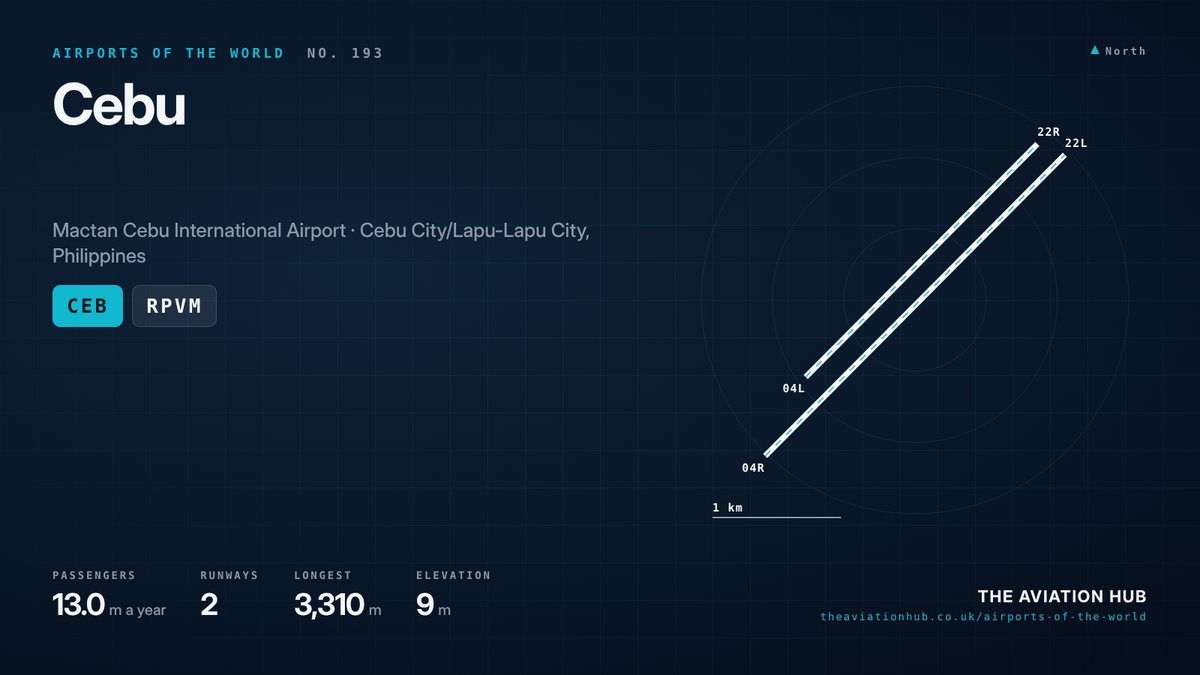
Cebu Airport, officially Mactan Cebu International Airport, is the main airport for the Visayas and the country’s second gateway after Manila. It stands on Mactan Island, across a narrow channel from Cebu City. Roughly 12 million passengers pass through in a typical recent year, a mix of domestic travellers, overseas workers and beach tourists. Its timber roofed international terminal and new second runway make it one of the more modern airports in the country.
Cebu Airport at a Glance
The IATA code is CEB and the ICAO code is RPVM. The terminals are roughly 9 miles (15 km) by road from downtown Cebu City, across one of the bridges linking Mactan with the mainland. Elevation is 9 metres (31 feet). There are two parallel runways and two passenger terminals, with Terminal 1 for domestic flights and Terminal 2 for international services.
Cebu Airport handled more than 11.6 million passengers in the latest full year reported, and traffic continues to grow. Philippine Airlines and PAL Express run a hub here, while Cebu Pacific, Cebgo, Philippines AirAsia and Sunlight Air keep bases. The Mactan Cebu International Airport Authority owns the site, and Aboitiz InfraCapital has operated it since fully taking over the concession in October 2024. Flight schedules are on the airport’s official website.
A Short History of Mactan
Cebu’s first airport was at Lahug, on the edge of the city, and by the 1960s it could not be extended. The answer lay on Mactan, where the United States had built a long runway in 1956. It served as an emergency field for Strategic Air Command bombers and was known as Mactan Air Base. American C-130 transports later flew from it during the Vietnam War era.
Domestic airline flights moved to Mactan on 27 April 1966, and Lahug closed. International charters followed in 1978. A 1990 law created the airport authority, and the terminal now known as Terminal 1 opened the same year. Passenger numbers passed 10 million by 2017, by which time the old building was badly overcrowded.
Privatisation changed the pace. A consortium of GMR and Megawide won the concession in April 2014 and took over that November. It built Terminal 2, which opened on 1 July 2018, and renovated Terminal 1 by January 2020. Aboitiz bought into the operator in 2022 and became sole owner in 2024.
Runways at Cebu Airport
Cebu Airport has two parallel runways. The main runway, 04R/22L, is 3,310 metres (10,860 feet) long and 45 metres wide with an asphalt surface. It is the original 1956 strip and handles all wide body traffic. Runway 04L/22R is newer, 2,560 metres (8,399 feet) long, 45 metres wide and built in concrete.
Work on the second runway began in January 2020. It was finished in January 2024 but stayed closed for a year, and it was inaugurated on 30 January 2025. It serves mainly as a backup when the main runway is closed, and it gave the Philippines its only pair of parallel runways. A second parallel taxiway and a larger apron opened in May 2021.
The northeast monsoon from November to April favours runway 04, while the southwest monsoon brings more use of runway 22. Storms are the main hazard. On 23 October 2022, Korean Air Flight 631, an Airbus A330-300, overran the runway in heavy rain. Nobody died, but the aircraft was written off.
Terminals and Airlines
Terminal 2 is the showpiece. Opened in 2018, it covers about 65,500 square metres and uses sweeping laminated timber arches that give it a resort feel. It has seven air bridges and capacity for around 8 million passengers a year. Terminal 1, rebuilt inside for domestic flights, can handle around 11.7 million passengers and has six air bridges plus remote stands.
Cebu Pacific dominates with its Airbus A320neo, A321neo and ATR 72 fleet. Philippine Airlines and its regional arm PAL Express fly Airbus A321neo, A320 and De Havilland Canada Dash 8-400 aircraft. Philippines AirAsia and Sunlight Air add further domestic capacity. Foreign carriers at Cebu Airport include Korean Air, Jeju Air, Jin Air, Air Busan, Cathay Pacific, Singapore Airlines, Scoot, EVA Air, Emirates and United.
Routes and Destinations
Manila is the busiest route by far, served many times a day by Cebu Pacific, Philippine Airlines and AirAsia. Davao, Cagayan de Oro, Iloilo, Bacolod, Puerto Princesa, Clark and Siargao complete the core domestic network. Cebu works as a secondary hub that links Mindanao and the smaller Visayan islands without a trip through Manila.
South Korea is the largest international market. Seoul Incheon and Busan see several daily flights, driven by Korean holidaymakers heading to the Mactan resorts. Hong Kong, Singapore, Tokyo, Osaka, Taipei and Bangkok are also well served, and Chinese routes are rebuilding. Philippine Airlines flew to Los Angeles from March 2016 to May 2017, the longest route the airport has seen. Peak seasons fall around Christmas, Lunar New Year and the Korean summer holidays.
Getting to and from Cebu Airport
There is no rail link to Cebu Airport. Road access depends on the bridges between Mactan and Cebu. The two older bridges reach Mandaue, while the Cebu Cordova Link Expressway, opened in 2022, runs from southern Mactan towards the south of Cebu City. Journeys to the city take 30 to 60 minutes, and much longer in rush hour.
White metered taxis are the cheapest door to door choice, while yellow airport taxis charge a higher flag fall. Grab ride hailing is widely used. MyBus runs from the terminals to the SM City Cebu mall, which is the cheapest sensible option for travellers heading into the city. Resorts on Mactan’s east coast usually arrange transfers of 15 to 30 minutes. Parking is available beside both terminals.
Spotting and Photography
The Terminal 2 departure gates give good views of the international apron and the main runway. Outside, side streets and open ground around the perimeter on Mactan offer glimpses of aircraft on short final, especially from the southwest when runway 04 is active. A Korean Air or Emirates wide body in the morning light is a typical prize.
The Philippine Air Force’s base shares the airfield, and the military side must not be photographed. On 12 November 2013 the Antonov An-225 landed here with a 150 ton power plant transformer, drawing crowds to the fences. Stay on public land, avoid restricted areas and follow instructions from security staff. Respect local rules at all times.
What Comes Next
The second runway gives Cebu Airport room to grow for years, but terminal capacity will tighten first. A third terminal was proposed in 2019, and Aboitiz InfraCapital is expected to set out its own development plans after taking full control. Better road links matter too, since traffic on the bridges is the biggest frustration for passengers.
Tourism to Cebu, Bohol and the wider Visayas keeps rising, and Cebu Pacific continues to grow its fleet. Cebu Airport is heading towards a larger role as the main alternative to congested Manila. Compare it with other Southeast Asian gateways on the Airports of the World map.
Continue to follow The Aviation Hub for more analysis and insight.
Advertise with us Your brand, in front of an aviation audience Home page and in-article placements, sold directly, one advertiser per slot. From £250 a year. See the rates

