The CFM RISE open fan programme has reached a point that few propulsion projects achieve within four years of launch: a dedicated flying testbed is being prepared, ground testing is imminent, and a commercial entry-into-service target of around 2035 is in place. What it does not yet have is an aircraft to go on. That gap, between a maturing engine architecture and the absence of a launched narrowbody programme to carry it, is the central question the RISE programme now poses to the industry.

What the CFM RISE Open Fan Architecture Actually Does
What sets the CFM RISE apart from every turbofan in service today is the absence of a nacelle around the fan. Aeronautics Magazine reports that the architecture features variable-pitch carbon-fibre composite blades on a single front rotor that rotates freely, paired with stationary outlet guide vanes. Because no nacelle limits the fan diameter, the rotor can be scaled up considerably relative to the core, and it is that enlarged ratio which delivers the efficiency improvements.
One direct result of that enlarged rotor is a profound shift in bypass ratio, the share of intake air routed around the core rather than through it. Aeronautics Magazine notes that CFM believes the design could reach a bypass ratio of more than 70:1, compared with approximately 11:1 on the current LEAP family. The RISE programme, developed by GE Aerospace and Safran Aircraft Engines through their equal-share venture CFM International, is targeting fuel burn reductions in excess of 20% over today's generation of engines. Our earlier article on Safran's LEAP engine ramp-up targets explains what that production baseline currently looks like.
GE Aerospace's Arjan Hegeman, who leads Future of Flight Engineering as Vice President, has addressed the novelty of the concept while making the case for its underlying maturity: "While Open Fan is a new architecture, the technologies inside have been proven over decades of innovation."
The A380 as a Flying Laboratory
The RISE programme was launched by CFM in June 2021, and the choice of flying testbed speaks to both the scale of the undertaking and the technical complexity of evaluating an unconventional propulsor in real flight conditions. As Aeronautics Magazine reported, Airbus and CFM formalised their agreement to conduct a flight-test demonstration on 19 July 2022 at that year's Farnborough Airshow.
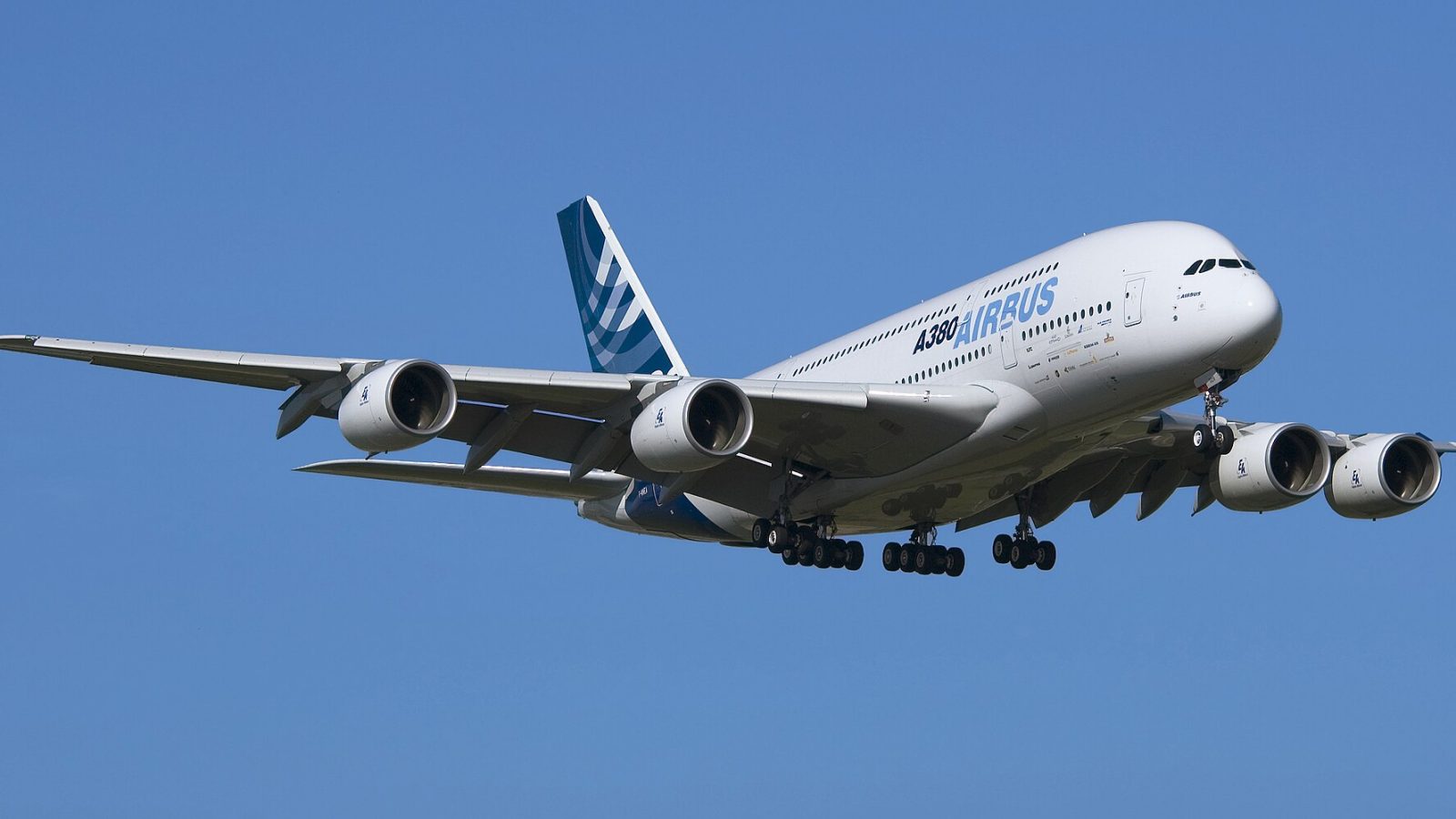
The testbed aircraft is an ex-Malaysia Airlines Airbus A380. Air Data News reports that the airframe carries the manufacturer's serial number MSN114, which completed its maiden flight in October 2012 and entered service with Malaysia Airlines under the registration 9M-MNF in 2013. The jet has since been repainted in an Airbus FlightLab scheme, with Air Data News reporting that the work took place at Shannon in Ireland before the aircraft departed for France and subsequently Tarbes.
The A380's four-engine layout is central to the programme's safety case. As Air Data News, Aeronautics Magazine and Simple Flying all note, the demonstrator can fly with the open fan mounted on one position while three conventional engines remain fully operational, removing any dependency on the new propulsor for continued safe flight. Major modifications to the aircraft for propulsion testing are expected to begin in 2027, with flight testing of the open fan demonstrator on the A380 targeted for 2029, or 2029 to 2030 depending on the source. Readers can follow the specific aircraft through our Aircraft Search tool.
Beyond the Testbed: The Singapore Airport Initiative
Ground-based infrastructure is being developed alongside the flight-test campaign. Simple Flying reports that an agreement between CFM International, Airbus and Singapore's Civil Aviation Authority (CAAS), revealed at the Changi Aviation Summit, will establish what the partners describe as the world's first airport-based testbed for next-generation propulsion technologies.
Han Kok Juan, Director-General of CAAS, said: "CFM International's and Airbus's partnership with CAAS to establish in Singapore the world's first airport testbed for next generation propulsion technologies is testament to Singapore's offering as an integrated air hub."
The airport testbed adds a dimension that a conventional ground-test cell cannot easily replicate: real-world operational conditions, including the acoustic and emissions environment that regulators and communities will ultimately judge the technology against.
What 2035 Actually Requires
Commercial entry into service is targeted for around 2035, which from today represents roughly a decade of further development, certification, industrial scale-up and integration. The engine demonstrator programme, with ground testing ahead and flight tests from 2029, fits plausibly within that timeline if no major technical obstacles emerge.
The harder constraint is structural. An open fan of this bypass ratio requires an aircraft designed around it: the fan diameter, the ground clearance needed, the pylon geometry and the aerodynamic interaction between the exposed rotor and the wing all depend on a specific airframe. No manufacturer has yet launched a new narrowbody that would carry the technology into service. The RISE programme can produce a certified engine; without a launched airframe programme, there is nothing to certify it on.
Airbus Chief Technical Officer Sabine Klauke has set out the wider ambition in clear terms: "New propulsion technologies will play an important role in achieving aviation's net-zero objectives, along with new aircraft designs and sustainable energy sources." The choice of words is intentional: propulsion and airframe are positioned as interdependent, because neither will reach service without the progress of the other.
The RISE programme sits inside the industry's wider push toward net-zero aviation, which we have covered across multiple fronts, including what the end of four-engine widebody operations means as twin-engine alternatives take over. Open fan is in many respects the most aggressive technical answer to the efficiency question for short and medium-haul flying, the segment responsible for a large share of commercial aviation's fuel burn.
The Bottom Line
The CFM RISE open fan programme is, by the evidence available, progressing as planned. A dedicated A380 testbed is being prepared, ground testing is approaching, and a Singapore airport testbed adds real-world validation to the laboratory work. The 2035 service entry target is credible on the engine side, provided the flight-test programme from 2029 onwards confirms what bench testing has suggested.
The binding constraint is not the engine. It is the absence of a narrowbody airframe programme that has committed to the architecture. Until an airframer launches a new short-haul aircraft designed to accept an open fan, the technology will be ready before the plane that needs it. That is the question the next few years must answer.
This article draws on reporting by Air Data News, Aeronautics Magazine and Simple Flying.
Continue to follow The Aviation Hub for more analysis and insight.
Advertise with us Your brand, in front of an aviation audience Home page and in-article placements, sold directly, one advertiser per slot. From £250 a year. See the rates