
Changchun Airport Guide: Jilin’s Gateway in the Snow
Changchun Airport at Longjia serves the capital of Jilin province in north east China. Runway, terminals, China Southern routes and rail access explained.
 By The Aviation Hub
6 min read
Updated October 20, 2026
Changchun Longjia International Airport is the main gateway to Jilin province in the far north east of China, a region of bitter winters, car factories and ski resorts. It sits on open farmland at Longjia, midway between the provincial capital Changchun and the city of Jilin, and the two cities share responsibility for running it. Changchun Airport handled close to 18 million passengers in 2025, which puts it among the busiest airports in China’s north east alongside Harbin, Shenyang and Dalian.
Changchun Airport at a Glance
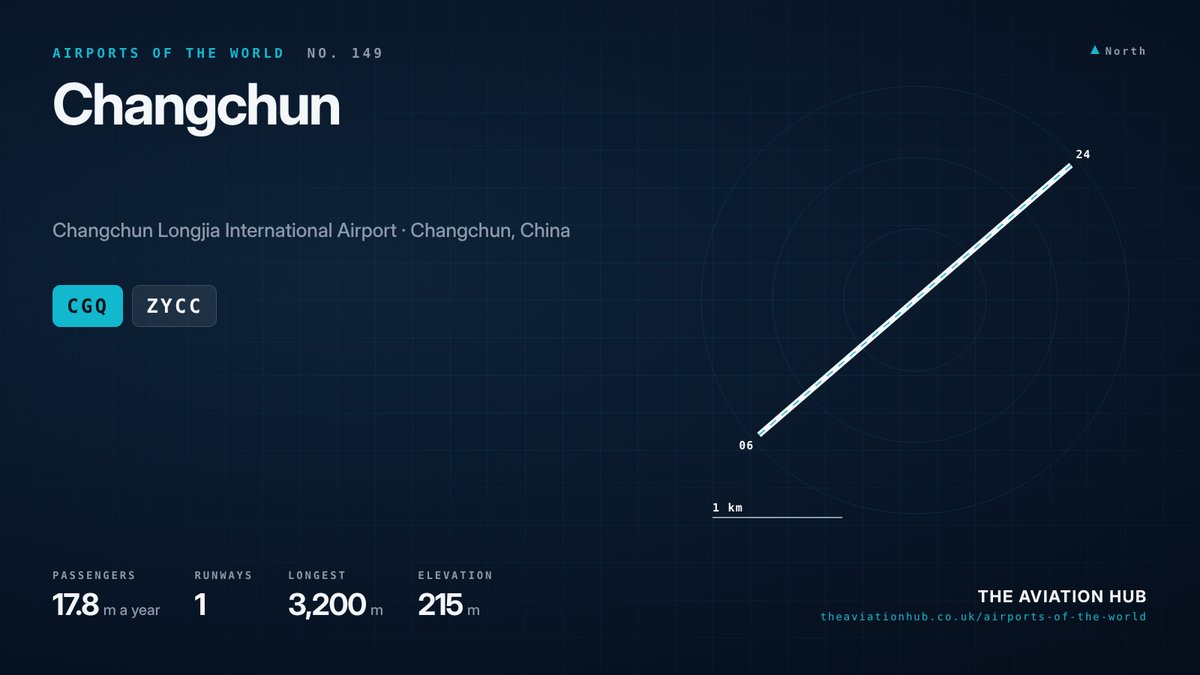
The IATA code is CGQ and the ICAO code is ZYCC. The airport lies about 19 miles (31 km) north east of central Changchun and around 47 miles (76 km) north west of Jilin City, at an elevation of 215 m (706 ft). There is one runway. The terminal complex has grown in stages since opening, with an expansion completed in 2011 and a larger Terminal 2 now handling most of the traffic.
Changchun Airport handled roughly 17.8 million passengers in 2025, with around 118,000 aircraft movements and about 106,000 tonnes of cargo. China Southern Airlines uses it as a regional hub, and China Eastern, Air China, Shanghai Airlines, Spring Airlines, Qingdao Airlines and Loong Air are regular operators. The airport is run by the Jilin Province Civil Aviation Airport Group, a state owned body. Timetables and ground transport details are on the airport’s official website.
How Changchun’s Airport Came to Be
For most of the twentieth century Changchun’s flights used Dafangshen Airport, a dual use military and civil field on the western edge of the city. Dafangshen dated from the Manchukuo era and was never suited to the jet age, hemmed in by urban development and shared with the air force. The central government approved a replacement in 1998, and construction began at Longjia on 29 May 2003.
The new airport opened on 27 August 2005, taking its name from the town of Longjia where it was built. Dafangshen reverted to military use. The site was chosen because it sits between Changchun and Jilin, the province’s two largest cities, so one airport could serve both. Traffic grew faster than planners had expected, and the field passed the 6.5 million passengers forecast for 2015 two years early.
A first expansion ran from 2009 to May 2011, adding two jet bridge gates to the international section and enlarging the apron so wide body aircraft such as the Boeing 747 could be handled. The intercity railway station beneath the terminal opened in the same period. The second terminal that followed was the real step change, lifting the airport into the ranks of China’s mid sized hubs.
Runways at Changchun Airport
Changchun Airport operates a single concrete runway, 06/24, which is 3,200 m (10,500 ft) long and 45 m wide. It runs north east to south west across flat land with no significant terrain nearby, and the length is ample for the Airbus A320 family and Boeing 737 aircraft that dominate the schedule. The concrete surface is a sensible choice in a climate where winter temperatures regularly drop below minus 20 degrees Celsius.
Winter is the operational challenge. Snow clearance crews work through the season, and de icing queues can stretch departures on the heaviest days. Prevailing winds favour runway 24 in summer and runway 06 when the cold northerlies arrive. A single runway handling around 118,000 movements a year leaves little slack at peak times, which is why a second runway features in the long term plan.
Terminals and Airlines
Terminal 2 at Changchun Airport is the main passenger building and handles the large domestic airlines. China Southern is the biggest operator, with a locally based fleet of Airbus A320neo and A321neo aircraft and Boeing 737-800s connecting Changchun to its hubs at Guangzhou, Beijing Daxing and Shenyang. China Eastern and Shanghai Airlines feed Shanghai, and Air China serves Beijing Capital, Chengdu and Hangzhou. Spring Airlines, Loong Air and Qingdao Airlines add low cost and regional competition.
International flights use a dedicated section with the jet bridge gates added in 2011. Asiana Airlines flies from Seoul Incheon, and Chinese carriers operate to Bangkok, Kuala Lumpur, Hong Kong and Vladivostok. Air China launched a Frankfurt service in 2021, the airport’s only European link, though its operation has been intermittent. Alliance wise, China Southern now sits outside the alliances, China Eastern is SkyTeam and Air China and Asiana are Star Alliance members.
Routes and Destinations
Beijing, Shanghai, Guangzhou and Shenzhen are the trunk routes, flown many times a day with a mix of A320neo, A321neo and 737 aircraft. Qingdao, Hangzhou, Nanjing, Chengdu and Xi’an are the next tier. The schedule is heavily domestic, and much of the traffic is business travel linked to the FAW car group and its joint ventures with Volkswagen, Audi and Toyota, which are headquartered in Changchun.
The tourist pattern is unusual. Summer brings visitors escaping the heat of southern China for the cool north east, while winter brings skiers and ice festival tourists heading for the resorts around Jilin and Changbai Mountain. The longest route is Air China’s intermittent Frankfurt service at roughly 4,900 miles (7,900 km), with Kuala Lumpur and Bangkok the longest in Asia. Cargo of about 106,000 tonnes a year is significant for the region, much of it automotive parts and agricultural produce.
Getting to and from Changchun Airport
The railway is the smart way to reach Changchun Airport. Longjia railway station sits in the basement of the terminal on the Changchun to Jilin intercity line, and trains reach Changchun railway station in roughly 15 to 20 minutes and Jilin in about 40 minutes. Fares are low, typically under CNY 20 (about £2) to Changchun, which makes the train the cheapest sensible option by a wide margin.
Airport coaches run throughout the day from the terminal to Quan’an Square, Renmin Square and Weixing Square in Changchun, and to Jiangcheng Square in Jilin, with departures timed from the first flight to the last arrival. A taxi to central Changchun takes 40 to 50 minutes on the airport expressway and costs roughly CNY 100 to 130 (about £11 to £14). Line 9 of the Changchun metro is planned to reach the airport. Parking is in surface lots and a garage in front of the terminals.
Spotting and Photography
Photography at Chinese airports is restricted outside the terminal, and Changchun is no exception. The gate lounges in Terminal 2 offer wide windows over the apron and the taxiways beyond. The international gates face stands where the occasional wide body freighter or Asiana jet parks.
The flat landscape and dry winter air give very clear light, and the snow covered ground from December to March makes for striking images from the windows. Morning light favours views to the west from the terminal. Spotting from roads around the perimeter will attract police attention quickly, so do not attempt it; stay inside the terminal, avoid photographing security staff or military aircraft, and keep any equipment discreet.
What Comes Next
Changchun Airport is approaching the practical limit of a single runway and a terminal complex designed for a smaller city. Provincial planners have set out an expansion built around a new 270,000 square metre Terminal 3, designed by MAD Architects for 22 million passengers a year, with a second runway in the long term plan and the metro extension providing a second rail link. Timescales for Chinese airport projects tend to be short once funding is confirmed, so the next decade should see major construction.
The verdict is steady growth driven by the car industry and by China’s domestic tourism boom, with international expansion limited by geography. Compare it with the rest of the country’s network on our Airports of the World map.
Continue to follow The Aviation Hub for more analysis and insight.
Advertise with us Your brand, in front of an aviation audience Home page and in-article placements, sold directly, one advertiser per slot. From £250 a year. See the rates

