
Changsha Airport Guide: Hunan’s Maglev Linked Hub
Changsha Airport at Huanghua is the gateway to Hunan Province and has a maglev train to the city. Read about its runways, terminals, routes and spotting.
 By The Aviation Hub
6 min read
Updated October 20, 2026
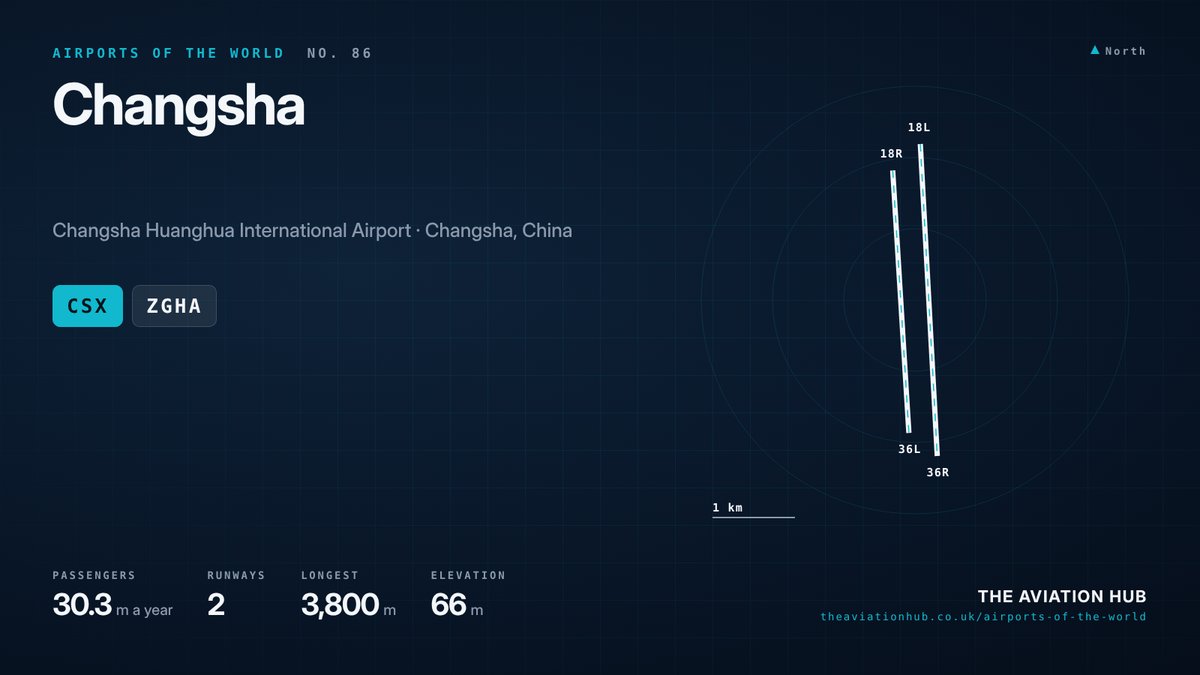
Changsha Huanghua International Airport is the main airport for Hunan Province in south central China. It lies in Huanghua Town, Changsha County, about 16 miles (25 km) east of the city centre, and is one of a handful of airports in the world served by a maglev train. Around 30 million passengers used Changsha Airport in 2025, which ranks it 15th in China. China Southern, Hainan Airlines and Xiamen Airlines all treat it as a focus city, and a huge expansion with a third terminal and a third runway is under way.
Changsha Airport at a Glance
The codes are CSX and ZGHA. The field sits at 217 ft (66 m) above sea level on rolling farmland east of the Liuyang River, 16 miles (25 km) from downtown Changsha and about 10 minutes from Changsha South high speed railway station by maglev. Hunan is a province of 66 million people, and this is its only large airport.
Changsha Airport has two runways and two terminals in use, with a third terminal under construction. Traffic in 2025 was around 30.3 million passengers, down about 3 per cent on the previous year, with roughly 206,000 aircraft movements and 167,000 tonnes of cargo. China Southern is the largest operator by a wide margin. Hunan Airport Group, a provincial state owned company, runs the field. Flight information is on the airport’s official website.
How Changsha’s Airport Came to Be
Changsha flew from Datuopu, a shared military and civil airfield south of the city, from 1957 until the late 1980s. The Hunan government proposed a purpose built civil airport in 1984, chose a site at Huanghua in Changsha County and started construction in June 1986. The new airport opened on 29 August 1989 with a single runway and a modest terminal, and Datuopu reverted to the air force.
The name simply comes from the town, Huanghua, which means yellow flower. For its first two decades the airport grew steadily rather than spectacularly. The first big expansion came between 2008 and 2011, when the original runway was lengthened from 2,600 m to 3,200 m and Terminal 2 was built. Terminal 2 opened on 19 July 2011 with a design capacity of 15.6 million passengers a year.
Terminal 1 then closed for a seven year renovation and reopened on 18 May 2018. China Southern started the first intercontinental route, to Frankfurt, on 23 June 2014. A second runway followed as traffic climbed past 20 million, and the Changsha Maglev Express opened in May 2016.
Runways at Changsha Airport
Runway 18L/36R is the main strip at 3,800 m (12,467 ft) long and 60 m (197 ft) wide, surfaced in concrete, and it suits the wide bodies on the long haul routes. Runway 18R/36L is 3,200 m (10,499 ft) long and 45 m (148 ft) wide with an asphalt surface. It is the lengthened original runway.
The pair run north to south and work as a parallel system. A further runway of 3,600 m is being built as part of the eastern expansion, and the master plan reserves space for a fourth. Together they are meant to support an eventual capacity of 90 million passengers, a figure the operator quotes with some confidence.
Changsha has a humid subtropical climate. Summer thunderstorms and the occasional winter ice storm are the main sources of delay. The 2008 freeze that paralysed southern China shut the airport for days and prompted investment in de icing.
Terminals and Airlines
Terminal 2 is the main building at Changsha Airport, with around 212,000 square metres of floor space, 80 check in desks and 22 air bridge gates. China Southern, China Eastern, Hainan Airlines, Xiamen Airlines, Sichuan Airlines and all international and regional carriers use it. The international pier handles Hong Kong, Macau, Taiwan and overseas flights.
Terminal 1 is smaller at about 39,000 square metres, with 38 check in desks, 10 air bridges and three concourses. Since its 2018 reopening it has taken the smaller domestic operators, including Air China, Shenzhen Airlines, Shandong Airlines, Chengdu Airlines, Tibet Airlines, Kunming Airlines, Okay Airways and Joy Air. The two terminals sit side by side and share the maglev and metro station.
Terminal 3, a much larger building on the east side of the field, is under construction and will become the main terminal when it opens. Terminal 4 is planned alongside it.
Routes and Destinations
Domestic trunk routes carry most of the traffic. Beijing, Shanghai, Guangzhou, Shenzhen, Chengdu, Kunming, Xi’an, Hangzhou and Sanya all see many flights a day, and China Southern connects the province to its Guangzhou hub with shuttle frequencies. Wuhan is close enough by high speed rail that few passengers fly.
International service from Changsha Airport has rebuilt since 2023 and covers Hong Kong, Macau, Seoul Incheon, Nagoya, Bangkok, Singapore, Kuala Lumpur, Yangon and Vientiane. London Heathrow is now the European link, as China Southern’s pioneering Frankfurt route is no longer listed, and a Nairobi route gives Hunan a direct connection to Africa, reflecting the province’s business ties there. London at around 5,600 miles (9,050 km) is the longest route.
Getting to and from Changsha Airport
The Changsha Maglev Express is the star attraction. Running since 6 May 2016, it links the terminals with Changsha South railway station in just over 10 minutes at up to 120 km/h, for a fare of 20 yuan (about £2). Changsha South connects to high speed trains for Guangzhou, Wuhan and Beijing and to the city metro.
Metro Line 6 also serves a station beneath the terminals and runs west across the city for a few yuan. It is the cheapest sensible option. Airport buses run to Changsha South, the South Bus Station and the Civil Aviation Hotel downtown. By road the Airport Expressway reaches the centre in 30 to 45 minutes, and a taxi costs around 100 yuan (£11).
Car parks sit in front of both terminals. A planned Changsha to Ganzhou high speed line will add a mainline rail station at the airport.
Spotting and Photography
Changsha Airport is not a well known spotting location, but it is easy to work. The departure piers of Terminal 2 have long glass walls facing the apron and the parallel runways, and the international pier catches the wide bodies from China Southern and Hainan when they are on stand.
Outside the fence, country roads around the 36 thresholds south of the airport give open views of arrivals when the field lands to the north. Morning light favours the east side and afternoon light the west. Summer haze is heavy, so autumn gives the best conditions.
As at all Chinese airports, security staff may question anyone with a camera near the perimeter. Stay on public roads, carry identification and comply politely. The terminal windows are the safest place to shoot.
What Comes Next
The eastern expansion is one of the largest airport projects in central China. Terminal 3 and the third runway are the first phase, with Terminal 4, a fourth runway and two tunnels linking the eastern and western terminal areas to follow. The operator talks of 90 million passengers a year in the long run, which would put Changsha among the busiest in the country.
The near term picture is quieter. Traffic dipped in 2025 and Shenzhen has overtaken Changsha as the second busiest airport in south central China. The province will need more international routes to fill the new capacity, and the Nairobi and London services show the strategy.
Changsha Airport is building for a future far bigger than its present. See how it sits beside the other Chinese hubs on the Airports of the World map.
Continue to follow The Aviation Hub for more analysis and insight.
Advertise with us Your brand, in front of an aviation audience Home page and in-article placements, sold directly, one advertiser per slot. From £250 a year. See the rates

