
Changzhou Airport Guide: A Naval Field Turned Civil Hub
Changzhou Airport explained: its naval origins, the long runway, airlines, routes across China and Asia, road access and how it competes with rail.
 By The Aviation Hub
5 min read
Updated October 20, 2026
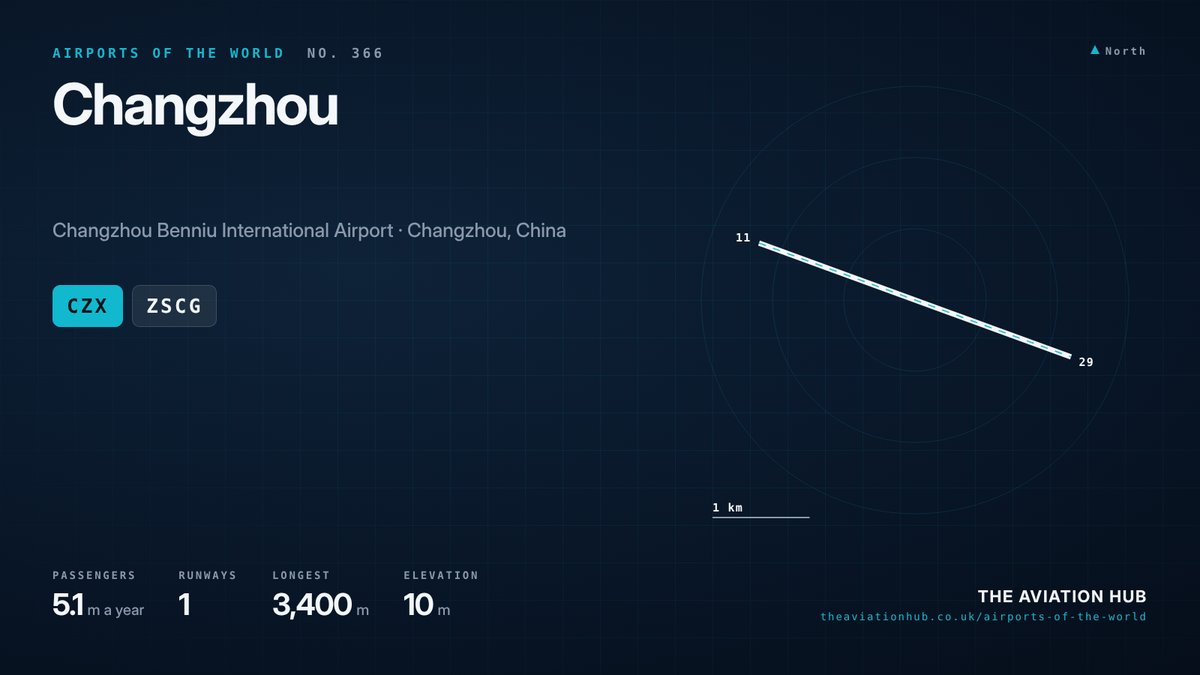
Changzhou Airport serves one of the manufacturing cities of southern Jiangsu, between Nanjing and Shanghai in the Yangtze River Delta. Officially Changzhou Benniu International Airport, it began life as a naval air base and still shares its runway with the military. Traffic passed five million passengers in 2025. That is a solid figure for a city surrounded by larger airports and some of China’s fastest trains.
Changzhou Airport at a Glance
The airport carries the IATA code CZX and the ICAO code ZSCG. It lies about 11 miles (18 km) northwest of downtown Changzhou, on the boundary between Xinbei District and the neighbouring city of Danyang. The elevation is just 33 feet (10 m), typical of the flat delta plain. There is one runway and a single passenger terminal complex.
In 2025 Changzhou Airport handled about 5.14 million passengers, around 49,400 aircraft movements and roughly 23,200 tonnes of cargo. China Eastern offers the widest choice of destinations, with a broad mix of other Chinese carriers filling in the network. Flight schedules and passenger notices are on the airport’s official website.
From Naval Base to Civil Gateway
The airfield was built in 1963 for the aviation arm of the People’s Liberation Army Navy East Sea Fleet. That naval origin remains a distinctive part of its story. For more than two decades the field served purely military needs.
Civil flights began on 15 March 1986, as economic reform turned southern Jiangsu into an industrial powerhouse. The airport takes the name Benniu from the nearby town, while most travellers simply call it by the city name. Growth was gradual at first, held back by competition from bigger airports in Nanjing and Shanghai.
The past decade brought faster growth, as low cost and regional carriers targeted secondary cities. International and regional routes to Hong Kong, Macau and Southeast Asia followed.
Runways at Changzhou Airport
A single concrete runway, 11/29, handles every movement. At 3,400 metres (11,155 feet), it is long enough for large wide body aircraft. The airport holds China’s 4E classification, which covers types up to the size of the Boeing 777 and Airbus A350.
The runway runs roughly east to west. Summer southeasterlies tend to favour runway 11, while northerly winter winds bring more operations onto runway 29. Fog and haze across the delta can reduce visibility in the colder months, and summer thunderstorms cause occasional delays.
Military use continues, so parts of the airfield are closed to the public and some movements are not published. Airline schedules work around the shared operation. With one runway and modest traffic, congestion is rarely a problem.
Terminals and Airlines
Passengers use a single terminal complex for both domestic and international flights. International and regional departures pass through separate immigration and customs areas. The building is compact, and check in to gate times are short by Chinese standards.
China Eastern, part of SkyTeam, has the largest network, serving more than a dozen destinations. Other mainland airline groups and their regional subsidiaries add routes to the south and west of the country. The fleet mix is dominated by the Airbus A320 family and Boeing 737, with occasional regional jets on thinner routes.
Foreign airlines rarely appear at Changzhou Airport. Lao Airlines flies to Vientiane, while HK Express and Air Macau link Hong Kong and Macau, and timetables can change at short notice.
Routes and Destinations
The city sits within easy reach of Shanghai by high speed rail, so Changzhou Airport focuses on longer domestic trips. Beijing, Chengdu, Guangzhou, Kunming, Shenzhen and Xi’an are among the key destinations, all journeys where flying beats the train. Routes to the southwest and northeast are particularly strong.
Regional links reach Hong Kong and Macau, while Vientiane in Laos shows the growing reach into Southeast Asia. Leisure routes to resort destinations tend to grow in winter and during national holidays. Chinese New Year and the October Golden Week bring the biggest peaks.
Cargo topped 23,000 tonnes in 2025, supported by the region’s manufacturers. Most of it travels in the holds of passenger aircraft.
Getting to and from Changzhou Airport
Road is the main option. The airport sits about 2 miles (3 km) from an interchange on the G42 Shanghai to Chengdu Expressway, giving fast links to Changzhou, Danyang, Wuxi and Nanjing. A taxi to the city centre takes around 30 to 40 minutes, depending on traffic.
Airport shuttle buses connect the terminal with central Changzhou and the main railway stations, and they are the cheapest sensible option. There is no direct rail station at the airport. Travellers heading to Shanghai or Nanjing usually take a shuttle to a high speed rail station and continue by train.
Ride hailing apps are widely used, and car parks sit next to the terminal. Allow extra time during holiday peaks, when roads around the city can be busy.
Spotting and Photography
Changzhou Airport offers limited scope for spotting. The airfield is a working military air base, and photographing military aircraft or installations in China can lead to detention and confiscated equipment. Visitors should avoid the perimeter with long lenses altogether.
The terminal windows and the aircraft seat are the safest vantage points. The flat landscape and wide runway make for clean departure shots from the cabin, especially on clear winter days. Airline traffic is mostly narrow body, with China Eastern A320s and 737s the most common sight.
Follow security instructions at once, and never fly a drone near the field. Local rules are strict and enforced without warning.
What Comes Next
Traffic now exceeds five million passengers a year, so terminal capacity is the obvious pressure point. Further expansion of terminal space, aprons and road access would help the airport keep pace with demand. The long runway already has plenty of spare capacity.
Competition will stay fierce. Wuxi lies about 48 miles (78 km) away, Nanjing roughly 68 miles (110 km) and Shanghai Hongqiao about 108 miles (174 km), all linked by fast trains. Changzhou Airport will thrive by sticking to routes the railway cannot match. Compare it with its delta neighbours on the Airports of the World map. The verdict: a busy secondary airport that has carved out a clear role.
Continue to follow The Aviation Hub for more analysis and insight.
Advertise with us Your brand, in front of an aviation audience Home page and in-article placements, sold directly, one advertiser per slot. From £250 a year. See the rates

