
Chania Airport sits on the Akrotiri peninsula, a high rocky headland above Souda Bay on the north coast of western Crete. It is the island’s second airport after Heraklion, and in 2024 it handled close to four million passengers. Most of them are holidaymakers heading for the Venetian harbour at Chania, the lagoons of Balos and Falasarna, or the Samaria Gorge. The runway is shared with the Hellenic Air Force, which gives the field a character unlike most Greek leisure airports.
Chania Airport at a Glance
The codes are CHQ for IATA and LGSA for ICAO. The terminal lies about 9 miles (14 km) north east of Chania city centre, at an elevation of 149 metres (490 feet). There is one runway and one passenger terminal. The full name is Chania International Airport Daskalogiannis, honouring an 18th century Cretan rebel.
Traffic reached 3.95 million passengers in 2024, up just over eight per cent, across about 26,500 aircraft movements. The first ten months of 2025 had already matched that total, and the full year passed four million. Aegean Airlines and Ryanair treat Chania Airport as a focus city, while easyJet, Jet2.com, TUI, Condor and Eurowings fill the summer schedule. Fraport Greece runs the civil side under a 40 year concession, and flight information is on the airport’s official website.
How Chania’s Airport Came to Be
Civil flights in western Crete first used Maleme, the airfield west of the city captured by German paratroopers in May 1941. Airline services stayed there from the end of the Second World War until 1959. They then moved to the military airfield on the Akrotiri plateau above Souda Bay. International flights followed in 1974, as charter operators began bringing Northern Europeans to the island.
The current terminal opened in 1996. It covers 14,650 square metres and was designed for 1.35 million passengers a year, a figure now exceeded almost threefold. In 2000 the airport took the name of Ioannis Daskalogiannis, who led a Sfakian uprising against Ottoman rule in 1770 and was executed the following year.
Privatisation brought the next turning point. Fraport and its Greek partner Copelouzos took over Chania Airport and 13 other regional fields on 11 April 2017. Works finished in June 2018 lifted the gate count from 14 to 16, tripled the duty free space and added security lanes. That same month Air Force One stopped to refuel, carrying Donald Trump from the G7 summit in Quebec to Singapore.
Runways at Chania Airport
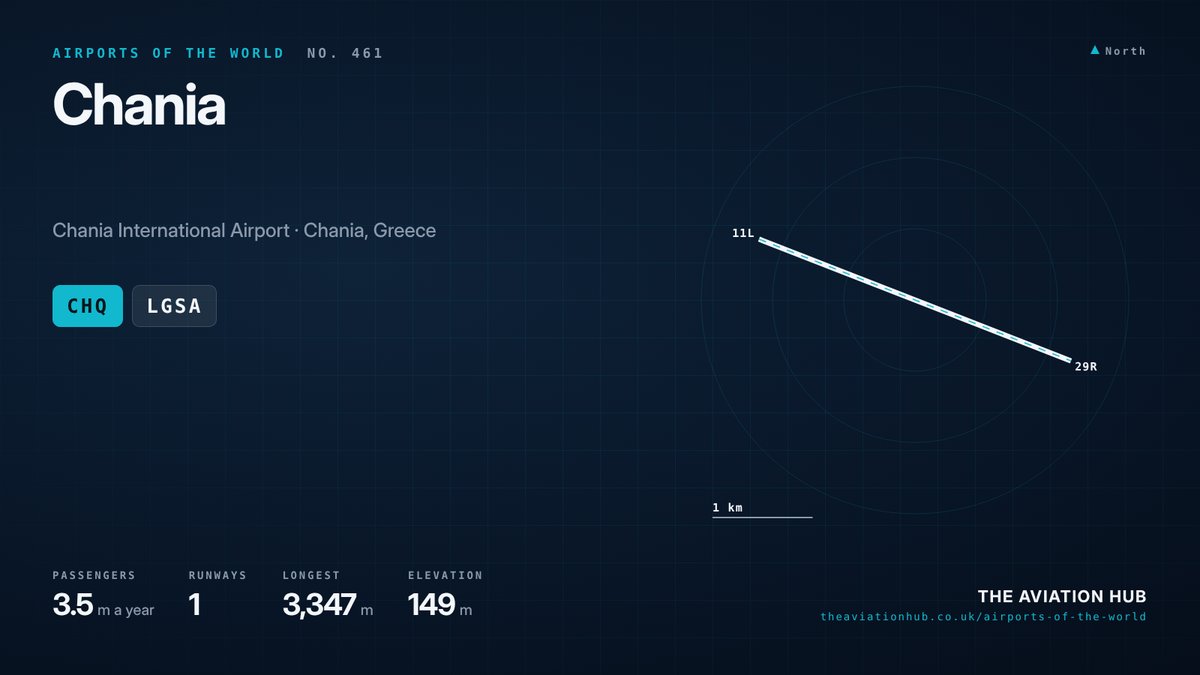
There is a single asphalt runway, 11L/29R, measuring 3,347 metres (10,982 feet) long and 45 metres wide. That is generous for a regional field. Fully loaded charter jets, wide body diversions and heavy military aircraft can all use it without weight restrictions. The runway runs roughly east to west across the flat top of the Akrotiri plateau. The L and R suffixes date from August 2024, when the parallel taxiway to the south was designated 11R/29L so that it can stand in as a runway when the main strip is closed.
The strong northerly summer wind, the meltemi, often brings a crosswind. Gusty afternoons can make for lively landings, and northwesterly winds usually favour runway 29R. The Hellenic Air Force bases its 115 Combat Wing here, flying F-16s, so military movements are slotted between the airliners. The US Navy’s Naval Support Activity Souda Bay also shares the airfield.
Shared use shapes daily life at Chania Airport. Air force exercises can bring short holds for civil traffic, and the military owns much of the land around the runway. The civil operator controls the terminal and apron, not the whole airfield.
Terminals and Airlines
All civil flights use the single terminal, which handles domestic, Schengen and non Schengen traffic. Since the 2018 works it has offered 16 boarding gates and a larger departure lounge. It still feels tight on summer Saturdays, when charter waves from Britain, Germany and Scandinavia arrive within a few hours of each other.
Aegean Airlines provides the domestic backbone, flying year round to Athens and Thessaloniki, with seasonal links to Rhodes. As a Star Alliance member, Aegean also offers onward connections through Athens. Sky Express competes on the Athens route. Ryanair and easyJet run the largest international networks, with seasonal flights to dozens of European cities. Jet2.com and TUI carry British package holidaymakers, and Condor and Eurowings serve the German market.
Routes and Destinations
Athens dominates the domestic market at Chania Airport, which carried around 900,000 domestic passengers in 2024. Thessaloniki is the other key Greek link, and both routes run all year. Everything else is international and heavily seasonal.
The United Kingdom is the largest foreign market, with more than 530,000 passengers in 2024. Germany follows at around 370,000, then Denmark at roughly 330,000. That Danish figure is striking for a country of six million people. It reflects decades of Scandinavian package holidays to the beaches west of Chania.
The season builds from April, peaks between July and September and fades in late October. Many international routes then stop until spring, and winter traffic shrinks to Athens, Thessaloniki and a thin low cost programme. There are no long haul flights, and cargo is minimal.
Getting to and from Chania Airport
Crete has no railway, so the road does all the work. KTEL buses run between the terminal and the main bus station in Chania, taking around 30 minutes for a fare of a few euros. That is the cheapest sensible option. Some services continue along the coast to Rethymno, but timetables thin out in winter and late at night.
Taxis wait outside arrivals and take 20 to 25 minutes to the old town, typically for around €30 to €35 (roughly £26 to £30). The route crosses the Akrotiri peninsula and drops down to the city through the suburbs. Car hire is popular, since the south coast and the far west are hard to reach by bus. Parking sits directly in front of the terminal.
Spotting and Photography
Spotting at Chania Airport needs more care than at most holiday airports, because it is an active military base. Greek law forbids photographing military installations and aircraft, and the authorities enforce it. Point the camera only at airliners, stay in public places and put it away if police or soldiers ask.
Quiet roads across the plateau give views of aircraft on final approach, but much of the perimeter is military land. Saturdays in July and August bring the richest mix, with Jet2 and TUI Boeing 737-800s, easyJet Airbus A320neos, Condor and Eurowings jets and Scandinavian charters. Aegean A320neos and ATR turboprops supply the year round traffic. The flat, open terrain gives clean backgrounds with the White Mountains on the horizon.
What Comes Next
Fraport’s concession runs until 2057, and its master plan for the regional airports frames future work at Chania. Traffic is now roughly three times the original design capacity of the 1996 terminal. More passenger space and more stands are the obvious priorities. Any expansion has to fit around air force land, which limits how far the civil side can spread.
Across the island, the new Kastelli airport in central Crete is planned to replace Heraklion later this decade, and it could reshape the market. For now, Chania Airport looks set to keep growing past four million passengers a year, helped by low cost airlines and a longer shoulder season. See how it compares with other Greek island fields on our Airports of the World map.
Continue to follow The Aviation Hub for more analysis and insight.
Advertise with us Your brand, in front of an aviation audience Home page and in-article placements, sold directly, one advertiser per slot. From £250 a year. See the rates

