
Charlotte Airport Guide: American’s Fortress Hub Explained
Charlotte Airport in depth: three runways with a fourth coming, five concourses, American's fortress hub, the public Overlook and the Destination CLT programme.
 By The Aviation Hub
7 min read
Updated October 20, 2026
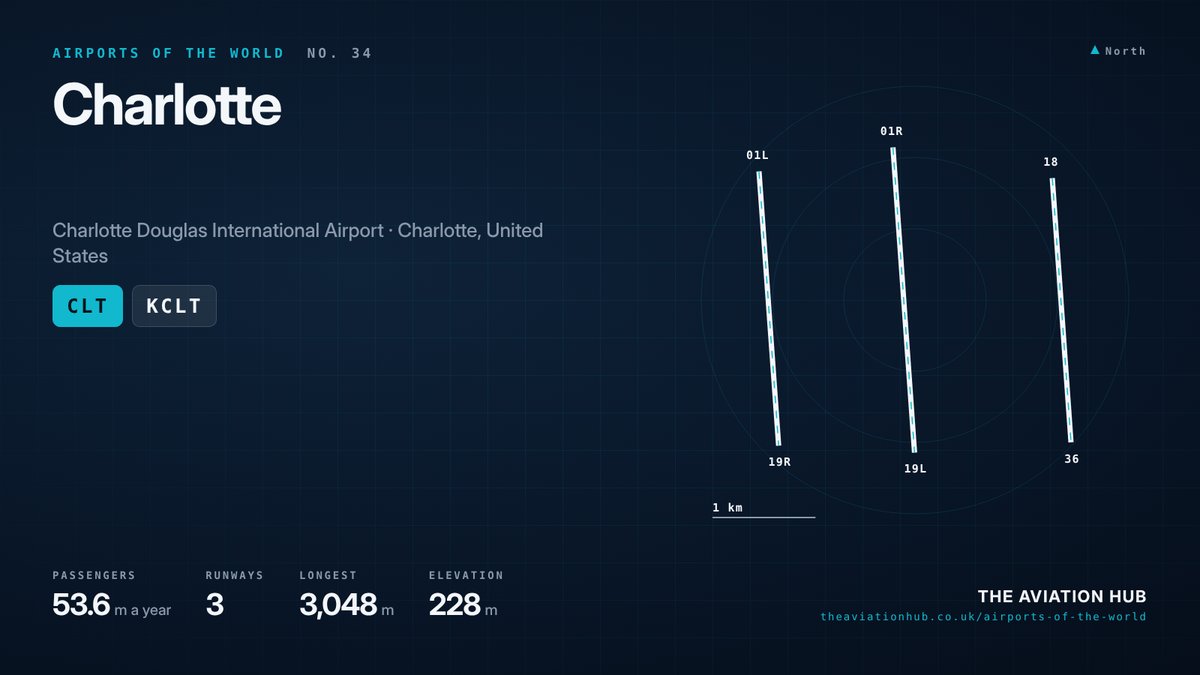
Charlotte Airport is the clearest example in America of a fortress hub. American Airlines runs the overwhelming majority of flights from this North Carolina field, funnelling passengers from across the eastern United States through a single terminal with 124 gates. Around 53.6 million passengers used it in 2025, down from a record 58.8 million the year before. It punches far above the size of the city it serves, and its public Overlook makes it one of the friendliest airports in the country for spotters.
Charlotte Airport at a Glance
The IATA code is CLT and the ICAO code is KCLT. The formal name is Charlotte Douglas International Airport. The field lies about 6 miles (10 km) west of Uptown Charlotte at an elevation of 228 m (748 ft) in the rolling Piedmont country. The City of Charlotte owns it and the city’s Aviation Department runs it.
One terminal with five concourses and three runways serve the traffic, with a fourth runway under construction. American Airlines operates Charlotte Airport as one of its largest hubs, and American Eagle’s regional operation here is the largest in the world. The North Carolina Air National Guard’s 145th Airlift Wing shares the field. Terminal maps, parking and the Overlook details are on the airport’s official website.
How Charlotte’s Airport Came to Be
The airport opened in 1936 as Charlotte Municipal Airport, built with Works Progress Administration money during the Depression. Eastern Air Lines began scheduled passenger service in 1937. The Army Air Forces used the field as Morris Field during the Second World War, and the city took it back afterwards. In 1954 it was renamed Douglas Municipal Airport for Mayor Ben Elbert Douglas Sr, who had pushed the project through, and it became Charlotte Douglas International Airport in 1982.
The turning point came with deregulation. Piedmont Airlines, a regional carrier from Winston Salem, chose Charlotte as its main hub in the late 1970s and grew it rapidly. USAir bought Piedmont in 1989 and inherited the hub, and the current terminal dates from 1982 with constant additions since. US Airways merged with American in 2013, and American has kept building here ever since.
The field has seen tragedy. Eastern Flight 212 crashed on approach in 1974, USAir Flight 1016 was lost to windshear in 1994 with 37 dead, and US Airways Express Flight 5481 crashed on departure in 2003, killing 21. The Sullenberger Aviation Museum on the airfield holds the Airbus A320 from the 2009 Hudson River landing.
Runways at Charlotte Airport
Charlotte Airport has three runways in operation. Runway 01R/19L is 3,048 m (10,000 ft) of grooved concrete and 46 m wide, the longest on the field and the primary departure runway for the heaviest aircraft. Runway 01L/19R is 2,743 m (9,000 ft) of concrete. Runway 18/36 is 2,644 m (8,676 ft) of asphalt. All three run roughly north to south, which allows parallel operations with arrivals and departures streamed onto separate runways.
South flow is used more often than north flow over the year. The hub works in banks, with a wave of arrivals landing on two runways in the space of half an hour, followed by a wave of departures 40 minutes later. At peak times the staggered layout gives controllers enough separation to keep the regional jets and mainline aircraft moving.
A fourth runway, a 3,048 m (10,000 ft) parallel strip costing about $1 billion, broke ground in June 2023 and is due to open in 2027. The original plan called for 12,000 ft but was trimmed. A new 367 ft FAA control tower is already in service. Lufthansa’s Airbus A350-900 from Munich is the largest regular visitor, and the runways handle it comfortably.
Terminals and Airlines
Everything happens in one terminal. Concourse A, with 32 gates, is split between American on the main pier and the other airlines on A North, where United, Delta, Southwest, Frontier, Sun Country and Air Canada share the gates beneath a vast digital artwork called Interconnected that displays live aircraft movements. Concourses B and C, with 16 and 18 gates, are American mainline domestic territory.
Concourse D has 13 gates and handles American’s international flights alongside Lufthansa, Etihad and Volaris, with customs and immigration processing for arrivals without preclearance. Concourse E is the regional giant, with 45 gates serving American Eagle’s Bombardier CRJ-900 and Embraer E175 fleets, plus Contour. American’s Admirals Clubs sit in B and C, and an American Express Centurion Lounge sits in the Plaza between D and E. The rocking chairs in the atrium are a Charlotte tradition.
Routes and Destinations
American serves around 180 destinations nonstop, and Charlotte Airport is the connecting point for much of the Southeast. Orlando, Dallas Fort Worth, New York LaGuardia, Miami, Chicago O’Hare, Tampa, Phoenix, Boston and Philadelphia carry the heaviest traffic, and American Eagle links dozens of smaller cities from Asheville to Wilmington that would otherwise have no jet service. Florida and the Caribbean are strong leisure markets year round.
International service is modest for a hub this size but growing. American flies the Boeing 777-200ER and 787-8 to London Heathrow, Frankfurt, Munich and Madrid all year, adding Dublin, Rome, Paris and Athens in summer. Lufthansa flies the A350-900 from Munich, Etihad connects Abu Dhabi, and Volaris serves Mexico. Cancun, Mexico City and the Caribbean islands fill out the rest. Cargo is light, handled mainly in the bellies of passenger aircraft.
Getting to and from Charlotte Airport
There is no rail link yet. The CATS Route 5 Sprinter bus runs from the terminal to the Charlotte Transportation Center in Uptown in about 25 minutes for $2.20, which makes it the cheapest sensible option. Route 60 connects to the LYNX Blue Line light rail at Tyvola station. The LYNX Silver Line is tentatively planned to reach the airport around 2037, with an automated people mover linking the station to the terminal.
Josh Birmingham Parkway links the terminal with Wilkinson Boulevard, Little Rock Road and the Billy Graham Parkway, which lead to Interstates 485, 85 and 77. The drive to Uptown takes 15 to 20 minutes outside rush hour. Taxis charge a flat rate of about $25 to Uptown, and app based rides pick up from the lower level. Hourly and daily decks stand in front of the terminal, with long term lots and a cheaper economy lot served by shuttle buses. The rental car centre is in the hourly deck.
Spotting and Photography
Charlotte Airport has one of the few proper public viewing areas in the United States. The Overlook on Old Dowd Road sits beside the western runway and the Concourse A ramp, with picnic tables, food trucks, toilets, a playground and a restored F-4 Phantom II on display. Aircraft land and taxi within a few hundred feet, and the arrival banks bring a stream of CRJ-900s, E175s, Airbus A321neos and Boeing 737-800s one after another.
Afternoon light is best at the Overlook, with the sun behind the viewer as aircraft roll out on northerly operations. The Sullenberger Aviation Museum has its own views across the field. Stay inside the Overlook boundaries, keep off the service roads and do not stop on the Josh Birmingham Parkway shoulders.
What Comes Next
Destination CLT is a $2.5 billion programme to catch the terminal up with the traffic. A $600 million lobby renovation has rebuilt the check in hall, concourse expansions costing around $1.1 billion are adding gates to A, B and C, and a $90 million terminal refresh has modernised the older sections. The fourth runway opening in 2027 will lift the field’s capacity for the banked hub operation.
The question is how far American wants to push it. The airline already carries about 89 per cent of the passengers, and the 2025 dip shows how exposed the airport is to a single carrier’s schedule decisions. The Silver Line will finally give it a rail link. Charlotte Airport is heading towards 60 million passengers with four runways and a terminal rebuilt around them. See how it compares with the other American hubs on the Airports of the World map.
Continue to follow The Aviation Hub for more analysis and insight.
Advertise with us Your brand, in front of an aviation audience Home page and in-article placements, sold directly, one advertiser per slot. From £250 a year. See the rates

