
Chengdu Shuangliu Airport Guide: Sichuan’s Original Hub
Chengdu Shuangliu Airport lost its international routes to Tianfu yet still handles 33 million passengers a year. Read how the old hub works today.
 By The Aviation Hub
7 min read
Updated October 20, 2026
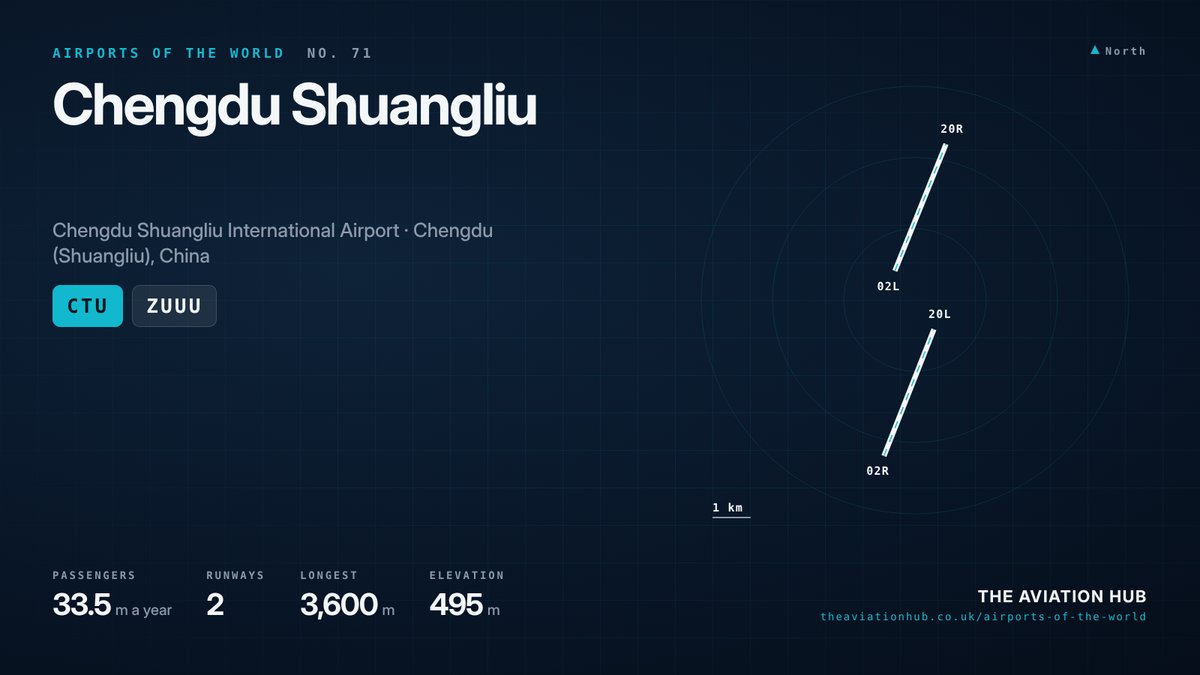
Chengdu Shuangliu International Airport lies in Shuangliu District about 10 miles (16 km) southwest of the centre of Chengdu, the capital of Sichuan Province in western China. For decades it was the dominant airport of the Chinese interior and the home of Sichuan Airlines and Air China’s second hub. The opening of Chengdu Tianfu in 2021 took its international traffic away, but Chengdu Shuangliu Airport still handled around 33.5 million passengers in 2025 and remains one of the busiest domestic airports in the country. Two long parallel runways and two large terminals give it plenty of capacity for that role.
Chengdu Shuangliu Airport at a Glance
The codes are CTU and ZUUU. The field sits at 1,625 ft (495 m) above sea level on the Chengdu plain, a basin ringed by mountains that holds in cloud and haze for much of the year. There are two parallel runways and two terminals, Terminal 1 and the much larger Terminal 2. Chengdu is the only city in western China with two major international airports, and the pair are now operated as a system.
Chengdu Shuangliu Airport handled roughly 33.5 million passengers, 223,000 aircraft movements and about 736,000 tonnes of freight in 2025. Sichuan Airlines and Chengdu Airlines are headquartered here, Air China treats it as a core hub alongside Beijing Capital, and China Eastern, China Southern, Shenzhen Airlines, Lucky Air and Tibet Airlines keep bases. The Sichuan Province Airport Group, a state owned company, runs both Chengdu airports. Terminal information and transport details are on the airport’s official website.
How Chengdu’s Airport Came to Be
The airfield opened in 1938 as Shuangguisi Airport, a military base built during the war with Japan. Chinese fighter pilots defended Chengdu from here, and several died in a famous air battle against Japanese Zero fighters in March 1941. The United States Fourteenth Air Force used the field later in the war, and it closed briefly in August 1945.
Civil aviation took over in 1956 and the field became Chengdu Shuangliu Airport, named after the county in which it stands. It gained international port of entry status in 1993 and took the word International into its name on 30 November 1995. China Southwest Airlines, later absorbed into Air China, had its headquarters on the airport grounds.
Growth in the 2000s was explosive. The second runway and Terminal 2 opened in 2009 and 2012 respectively, and by 2019 the airport was handling close to 56 million passengers, among the top five in China. That volume prompted the decision to build Tianfu, which opened on 27 June 2021 and took over the international passenger and long haul flying.
Runways at Chengdu Shuangliu Airport
Chengdu Shuangliu Airport has two parallel runways, each 3,600 m (11,811 ft) long. Runway 02L/20R is asphalt and 45 m wide, while 02R/20L is concrete and 60 m wide and rated to take the Airbus A380. They are staggered, with 02R/20L offset to the southeast of its partner, and the airport runs a very high domestic movement rate on them.
Winds on the Chengdu plain are light and variable, so the choice of direction often depends on traffic flow rather than weather. Northerly operations on the 02 runways bring arrivals in over the suburbs of Shuangliu, while southerly flow uses the 20 runways. Fog and low cloud are the chief operational problem, especially in winter, and the airport has invested heavily in low visibility procedures.
The elevation and summer heat have little effect on performance because the runways are so long. The field has no formal curfew and freighters, including those of Sichuan Airlines, operate through the night.
Terminals and Airlines
Terminal 1 is the older building, extended several times. In recent years it has housed Air China, Shenzhen Airlines, Tibet Airlines and Lucky Air, and its international hall reopened in July 2026 when flights to Hong Kong, Macau and Taiwan moved back from Tianfu. Terminal 2, opened in 2012, is the larger and more modern of the pair and serves Sichuan Airlines, China Eastern, China Southern, Chengdu Airlines and most other domestic carriers.
Allocations have changed more than once since 2021, so passengers should check their airline before setting out. Both buildings have Air China and Sichuan Airlines lounges, and a landside link allows transfers on foot or by shuttle bus. The airport is famed for its food courts, which serve genuine Sichuan dishes rather than the bland fare common at Chinese terminals.
Routes and Destinations
The network at Chengdu Shuangliu Airport is almost entirely domestic. Beijing, Shanghai, Guangzhou and Shenzhen are the busiest routes by a wide margin, each served many times a day by several carriers with a mix of Airbus A320neos, A321neos, A330s and Boeing 737-800s. Kunming, Hangzhou, Xi’an, Wuhan and Lhasa are also busy. The Lhasa route is one of the most important in Tibet’s connection to the rest of China and Tibet Airlines and Air China fly it with specially equipped aircraft.
Regional flights to Hong Kong, Macau and Taipei returned in 2026 and are the only scheduled services beyond mainland China. Before Tianfu opened, Shuangliu had direct flights to London, Paris, Amsterdam, Frankfurt, San Francisco, Los Angeles, New York and Sydney, and the longest routes exceeded 7,000 miles (11,300 km). Those are now Tianfu’s business.
Cargo remains substantial. Freighters from Sichuan Airlines Cargo, SF Airlines, China Postal Airlines and foreign operators fly to Europe, the Middle East, Southeast Asia and North America, carrying the electronics output of the Chengdu industrial zones. Peaks follow the Chinese New Year and National Day holiday periods.
Getting to and from Chengdu Shuangliu Airport
Chengdu Metro Line 10, opened in September 2017, has stations at both terminals and runs to Taipingyuan, where it connects with Lines 3 and 7 for the city centre. The journey downtown takes 35 to 45 minutes with a change and costs a few yuan, which makes the metro the cheapest sensible option. The Chengdu to Mianyang and Leshan intercity railway also stops at Shuangliu Airport station, with CRH trains to Chengdu South and Chengdu East in around 20 minutes.
Airport buses 1, 2 and 3 run to the city centre and to the North and East railway stations. The Airport Expressway connects to the Second and Third Ring Roads, and a taxi to Tianfu Square takes 30 to 50 minutes depending on traffic and costs around CNY 60 to 80 (roughly £7 to £9). Both terminals have large multi storey car parks. A direct road link and shuttle buses connect Shuangliu with Tianfu, about 30 miles (50 km) away, for transfers between the two airports.
Spotting and Photography
Spotting in China requires care, but Chengdu Shuangliu Airport is among the more approachable fields. The road along the eastern side of the airport near the 02R threshold gives views of arrivals in northerly operations, and the terminal windows and the upper levels of the Terminal 2 car park overlook the aprons.
The haze is the main enemy and clear days are rare, so winter mornings after rain give the best conditions. The reward is a parade of Chinese airline liveries, including Sichuan Airlines’ panda special schemes on Airbus A350-900s and A330s, Tibet Airlines A319s and A330s, and the full Air China fleet.
Photography near the perimeter can attract police attention. Stay on public roads, avoid long lenses at the fence, do not photograph military aircraft and move on politely if asked.
What Comes Next
Chengdu Shuangliu Airport has settled into a new role as the city’s domestic and regional airport, with Tianfu taking long haul and international growth. The return of Hong Kong, Macau and Taiwan flights in 2026 suggests the authorities see value in keeping a convenient, close in airport for premium short haul traffic, much as Shanghai keeps Hongqiao alongside Pudong. Terminal refurbishment and metro improvements are the likely investments rather than new runways.
The airport will not return to its 2019 peak, but it remains one of the busiest in China and a vital link for Sichuan and Tibet. See the two Chengdu airports side by side on the Airports of the World map.
Continue to follow The Aviation Hub for more analysis and insight.
Advertise with us Your brand, in front of an aviation audience Home page and in-article placements, sold directly, one advertiser per slot. From £250 a year. See the rates

