
Chennai Airport Guide: South India’s Crossing Runways
Chennai Airport serves 23 million passengers a year from a site where a runway crosses a river. Read about its terminals, routes and best spotting spots.
 By The Aviation Hub
7 min read
Updated October 20, 2026
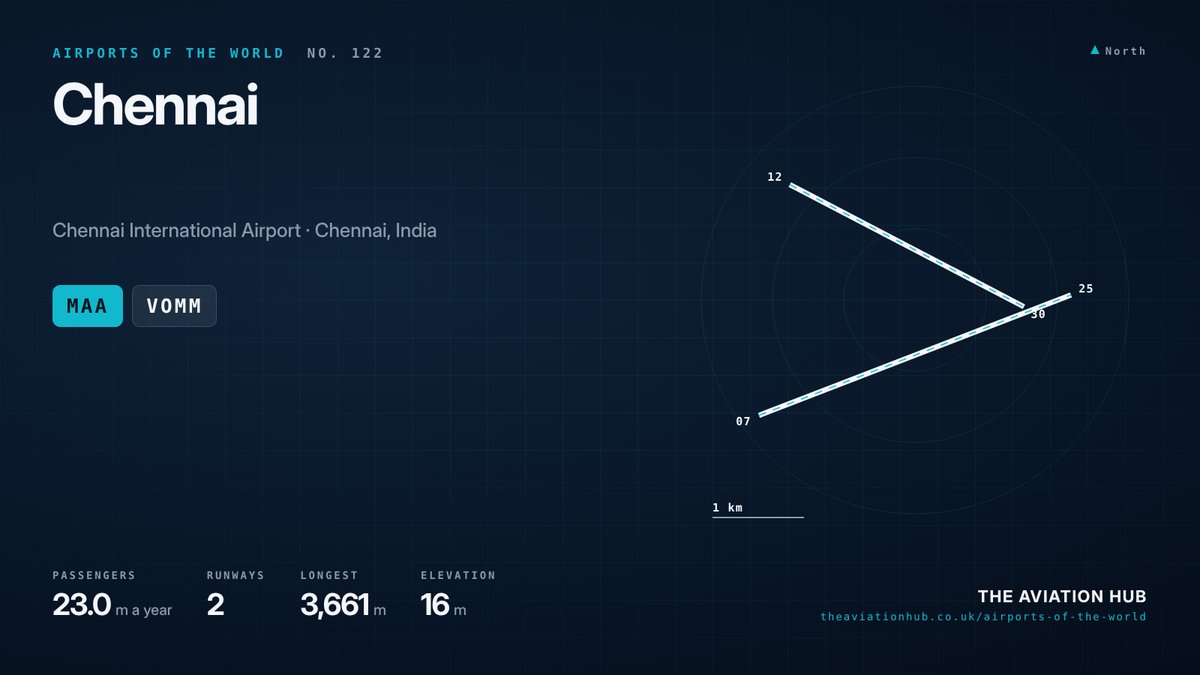
Chennai International Airport lies at Tirusulam, about 13 miles (21 km) south west of the centre of Chennai, capital of Tamil Nadu. It is the main gateway to south east India and ranks among the four or five busiest airports in the country. Chennai Airport handles around 23 million passengers a year on two crossing runways, one of which is built over the Adyar river. A new integrated terminal, a satellite building under construction and the search for a second airport site mark a site in transition.
Chennai Airport at a Glance
The codes are MAA and VOMM, the first a relic of the city’s old name of Madras. The field lies at 16 m (52 ft) above sea level on the Grand Southern Trunk Road, with the suburban railway running along its southern side. It has two runways, 07/25 and 12/30, and three passenger terminals in use: Terminal 1 and Terminal 4 for domestic flights and Terminal 2 for international.
The Airports Authority of India owns and operates the airport, one of the largest it still runs directly. In the year to March 2026 Chennai Airport handled just over 23 million passengers, about 159,000 aircraft movements and more than 420,000 tonnes of cargo. IndiGo is the largest operator and keeps a base there, Air India treats it as a focus city and Blue Dart Aviation runs its freighter hub from the cargo apron. Current information is on the airport’s official website.
A Short History of Madras Airport
Chennai claims the first powered flight in Asia, when Giacomo D’Angelis flew a biplane from the Island Grounds in 1910. Tata Air Mail linked Karachi and Madras from 1932, and the Madras Flying Club was founded at Meenambakkam in 1930, the year the airport was commissioned. In 1932 J. R. D. Tata’s Karachi to Bombay mail service was extended to Madras, the first scheduled flight to land there.
The old terminal at Meenambakkam served until the 1980s, when new domestic and international buildings opened at Tirusulam. A bomb blast near the airport in 1984 killed 33 people. In 1999 an Air France Boeing 747 freighter crash landed and burned out, although all five crew escaped.
The secondary runway was extended across the Adyar river on a bridge, completed in March 2011, the first such crossing at an Indian international airport. Floods in December 2015 closed the field for six days and forced the evacuation of around 1,500 passengers. The new Terminal 2 opened in July 2023 and the old Terminal 3 was pulled down to make room for its second phase.
Runways at Chennai Airport
The main runway, 07/25, measures 3,661 m (12,011 ft) by 45 m and is surfaced in asphalt. It handles nearly all commercial traffic, including the Boeing 777 and Airbus A350 wide bodies on Gulf, European and Far East routes. The secondary runway, 12/30, is 2,890 m (9,482 ft) long and 45 m wide. Part of its length sits on the river bridge, and it carries a much smaller share of the traffic.
The two runways cross near the eastern end of 07/25, so they cannot be used independently. Arrivals land on 07 from the west, over the suburbs of Pallavaram and Chromepet, when easterly winds blow in from the sea, as they do in the north east monsoon from October to December. Westerly winds in the south west monsoon bring 25 into use, with aircraft approaching from the east.
Both runways have Category I instrument landing systems but no Category III, so the heavy fog that occasionally settles on the coast in winter can stall operations. Chennai Airport announced 11 new rapid exit taxiways in January 2024 to cut runway occupancy times and squeeze more movements out of the single active runway.
Terminals and Airlines
Terminal 1 is the main domestic building, rated for about 16 million passengers a year. IndiGo, Air India and Akasa Air work from here, with IndiGo alone running well over half the domestic departures. Terminal 4 next door, built in the 2008 modernisation for international flights and now used for domestic ones, adds capacity for around 7 million.
Terminal 2 is the new integrated international building, partly open since July 2023 with a planned capacity of 10 million. Emirates, Qatar Airways, Etihad, Singapore Airlines, Scoot, Malaysia Airlines, Cathay Pacific, SriLankan, Thai Airways, Lufthansa and British Airways all use it, alongside Air India and Air India Express on their international routes. British Airways flies to London Heathrow and Lufthansa to Frankfurt.
The terminals sit in a row along the southern side of the field, connected by walkways and shuttles. A large multi level car park serves all three. The buildings have a reputation for falling ceiling panels and cracked glass, with more than 65 such incidents reported.
Routes and Destinations
Mumbai is the busiest domestic route with around 1.2 million passengers a year, followed closely by Delhi at roughly 1.16 million and Bengaluru at about 655,000. Hyderabad, Kolkata, Madurai, Coimbatore and Kochi fill out a dense domestic network flown mostly by IndiGo Airbus A320neo and A321neo aircraft.
Dubai leads the international list with about 500,000 passengers, then Singapore at 438,000 and Colombo at nearly 400,000. The Gulf carriers, Singapore Airlines and SriLankan carry much of that traffic, and the diaspora links to Malaysia and the Gulf are strong year round. London Heathrow is the longest route from Chennai Airport at around 5,100 miles (8,200 km).
Cargo is a major business. Chennai Airport moved more than 420,000 tonnes in the year to March 2026, up 11 per cent, driven by the city’s car, electronics and pharmaceutical exports. Blue Dart’s Boeing 757 freighters connect it to Delhi, Mumbai, Bengaluru and Kolkata overnight.
Getting to and from Chennai Airport
The airport is better connected than most in India. Tirusulam station on the Chennai Suburban Railway sits across the GST Road from the terminals, linked by a footbridge. Trains run to Chennai Beach via Egmore every few minutes for a few rupees, with a journey of about 40 minutes.
Chennai Metro’s Blue Line terminates at Airport station, joined to the terminals by a walkway and shuttle. The ride to Central station takes around 35 minutes and costs under INR 70 (about 60p). This is the cheapest sensible option and avoids the city’s traffic entirely.
By road the airport sits on National Highway 32 with a flyover at the entrance. MTC buses stop outside, and pre paid taxis, Ola and Uber work from the arrivals forecourt. A cab to the city centre costs around INR 500 to 700 and takes 45 minutes to over an hour. Parking is in front of the terminals.
Spotting and Photography
The railway footbridge at Tirusulam and the platforms give a clear view across the GST Road to the apron and the threshold of Runway 07. Aircraft landing on 07 pass low over Pallavaram, where the roads near the railway station offer approach shots with the morning sun behind the camera.
When 25 is in use, the approach crosses the Adyar river and the Meenambakkam side of the field. The roads around Meenambakkam station work for arrivals in the afternoon. The cargo apron at the eastern end is visible from the perimeter road, and Blue Dart’s 757s depart in the evening.
Chennai Airport is a high security site, so security staff take photography seriously. Stay on public roads and railway property, keep cameras away from the fence, and expect questions from police. A polite explanation and a willingness to move on usually settles matters.
What Comes Next
Terminal 2 will be completed in full over the next few years, and a satellite terminal is under construction, linked to the main buildings by a 1.5 km tunnel. A new integrated cargo terminal with room for around 300,000 tonnes a year is also planned. The rapid exit taxiways should let the main runway handle more movements per hour.
The Airports Authority expects Chennai Airport to saturate at about 40 million passengers by 2035. With no room for a third runway, the Tamil Nadu government chose a greenfield site at Parandur, west of the city, in August 2022 for a second airport. Farmers protested, and in August 2026 the state dropped Parandur and began looking for another site. It also plans a fifth terminal on the north western side, adding room for about 20 million passengers a year.
Chennai will keep growing until a second airport opens, and the squeeze on the single active runway will define the decade. See how it compares with other Indian gateways on the Airports of the World map.
Continue to follow The Aviation Hub for more analysis and insight.
Advertise with us Your brand, in front of an aviation audience Home page and in-article placements, sold directly, one advertiser per slot. From £250 a year. See the rates

