
Cheongju Airport Guide: Korea’s Shared Civil and Military Field
Cheongju Airport serves central South Korea and shares its runways with an F-35A wing. Learn about its history, runways, airlines, routes and rail links.
 By The Aviation Hub
5 min read
Updated October 20, 2026
Central South Korea has no shortage of motorways and high speed rail, but for flights to Jeju and the wider region it relies on one airfield. Cheongju Airport, in North Chungcheong Province, serves Cheongju, Daejeon and the administrative capital of Sejong. It handled almost 4.6 million passengers in 2024, a remarkable rise for a field that once struggled to fill its schedule. It is also home to a frontline fighter wing, which shapes almost everything about how it operates.
Cheongju Airport at a Glance
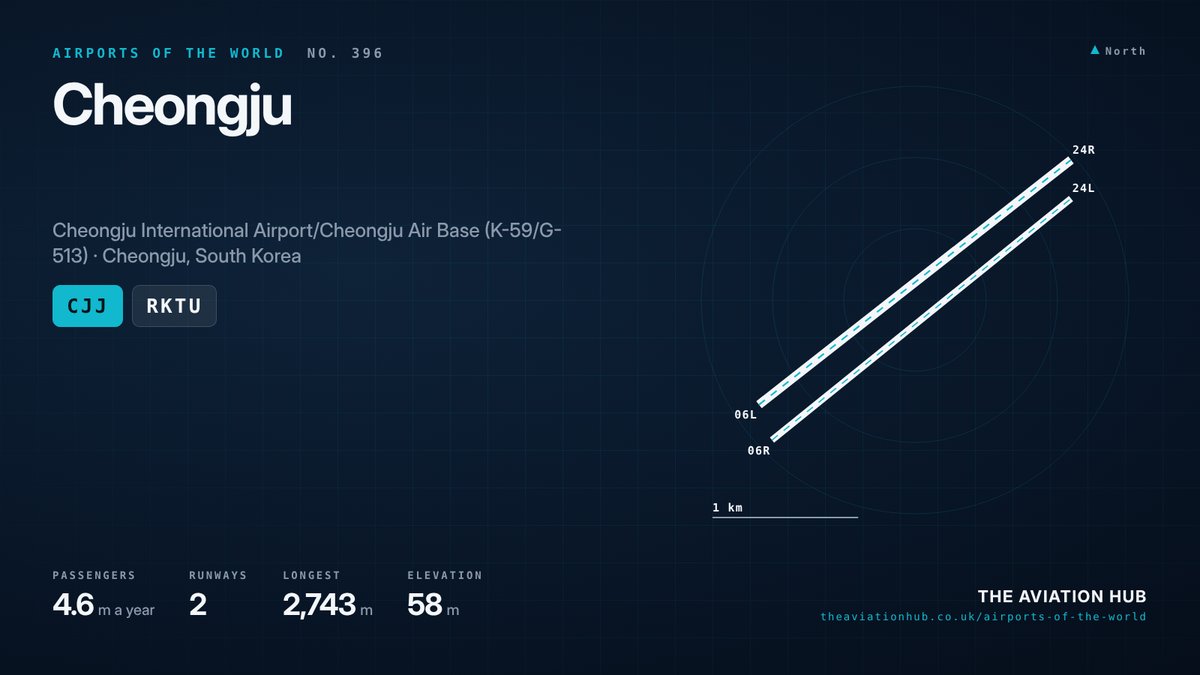
The IATA code is CJJ and the ICAO code is RKTU. The airport lies in Cheongwon district, about 5 miles (8 km) north of central Cheongju, at an elevation of 58 m (191 ft). It has two parallel runways and a single passenger terminal. Cheongju Airport recorded 4,579,221 passengers, 28,387 aircraft movements and around 28,200 tonnes of cargo in 2024. The low cost airline Aero K uses it as its hub. Korea Airports Corporation runs the civil side, while the Republic of Korea Air Force’s 17th Fighter Wing flies Lockheed Martin F-35A jets from the base.
How Cheongju’s Airport Came to Be
The field began life as a military air base in September 1978. In the mid 1980s it was briefly considered as a site for Korea’s main international airport, before the government chose Incheon instead. Construction of civil facilities began in 1984.
The work was completed in December 1996, and Cheongju International Airport opened to passengers on 28 April 1997. For many years it struggled. Fast trains and expressways made the drive to Seoul’s airports easy, and early routes to Busan and Saipan were dropped for lack of demand.
Growth finally arrived with low cost carriers. Chinese and Japanese routes multiplied in the 2010s, although Chinese traffic fell sharply after 2017, when a diplomatic dispute over a US missile defence system curbed group tours from China. Recovery followed, and Aero K launched in 2021 with Cheongju Airport as its base. Korea’s broader travel boom after the pandemic then pushed traffic to record levels.
Runways at Cheongju Airport
Two concrete runways run side by side. Runway 06L/24R measures 2,743 m (9,000 ft) long and 61 m wide, while 06R/24L is the same length at 46 m wide. The parallel layout reflects the base’s military origins and gives the air force flexibility for formation and training flights.
Both strips are long enough for the narrow body jets that dominate civil flying here. The 17th Fighter Wing began receiving its F-35As in 2019, replacing older types. Because the air force controls the airfield, military flying takes priority, and civil slots are fitted around training sorties. Local politicians have argued for a dedicated civil runway to free up capacity. The F-35A wing also makes the base one of the more sensitive military sites in the country.
Terminals and Airlines
Passengers use a single terminal with domestic and international sections. Parking faces the building directly, with around 770 spaces recorded in 2019, and an expansion plan was announced in 2024. The terminal is compact, with shops, cafés and duty free on the international side. The original design figures, around 1.2 million domestic and 1.15 million international passengers a year, have long been overtaken by actual demand.
Aero K is the anchor airline at Cheongju Airport, flying Airbus A320s to Jeju and to destinations in Japan, China and Taiwan. Korean Air, Asiana, Jeju Air and Jin Air serve the field on the Jeju route, while Trinity Airways, formerly T’way Air, and Eastar Jet add Jeju and international flights. Chinese airlines add further international links.
Routes and Destinations
Jeju is the backbone of the network. The island route carries the majority of domestic passengers, with frequent departures through the day and peaks during school holidays. It is the only domestic destination currently served.
International flying covers China, Japan, Taiwan, Vietnam and Mongolia. Japanese cities such as Osaka are popular with Korean leisure travellers, while Chinese routes carry tourists in the other direction. Vietnam, Bali and the Philippines add longer leisure links to the south. New routes appear regularly as low cost carriers compete for passengers who would otherwise make the long trip to Incheon. For many travellers in central Korea, Cheongju Airport saves two hours or more on the road each way. Cargo is modest, at around 28,000 tonnes a year.
Getting to and from Cheongju Airport
Cheongju Airport station sits next to the terminal on the Chungbuk Line. Service is limited, though, as the line is not a main route, and the KTX high speed trains do not stop in Cheongju itself. The nearest KTX station is Osong, about 30 minutes away by bus or taxi.
Buses are the main public option. Express and conventional coaches link the airport with Seoul’s Central City Terminal and the COEX City Airport Terminal, with around 13 and four daily departures respectively in 2019. Local buses connect with central Cheongju, which is the cheapest choice. Taxis reach the city centre in around 20 minutes, and Daejeon and Sejong are under an hour by road. Further travel details are on the airport’s official website.
Spotting and Photography
This is one airport where enthusiasts must leave their cameras packed. Because Cheongju is a joint civil and military installation, photography and videography are strictly prohibited on the site. That covers the F-35As, the military ramps and the airfield in general. Enthusiasts hoping to photograph Korean F-35As are better served by public events such as the Seoul ADEX show, where cameras are welcome.
Visitors flying through Cheongju Airport should keep phones and cameras away from windows during taxi, take off and landing, and avoid filming from the terminal. South Korean security laws are strict, and penalties can be serious. Respect all signage and follow any instruction from police, soldiers or airport staff without argument.
What Comes Next
Demand has outgrown the terminal and the car park, and the parking expansion is only a first step. The bigger debate is over a dedicated civil runway, which regional leaders see as essential if the airport is to handle larger aircraft and more international routes.
Aero K’s growth and new routes to Japan and Southeast Asia point to further gains. Expect Cheongju Airport to keep growing as central Korea’s main regional airport, with military priorities setting the limits. See where it fits on the Airports of the World map.
Continue to follow The Aviation Hub for more analysis and insight.
Advertise with us Your brand, in front of an aviation audience Home page and in-article placements, sold directly, one advertiser per slot. From £250 a year. See the rates

