
Chiang Mai Airport Guide: Northern Thailand’s City Centre Field
Chiang Mai Airport sits minutes from the old city under Doi Suthep. Learn about its runway, terminals, Thai AirAsia base, routes, access and spotting.
 By The Aviation Hub
7 min read
Updated October 20, 2026
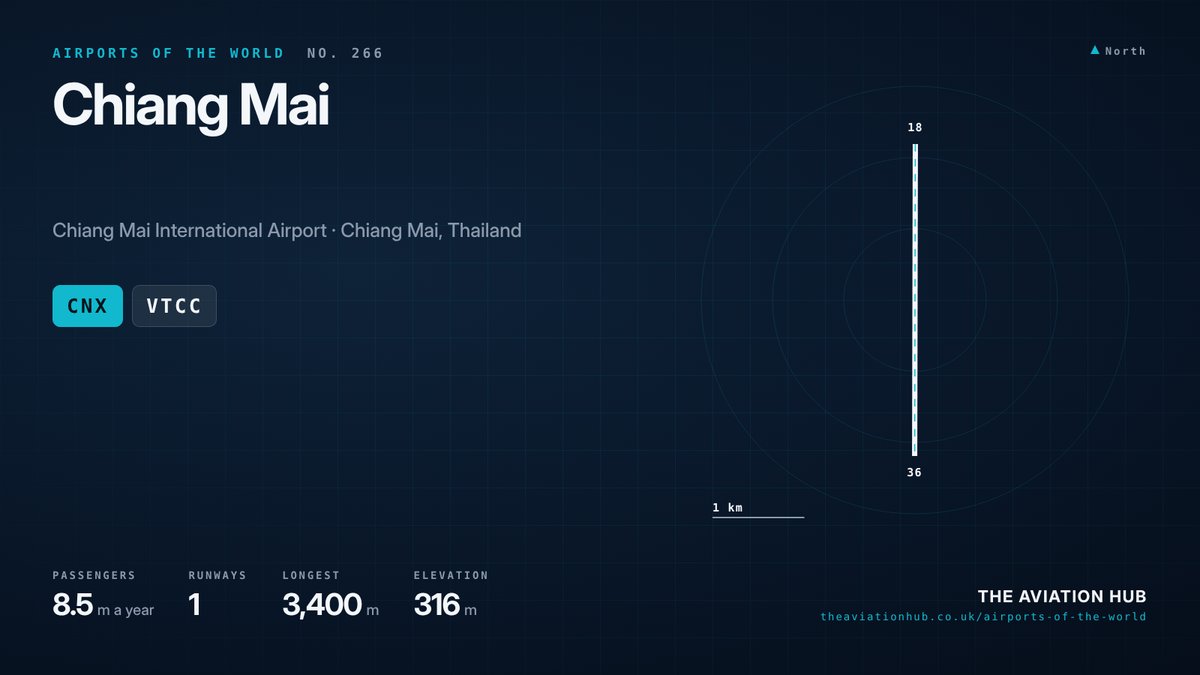
Chiang Mai Airport lies so close to the city it serves that the old walled town is a ten minute drive from the terminal. It is the main gateway to northern Thailand, handling close to nine million passengers a year on a single runway shared with the Royal Thai Air Force. Thai AirAsia built its second hub here, Bangkok Airways and Nok Air have bases and Thai Airways treats it as a focus city. The mountain of Doi Suthep rises directly to the west, which makes for memorable approaches and a tight operating envelope.
Chiang Mai Airport at a Glance
The codes are CNX for IATA and VTCC for ICAO. Chiang Mai Airport sits about 2 miles (3 km) southwest of the city centre in the Suthep subdistrict, at an elevation of 316 metres (1,036 feet). There is one runway and two passenger terminals, one for domestic and one for international flights, joined under a single roof. The field has operated around the clock since April 2014.
Traffic reached roughly nine million passengers in 2024, up about ten per cent on 2023, and 2025 ran at a similar level of between eight and a half and nine million. Thai AirAsia is the largest carrier and has treated the field as a secondary hub since January 2011. Bangkok Airways and Nok Air have bases, and Thai Airways uses it as a focus city. Airports of Thailand, the part state owned operator of the six big Thai airports, runs the civil side while Wing 41 of the air force shares the runway. Flight schedules are on the airport’s official website.
A Short History of Suthep Airfield
Aviation in Chiang Mai began with an airstrip laid out at Suthep in the early 1920s, used mainly to carry mail to the north. The field began regular operations in 1934 as Suthep Airport. During the Second World War the occupying Japanese forces used it, and British and American aircraft bombed it repeatedly.
Scheduled passenger flights began in 1947 with Siamese Airways, though the runway stayed grass or dirt until the late 1950s. The Royal Air Force returned from 1961 to 1970, when a detachment of No. 20 Squadron flew Hawker Hunter FGA 9 fighters from the field during the Laos crisis. Domestic and then international traffic grew as tourism took off.
Thai AirAsia set up its base in 2011 and the Chinese market exploded after the film Lost in Thailand made Chiang Mai famous in 2012. A 2014 upgrade enlarged the apron for bigger aircraft and expanded the international arrivals and domestic departures halls. The decision in the same year to operate 24 hours a day lifted capacity without any new concrete.
Runways at Chiang Mai Airport
Chiang Mai Airport has one asphalt runway, 18/36, measuring 3,400 metres (11,155 feet) long and 45 metres wide. It runs north to south along the foot of Doi Suthep, which climbs to more than 1,600 metres within a few miles of the western boundary. The length is generous for the Boeing 737 and Airbus A320 family traffic, and it comfortably takes Airbus A330s and Boeing 787s on the busier Chinese and Korean routes.
The terrain dictates the procedures. Approaches to runway 36 come in from the south over the suburbs and the ring road, and departures from 36 climb straight ahead before turning away from the mountain. Runway 36 has the instrument landing system. Runway 18 is used when the wind favours it, with arrivals descending over the western side of the city, west of the old town. Circuits for both directions are flown on the eastern side, away from the mountain. Haze from agricultural burning in March and April can cut visibility badly.
Terminals and Airlines
The domestic terminal is the busier of the two, with Thai AirAsia, Nok Air, Thai Lion Air, Thai Vietjet and Bangkok Airways running a stream of flights to Bangkok. Thai Airways, which has folded its regional arm Thai Smile back into the parent, also flies from here. Thai AirAsia flies the widest domestic network, reaching Hat Yai, Hua Hin, Krabi, Phuket and Udon Thani. The international terminal next door handles the Chinese, Korean, Taiwanese and Southeast Asian carriers.
Thai Airways is the Star Alliance member, and EVA Air and Air China also fly in. Korean Air represents SkyTeam, with China Airlines on the Taipei route. Malaysia Airlines flies the oneworld flag from Kuala Lumpur, and Etihad links the city to Abu Dhabi. The terminal complex at Chiang Mai Airport is cramped for the traffic it handles, and queues at immigration during the winter peak are a known weakness.
Routes and Destinations
Bangkok is everything. Don Mueang alone carried more than three and a half million passengers on the Chiang Mai route in 2019, and Suvarnabhumi adds another large block with Thai Airways and Thai Vietjet. Other domestic routes reach Phuket, Hat Yai, Krabi, Khon Kaen, Udon Thani and Samui, the last an exclusive Bangkok Airways service.
Internationally China led before the pandemic, with Shanghai Pudong the top foreign route at about 450,000 passengers in 2019, and Chinese services have been rebuilding since. Seoul Incheon is served by Korean Air, Jeju Air and Eastar Jet, and Taipei by EVA Air, China Airlines and Starlux. Kuala Lumpur, Singapore, Hong Kong, Hanoi and Luang Prabang are all served. The peak runs from November to February in the cool season.
Getting to and from Chiang Mai Airport
There is no rail link. Chiang Mai railway station on the eastern side of the city, the terminus of the overnight trains from Bangkok, is about 20 minutes from Chiang Mai Airport by taxi. Airport taxis operate from a counter in the arrivals hall at a fixed price of around 150 to 200 baht (roughly £3.50 to £4.50) to anywhere in the city. Grab ride hailing is cheaper and picks up from a marked area outside.
The RTC city bus runs from the terminal into the city and is the cheapest sensible option. Red songthaew trucks will also take passengers for a negotiated fare. Driving is easy, with the airport beside the Mahidol Road section of the ring road. Parking is in surface lots and a multi storey car park with low hourly rates.
Spotting and Photography
The approach to runway 36 crosses the ring road just short of the threshold. A pedestrian footbridge near the southern end of the runway gives views of aircraft lining up on runway 36 and of landings from early afternoon. Heat haze eases after about four o’clock.
Light on the runway is best in the morning from the eastern side with Doi Suthep as a backdrop, which is the signature photograph of Chiang Mai Airport. The traffic is dominated by A320s and A321neos of Thai AirAsia and Thai Vietjet, 737-800s of Nok Air and Thai Lion Air, Bangkok Airways A319s and ATR 72-600s, and Thai Airways A320s and A330s, with Korean and Taiwanese wide bodies in the evenings. Thailand takes airport security seriously and the military presence makes it more so, so photograph only from public spaces, never through the fence and never towards the air force apron.
What Comes Next
The city centre location is both the charm and the ceiling. Airports of Thailand plans a new international terminal on the southern side of the field, with the existing buildings converted for domestic use and a larger apron. The aim is about 16.5 million passengers after the first phase and 20 million later, with completion expected in 2034. The longer term answer is a second airport, the proposed Lanna International Airport on a site straddling San Kamphaeng district and Ban Thi in Lamphun province, though funding and timing remain uncertain.
Until that arrives Chiang Mai Airport will keep squeezing more flights into its single runway, relying on the 24 hour schedule and the appetite of Chinese, Korean and Thai low cost travellers. Expect congestion in the peak and steady growth overall. See where it ranks among Southeast Asia’s regional gateways on our Airports of the World map.
Continue to follow The Aviation Hub for more analysis and insight.
Advertise with us Your brand, in front of an aviation audience Home page and in-article placements, sold directly, one advertiser per slot. From £250 a year. See the rates

