
Cincinnati Airport Guide: Amazon, DHL and a Former Delta Hub
Cincinnati Airport is a former Delta hub turned cargo giant for Amazon and DHL. Our guide covers four runways, airlines, routes, transport and spotting.
 By The Aviation Hub
6 min read
Updated October 20, 2026
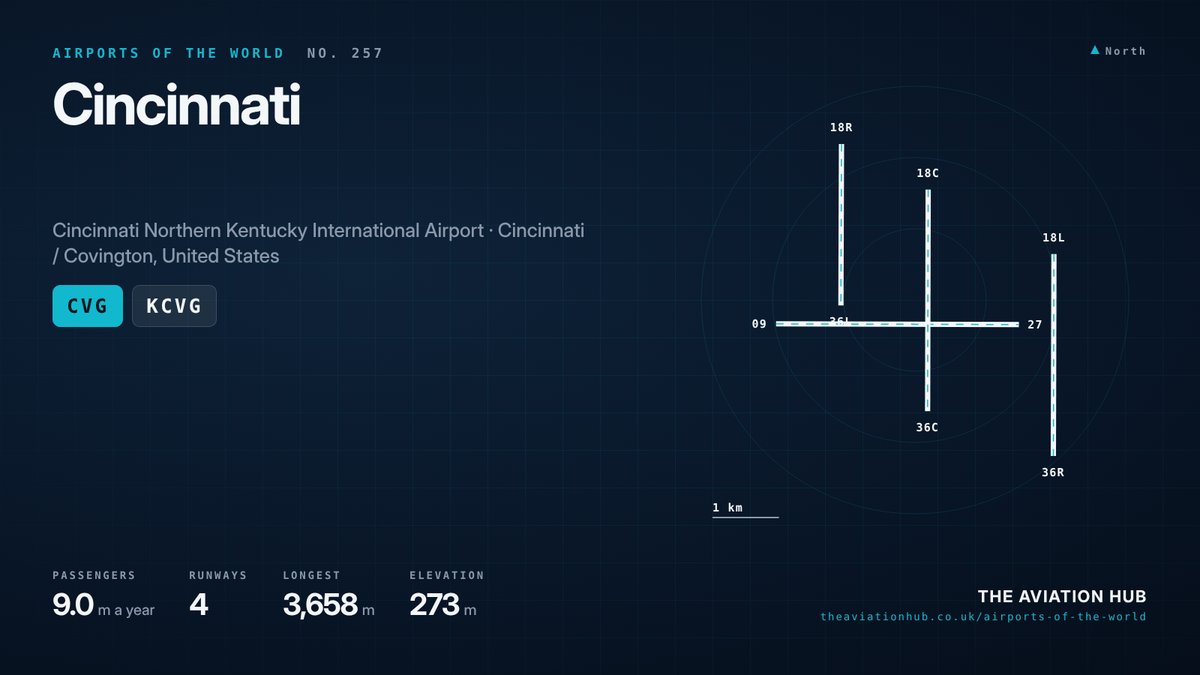
Cincinnati/Northern Kentucky International Airport sits across the Ohio River from the city it serves, in Boone County, Kentucky. Cincinnati Airport handled about 9 million passengers in 2025, but its real weight lies in freight. Amazon Air runs its main global hub here and DHL its Americas hub, making the field one of the busiest cargo airports in the world. That is a striking reinvention for an airport that was once a fortress hub for Delta.
Cincinnati Airport at a Glance
The IATA code is CVG and the ICAO code is KCVG. Cincinnati Airport lies near Hebron, Kentucky, about 13 miles (21 km) southwest of downtown Cincinnati by road, at an elevation of 273 metres (896 feet). It has four runways and a single passenger terminal with two concourses and 51 gates, spread over a site of around 7,000 acres.
Passenger traffic was just under 9 million in 2025, down about 2.6 per cent on 2024, while cargo reached around 1.7 million tons. Delta still carries about a quarter of passengers, and Allegiant, Frontier and American are also significant. The Kenton County Airport Board runs the airport, and terminal and parking details are on the airport’s official website.
How Cincinnati’s Airport Came to Be
Cincinnati’s main airfield was Lunken Airport, in the Ohio River valley. The great flood of 1937 submerged it, and federal officials wanted a new site that would not flood. Northern Kentucky officials lobbied for the Kentucky plateau, and the field was built during the Second World War for Army Air Corps training.
Commercial service began in 1947. The CVG code comes from Covington, then the nearest city. The airport became Greater Cincinnati International in 1978 and took its current name in 1992. In 1983 Air Canada Flight 797 made an emergency landing after a cabin fire, and 23 people died, including the folk singer Stan Rogers. The accident led to new rules on lavatory smoke detectors and floor lighting.
Delta built a huge hub here from the 1980s, and by 2005 it ran more than 600 daily flights. Bankruptcy and cuts followed, Comair shut down in 2012, and the hub was downgraded to a focus city in 2017, a status that ended in 2021. Concourse C closed in 2009 and was demolished in 2016. Low cost carriers and freight have filled the gap.
Runways at Cincinnati Airport
Cincinnati Airport has four runways, all 46 metres wide. Runway 09/27 is 3,658 metres (12,001 feet) long with an asphalt and concrete surface. Three parallel runways run north to south: 18C/36C at 3,353 metres (11,000 feet) in asphalt and concrete, 18L/36R at 3,048 metres (10,000 feet) in concrete, and 18R/36L at 2,438 metres (8,000 feet), also concrete.
The three parallels carry most traffic, with the direction of flow set by the wind. The layout allows simultaneous operations, a legacy of the Delta hub that now serves the cargo banks well. Runway 09/27, the longest, is valuable for the heaviest freighters and for crosswind days.
Night is the busiest time on the airfield. Amazon and DHL schedule their sorts overnight, so waves of freighters arrive in the evening and leave before dawn.
Terminals and Airlines
Passengers use Terminal 3, with Concourses A and B linked by an underground walkway and people mover. Older Terminals 1 and 2 have been demolished. Concourse B handles international arrivals without preclearance. Five Art Deco mosaic murals rescued from Cincinnati Union Terminal decorate the building, and a walkway here appeared in the film Rain Man.
Delta and its regional partner Endeavor Air remain the largest presence at Cincinnati Airport, flying to Delta’s hubs and a handful of focus routes. Allegiant has built a sizeable leisure network, and Frontier adds low cost flights to sun destinations. American, United and Southwest connect the region with their own networks.
On the cargo side, Amazon Air’s hub has a sorting building of around 3 million square feet and more than 200 daily flights. DHL has operated here since 1984 and expanded significantly in 2015 and 2016. Atlas Air, ABX Air and Kalitta Air are among the cargo operators flying for these customers.
Routes and Destinations
Atlanta is the busiest passenger route, with about 435,000 passengers in the year to April 2026. Chicago O’Hare, Orlando, Dallas Fort Worth and Denver follow, each carrying between roughly 217,000 and 281,000. Florida dominates the leisure market, especially in winter.
Nonstop service reaches more than 50 destinations in North America and Europe. Delta’s Paris Charles de Gaulle service is the longest route, at roughly 4,150 miles (6,700 km), and British Airways flies to London Heathrow. United adds San Francisco from October 2026, and Allegiant continues to add leisure routes.
Cargo is the headline. Cincinnati Airport ranks as the fifth busiest US airport for cargo and around twelfth in the world, and it is often described as the fastest growing cargo airport in North America. Amazon’s hub reached full phase one capacity in early 2026.
Getting to and from Cincinnati Airport
There is no rail link. TANK bus route 2X runs between the airport, Florence and downtown Cincinnati, taking around 30 to 40 minutes. It is the cheapest sensible option, with fares of a couple of dollars.
By road, the airport sits beside Interstate 275 at exit 4, with Interstate 71 and 75 leading north across the Ohio River to downtown. The drive takes 20 to 25 minutes outside rush hour. Taxis and app cars with Uber and Lyft cost around US$35 to US$45 (roughly £27 to £35).
A rental car and ground transportation centre opened in 2021 and brings car hire firms under one roof. Garage and economy parking sit close to the terminal, with shuttle buses serving the outer lots.
Spotting and Photography
Cincinnati Airport is a cargo spotter’s dream. Amazon Boeing 767 and Airbus A330 freighters, DHL Boeing 777F and 757 aircraft, plus Atlas Air 747s and Kalitta freighters all appear. Summer evenings give the best chance of photographing the cargo waves in daylight.
There is no official viewing area. Public roads around the perimeter and near the ends of the parallel runways give views of arrivals, and the rolling countryside offers some elevated spots. The sun sits to the south, so positions on the north side of the field work well for most of the day.
Airport police patrol the cargo areas closely. Stay on public land, never stop on the shoulder of busy roads and respect all fences and private property.
What Comes Next
Cargo will keep driving growth. Amazon’s hub has reached its first phase capacity, and DHL continues to invest in its facilities. The airport authority is looking to add more passenger routes, particularly with low cost carriers, to rebuild traffic lost from the Delta hub.
The terminal is far bigger than current passenger demand needs, which gives room to grow without major construction. Cincinnati Airport looks set to remain a cargo powerhouse with a steady passenger business alongside it. Compare it with other Midwest airports on the Airports of the World map.
Continue to follow The Aviation Hub for more analysis and insight.
Advertise with us Your brand, in front of an aviation audience Home page and in-article placements, sold directly, one advertiser per slot. From £250 a year. See the rates

