
Clark Airport occupies part of the former Clark Air Base in Pampanga, north of Manila on the island of Luzon. Once a major American military installation, it now serves as the second gateway for the Philippine capital region and Central Luzon. A striking terminal opened in 2022 with room for 12 million passengers a year. Traffic reached about 2.4 million in 2024, so there is plenty of space to grow while Manila’s main airport strains at capacity.
Clark Airport at a Glance
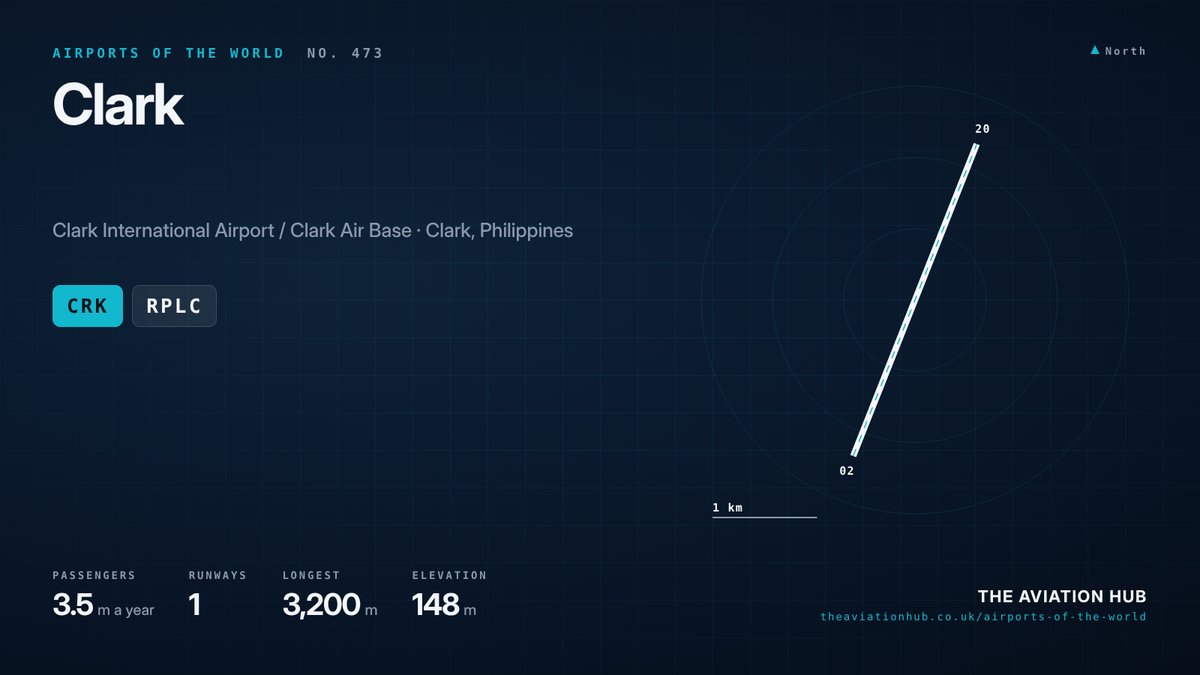
The codes are CRK for IATA and RPLC for ICAO. The airport lies in Mabalacat, next to Angeles City, about 50 miles (80 km) north of Manila. Elevation is 148 metres (484 feet). There is one active runway and one passenger terminal.
Traffic in 2024 was 2,404,888 passengers, up nearly 17 per cent, with about 19,200 aircraft movements and 58,500 tonnes of cargo. PAL Express uses Clark Airport as a hub, and Cebu Pacific, Cebgo and Sunlight Air have bases here. Since 2019 the Luzon International Premier Airport Development consortium, including JG Summit, Filinvest and Changi Airports Philippines, has run operations. Details are on the airport’s official website.
A Short History of Clark
Clark Air Base was named after Major Harold Melville Clark, an American aviator. For decades it was the largest overseas base of the US Air Force, a hub for operations across Asia, including during the Vietnam War. In June 1991 the eruption of Mount Pinatubo buried the base in ash, and later that year the Philippine Senate declined to renew the bases agreement. The Americans left.
Commercial flights began at Clark Airport on 16 June 1996, as the government turned the old base into a freeport zone. Growth was slow at first, though UPS ran an Asian hub here for several years. In 2003 President Gloria Macapagal Arroyo renamed the airport after her father, Diosdado Macapagal. The Clark name returned in February 2012.
Terminal expansions in 2008, 2010 and 2013 raised capacity to 4.2 million passengers. Traffic peaked at about four million in 2019. The new terminal opened to passengers on 2 May 2022 and was formally inaugurated by President Ferdinand Marcos Jr on 28 September that year.
Runways at Clark Airport
The active runway, now designated 02/20, is a concrete strip measuring 3,200 metres (10,499 feet) long and 60 metres wide. That generous width is a legacy of military days, when it handled heavy transports and fighter wings. It has a Category I precision approach and can take the largest wide body jets.
A parallel runway, 02L/20R, of the same length but 45 metres wide, was used for visual flights only and was decommissioned in 2017. A maintenance hangar is being built on its stopway. The runways run roughly north to south, and the volcanic peaks of Pinatubo to the west and Arayat to the east frame the approaches.
A new second runway is planned. In April 2026 the Bases Conversion and Development Authority awarded a design contract, with opening targeted for the end of 2029. The Philippine Air Force still uses the southern section of the airfield.
Terminals and Airlines
The 2022 terminal has about 110,000 square metres of floor space and 18 jet bridges. Its arched roof is designed to mirror the Zambales mountain ranges to the west. It was included in the 2023 Prix Versailles list of the world’s most beautiful airports.
Cebu Pacific has the widest network, flying to Cebu, Davao, Bangkok, Hong Kong, Singapore and Tokyo Narita. PAL Express links Clark Airport with domestic points. Emirates flies to Dubai and Qatar Airways to Doha, giving the region direct long haul connections. EVA Air and Starlux serve Taipei, Asiana and Jeju Air fly to Seoul Incheon, Jin Air to Busan and Incheon, Aero K to Cheongju and Scoot to Singapore.
Routes and Destinations
Domestic routes to Cebu, Davao and other Visayas and Mindanao cities form the base of the network at Clark Airport. Many passengers from Central and Northern Luzon prefer Clark to the long and unpredictable drive to Manila.
Internationally, the Middle East is the stand out market. Emirates and Qatar Airways carry overseas Filipino workers to the Gulf and connect them onward across the world. Korea, Taiwan, Japan and Singapore draw tourists in both directions, and Angeles City is popular with Korean visitors. VietJet adds Ho Chi Minh City flights from 10 November 2026.
Cargo is significant at nearly 60,000 tonnes in 2024. Lufthansa Technik Philippines announced an ₱8.4 billion maintenance hangar at the airport in March 2024, adding heavy maintenance traffic.
Getting to and from Clark Airport
The Subic Clark Tarlac Expressway passes the airport, with exits at Clark North and Clark South, and links to the North Luzon Expressway towards Manila. Point to point buses run to Manila hubs, Subic, Olongapo, Dagupan and Vigan. The journey to Manila takes around two hours or more, depending on traffic.
Air conditioned jeepneys connect the terminal with the Dau bus terminal in Mabalacat and SM City Clark, and they are the cheapest sensible option locally. The North South Commuter Railway will add an underground station at Clark International Airport, with the extension to Clark targeted for the second half of 2028. It should transform the link to Manila. Taxis and ride hailing cars serve the terminal, and the drive to central Angeles City takes around 15 to 20 minutes. Car hire and pay parking are also available beside the building.
Spotting and Photography
The open Clark Freeport Zone around Clark Airport gives spotters far more space than crowded Manila. Roads around the former base offer views of aircraft on final approach, with Mount Arayat as a backdrop.
Expect Cebu Pacific Airbus A320neos and A321neos, Emirates Boeing 777s, Qatar Airways jets, Jeju Air 737-800s and Starlux A321neos. Freighters and maintenance visitors add interest. The Philippine Air Force still operates on the southern side, so avoid photographing military aircraft. Respect fences and follow security instructions.
What Comes Next
The second runway, a new 54 metre control tower and the commuter rail link will shape the next decade. The government has rebranded the whole 2,367 hectare property as the Clark Aviation Capital of the Philippines, signalling ambitions beyond passenger flights.
Clark Airport has the terminal capacity and land that Manila lacks. If the railway opens on time, it could finally become the real second airport for the capital region. Compare it with Manila and Cebu on our Airports of the World map.
Continue to follow The Aviation Hub for more analysis and insight.
Advertise with us Your brand, in front of an aviation audience Home page and in-article placements, sold directly, one advertiser per slot. From £250 a year. See the rates

