
Cleveland Hopkins International Airport lies about 9 miles (14 km) south west of downtown Cleveland, Ohio, beside the NASA Glenn Research Center. It opened in 1925 as one of the first municipally owned airports in the United States and gave the world its first air traffic control tower. Cleveland Airport handled about 10 million passengers in 2025, having lost its United hub in 2014. Frontier’s rapid growth and a 1.6 billion dollar rebuild now point to a new chapter.
Cleveland Airport at a Glance
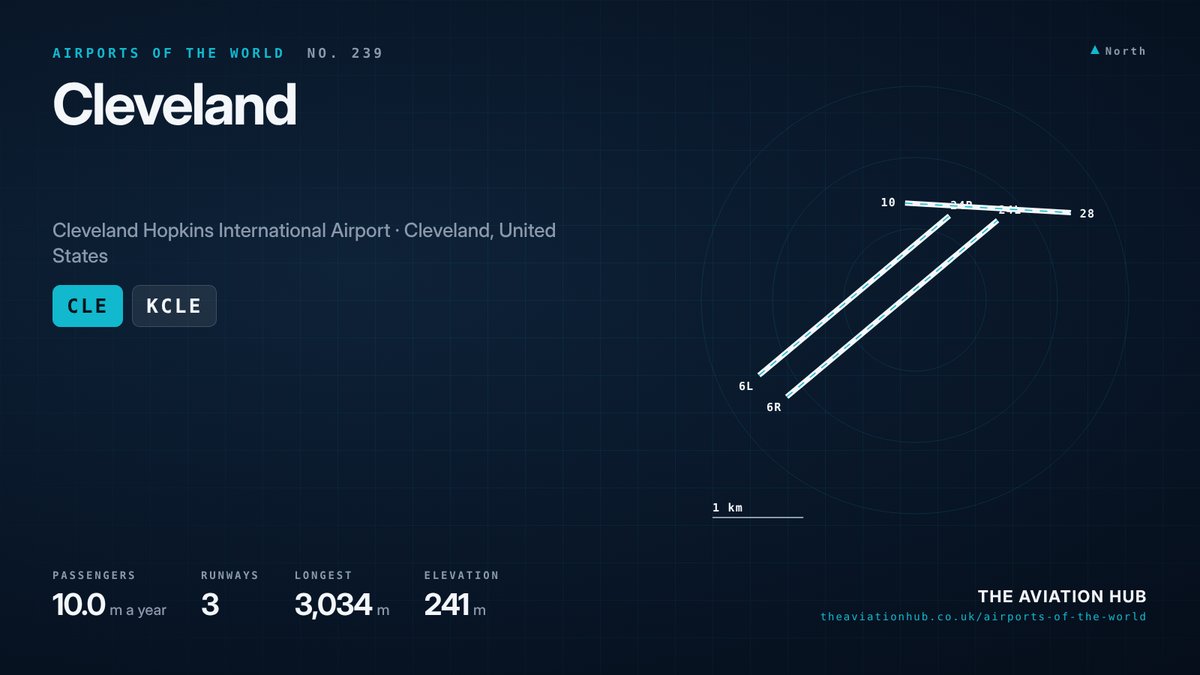
The IATA code is CLE and the ICAO code is KCLE. The field sits at 791 feet (241 m) on the plateau south of Lake Erie, bordered by Brook Park and the Interstate 71 and 480 corridors. It has three runways and a single two level terminal with four concourses, three of them in use. In 2025 the airport handled about 10.0 million passengers, down 1.7 per cent on 2024.
No airline runs a full hub. United carried about 23 per cent of passengers in 2025 and Frontier about 21 per cent, with Frontier treating Cleveland Airport as a focus city. United still keeps crew, pilot and maintenance bases here. The City of Cleveland’s Department of Port Control runs the airport. Flight status and parking information are on the airport’s official website.
How Cleveland’s Airport Came to Be
The airport opened on 1 July 1925, championed by city manager William R. Hopkins. Cleveland quickly became a laboratory for airport operations. It opened the first air traffic control tower in 1929, the first airfield lighting system in 1930 and the first ground to air radio control system in 1939. In 1951 the field was named after Hopkins on his 82nd birthday.
In 1968 it became the first airport in the United States connected directly to a rail transit line, when the Red Line reached the terminal. The present two level terminal, which separates arrivals from departures, was completed in 1978. United ran a hub here until the mid 1980s, and Continental then built a large operation that dominated the 1990s and 2000s.
After the 2010 merger, the new United kept Cleveland Airport as a hub for a few years but closed it in 2014. Concourse D, built for regional jets, has stood empty since. Frontier opened a crew base in March 2024 and overtook United in monthly passengers that June.
Runways at Cleveland Airport
There are three runways. Runway 6R/24L is concrete, 3,034 metres (9,953 feet) long and 46 metres wide. Its parallel partner, 6L/24R, is also concrete and 46 metres wide, at 2,743 metres (9,000 feet). Runway 10/28 is concrete, 1,834 metres (6,018 feet) long and 46 metres wide, and serves as the crosswind runway.
The airfield was reshaped in the 2000s, when a new parallel runway and extensions gave Continental room to grow. South westerly winds are the norm, so 24L and 24R see the most use. Lake effect snow from Lake Erie makes winter operations a constant battle, and de icing is critical. In 1991 a cargo Douglas DC-9 stalled after take off in snow when its wings had not been de iced, killing both crew.
Terminals and Airlines
Each concourse has its own security checkpoint. Concourse A serves Avelo and Frontier and contains the customs hall for international arrivals without preclearance. Concourse B houses Delta and Southwest. Concourse C is the busiest, with United, American, Alaska, JetBlue, Air Canada Express and Aer Lingus. Concourse D, with 12 jet bridge gates, remains vacant.
United flies Boeing 737 and Airbus A320 family jets to its hubs, plus regional aircraft. Frontier’s Airbus A320neo and A321neo fleet has spread across leisure and business routes since 2024. Spirit Airlines left Cleveland Airport on 15 April 2026, while Avelo began flying on 19 June 2026. The 2016 renovation refreshed the terminal, but its 1978 core is showing its age.
Routes and Destinations
The airport serves 43 nonstop destinations. Atlanta was the busiest route in 2025 with about 455,000 passengers, followed by Chicago O’Hare, Orlando, Denver and Dallas Fort Worth. Florida is a constant draw, with Fort Lauderdale, Tampa and Fort Myers popular through the winter.
International flying is limited. Aer Lingus links Dublin, about 3,500 miles (5,560 km) away, giving the city a direct route to Europe. Air Canada Express connects Toronto, and seasonal flights reach Cancun and the Caribbean. Cleveland’s large Irish American community has helped the Dublin route.
The loss of the hub cut the number of destinations, but local demand remains strong. Summer and the winter sun season are the busiest periods. Cargo is modest, carried mainly in bellyholds and by small feeder freighters.
Getting to and from Cleveland Airport
The RTA Red Line station sits beneath the terminal, a legacy of the 1968 rail first. Trains reach Tower City in downtown Cleveland in about 25 minutes for a flat fare of a few dollars, which makes the train the cheapest sensible option.
By road, Interstate 71 and Interstate 480 meet beside the airport, and downtown is about 20 minutes away outside the rush hour. A dedicated taxi service runs 110 vehicles, and ride hailing pickups use marked zones. Rental cars sit in an off site consolidated facility linked by shuttle buses. Short term and long term garages serve Cleveland Airport, with cheaper surface lots further out.
Spotting and Photography
Spotting at Cleveland Airport is relaxed. Public roads along the perimeter give views of arrivals on 24L and 24R, and positions near the north eastern end keep the sun behind you in the afternoon. The parking areas around the large exhibition centre on the edge of the field have long been used by local enthusiasts.
The traffic is mostly narrow body, with Frontier’s colourful animal tails, United, Delta, Southwest and American dominating. The Aer Lingus Airbus A321 and visiting charter wide bodies add interest. NASA Glenn’s research aircraft occasionally appear, and winter snow brings dramatic de icing scenes.
Behave sensibly. Stay off airport property, keep clear of fences and the NASA site, and move on if police ask.
What Comes Next
In 2025 the city announced a seven year, 1.6 billion dollar landside rebuild, and construction began in July 2026. It includes a 6,000 space garage, a relocated Red Line station and a new Ground Transportation Center, all due by 2029. A new terminal headhouse costing about 1.1 billion dollars is targeted for 2032.
Cleveland Airport is heading for a modern front door and a more competitive mix of airlines, though the empty Concourse D shows how far it fell after the hub closed. See how it compares with Pittsburgh, Detroit and Columbus on the Airports of the World map.
Continue to follow The Aviation Hub for more analysis and insight.
Advertise with us Your brand, in front of an aviation audience Home page and in-article placements, sold directly, one advertiser per slot. From £250 a year. See the rates

