
Cologne Bonn Airport Guide: Night Freight and Rhineland Holidays
Cologne Bonn Airport mixes Eurowings holiday flights with a 24 hour UPS and FedEx freight hub. Explore its runways, terminals, routes and rail links.
 By The Aviation Hub
6 min read
Updated October 20, 2026
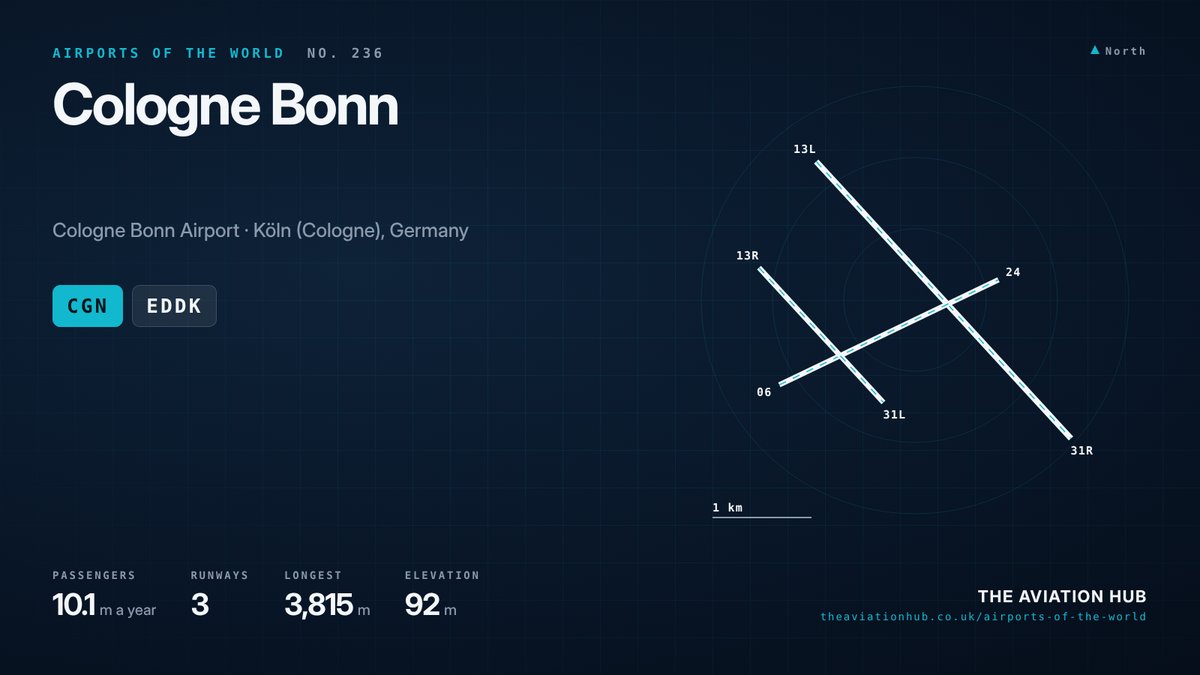
Cologne Bonn Airport sits on the edge of the Wahner Heide heathland, about 7.5 miles (12 km) south east of Cologne and 10 miles (16 km) north east of Bonn. By day it is a busy leisure airport for the Rhineland, dominated by Eurowings and Ryanair. By night it becomes one of Europe’s major freight hubs, with UPS and FedEx freighters arriving in waves. It handled about 10 million passengers and more than 840,000 tonnes of cargo in 2025, and it operates around the clock.
Cologne Bonn Airport at a Glance
The IATA code is CGN and the ICAO code is EDDK. The field lies 302 feet (92 m) above sea level in the Porz district of Cologne. It has three runways and two passenger terminals linked by a shared railway station. In 2025 it recorded roughly 10.06 million passengers and 842,377 tonnes of cargo, still well short of the 12.4 million passengers it handled in 2019.
Eurowings runs a hub at Cologne Bonn Airport, and Ryanair and Corendon Airlines Europe keep bases here. UPS operates its main European air hub on the field with about 140 flights a week, and FedEx Express runs a hub too. The airport company is owned by the city of Cologne, the federal government, the state of North Rhine Westphalia and other local authorities. Timetables and parking information are on the airport’s official website.
How Cologne and Bonn Got Their Airport
The first airfield on the heath was built in 1938 for the Luftwaffe. After the Second World War the British took it over as RAF Wahn. Civil flights began in 1950, the first scheduled international route followed on 1 January 1951, and a civil airport was formally opened in 1957.
Bonn’s role as the capital of West Germany shaped the airport for decades. Government jets, diplomats and visiting heads of state passed through, and the German Air Force’s Executive Transport Wing is still based on the south west side. Terminal 1 opened in 1970, a bold concrete design with two star shaped satellites for the gates. Brian Eno was waiting there in the 1970s when he conceived his 1978 album Music for Airports.
The airport is named after Konrad Adenauer, a Cologne native and West Germany’s first post war chancellor. Terminal 2 at Cologne Bonn Airport opened in 2000, just before low cost airlines arrived in force, and a long distance railway station followed, served by trains on a loop from the high speed line between Cologne and Frankfurt.
Runways at Cologne Bonn Airport
Runway 13L/31R is the main runway, asphalt, 3,815 metres (12,516 feet) long and 60 metres wide. It takes the heaviest freighters, including Boeing 747-8F and 777F aircraft, at full weight. Runway 06/24 is concrete, 2,459 metres (8,067 feet) long and 45 metres wide, and works as a crosswind runway. Runway 13R/31L is asphalt, 1,863 metres (6,112 feet) long and 45 metres wide, and suits smaller aircraft.
With the usual westerly winds, traffic tends to use 31R and 24, while easterly conditions flip operations to 13L and 06. The 24 hour licence is the defining feature. Noise rules govern which aircraft may fly at night, and the arrangement has long been contested by residents in Cologne and the surrounding towns.
Terminals and Airlines
Terminal 1 handles Eurowings, Lufthansa and Austrian Airlines, with its star shaped satellites keeping walks to the gates short. Terminal 2 serves Ryanair and most of the other low cost and leisure carriers. Both buildings connect directly to the railway station between them.
Eurowings is the largest airline at Cologne Bonn Airport, flying a fleet of Airbus A319, A320 and A321 jets to Mediterranean beaches, the Canary Islands and European cities. Ryanair flies Boeing 737-800 and 737 MAX 8 aircraft across a broad network. Lufthansa connects Munich, and Turkish Airlines flies to Istanbul. Since Eurowings moved its long haul flights to Dusseldorf in 2018, there has been no scheduled long haul passenger service.
Routes and Destinations
Leisure dominates at Cologne Bonn Airport. Palma de Mallorca, Antalya, Istanbul, the Canary Islands, Greece and Portugal fill the summer schedule, while Berlin, Munich, Hamburg and Vienna anchor the business routes. Turkey is a particularly strong market, reflecting the large Turkish community in the Rhineland. New routes for 2026 include Jet2 flights from Bristol and London Gatwick.
Wizz Air pulled out in October 2024 and returned a year later with flights to Bucharest, a reminder that German taxes and fees weigh on low cost growth. Hurghada on the Red Sea, roughly 2,150 miles (3,460 km) away, and the Canary Islands at around 2,000 miles (3,200 km) are among the longest routes.
Freight is the airport’s real strength. UPS, FedEx and other carriers move parcels and express cargo through overnight sorts, linking Germany with hubs in the United States, Asia and across Europe.
Getting to and from Cologne Bonn Airport
Rail is the best way to reach Cologne Bonn Airport. The S19 suburban line and regional trains run to Cologne Hauptbahnhof in about 15 minutes, and a single ticket costs a few euros. Long distance ICE trains call at least once an hour in each direction, linking the airport with Frankfurt, Siegburg and beyond.
For Bonn, express bus SB60 runs to the main station in around 30 minutes. Bus 161 serves parts of Cologne, and a coach terminal opened in 2015 for long distance operators. The airport has its own exit on the A59 motorway, which reaches central Cologne in about 20 minutes outside the rush hour. Taxis wait outside both terminals, with fares to Cologne around 40 euros, and the multi storey car parks sit next to the terminals.
Spotting and Photography
Spotting at Cologne Bonn Airport rewards patience. The terminal car parks give views over the aprons, while the public paths around the Wahner Heide reserve offer glimpses of the main runway. The heath is protected, so stay on marked paths and respect closed areas.
The freighters are the main draw. UPS and FedEx movements peak overnight, but some arrive or depart in daylight, especially early in the morning and at weekends. Boeing 747-8F, 767-300F and 777F freighters regularly appear. Government Airbus A350 and A321 jets of the Executive Transport Wing add a rare touch. The former DLR Zero G Airbus A300, now a museum piece near Terminal 2, is worth a visit.
Behave sensibly near fences, never enter restricted military areas and follow instructions from police or security staff.
What Comes Next
The airport has the runway capacity to grow, but passenger expansion depends on airline decisions shaped by German taxes. Cargo remains the stable core, and the UPS and FedEx hubs anchor thousands of jobs. Debate over night flights will continue as long as the airport keeps its 24 hour licence.
Cologne Bonn Airport is heading for steady recovery, with freight growth and leisure flying carrying the load while long haul passenger service waits for a new champion. Compare it with Dusseldorf and Frankfurt on the Airports of the World map.
Continue to follow The Aviation Hub for more analysis and insight.
Advertise with us Your brand, in front of an aviation audience Home page and in-article placements, sold directly, one advertiser per slot. From £250 a year. See the rates

