
Columbus Airport Guide: From Port Columbus to John Glenn
Columbus Airport, now named after John Glenn, is building a new terminal for 2029. Our guide covers runways, airlines, routes, transport and spotting.
 By The Aviation Hub
5 min read
Updated October 20, 2026
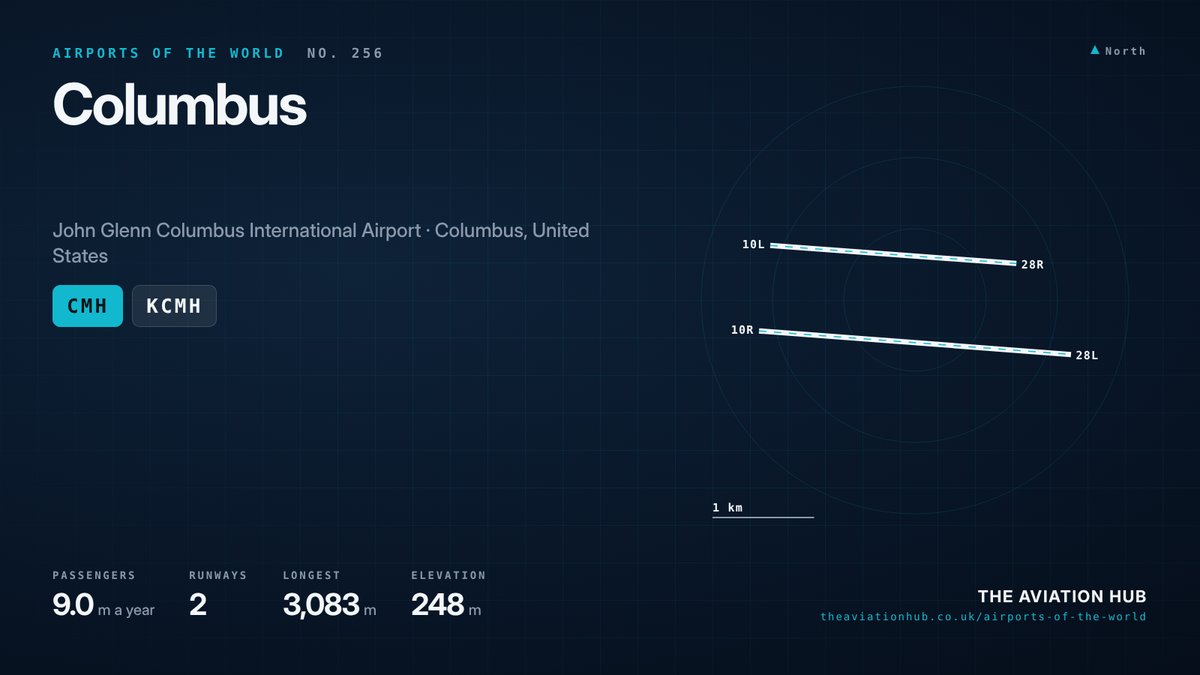
John Glenn Columbus International Airport sits on the east side of Ohio’s capital, a short drive from downtown along Interstate 670. Columbus Airport handled just over 9 million passengers in 2025 and serves one of the fastest growing metro areas in the Midwest. It has a long and colourful history, from a 1929 air and rail experiment to a failed airline hub, and a new terminal is now rising beside the old one.
Columbus Airport at a Glance
The IATA code is CMH and the ICAO code is KCMH. Columbus Airport lies about 6 miles (10 km) east of downtown at an elevation of 248 metres (815 feet). It has two parallel runways and a single terminal with three concourses.
Traffic reached about 9 million passengers in 2025, up slightly on the year before. Southwest is the largest airline, with around 32 per cent of passengers, ahead of Republic Airways, American, Delta and United. The Columbus Regional Airport Authority runs the airport, along with Rickenbacker International and Bolton Field. Parking rates and terminal maps are on the airport’s official website.
How Columbus’s Airport Came to Be
The airport opened on 8 July 1929 as the Columbus Municipal Hangar, which explains the CMH code. It was the eastern terminus of the flying section of Transcontinental Air Transport’s air and rail service. Passengers took an overnight train from New York, then flew west by day in Ford Trimotors, switching back to rail at night on the way to Los Angeles.
TWA, which grew out of that venture, served Columbus for more than 70 years. The field became Port Columbus, and America West turned it into a hub in 1993. The hub struggled, and America West closed it in 2003 after the post 9/11 downturn. Skybus Airlines, an ultra low cost start up, flew from the airport between May 2007 and April 2008 before collapsing.
In 2016 the Ohio General Assembly renamed the airport after John Glenn, the astronaut and senator from New Concord, Ohio. The original 1929 terminal building still stands. A Roy Lichtenstein sculpture, Brushstrokes in Flight, has become a well known feature of the site.
Runways at Columbus Airport
Columbus Airport has two parallel asphalt runways, both 46 metres wide. The south runway, 10R/28L, is 3,083 metres (10,114 feet) long. The north runway, 10L/28R, is 2,438 metres (8,000 feet) long.
A US$140 million project completed in 2013 moved the south runway further from the north one. The wider spacing allows simultaneous takeoffs and landings, adding capacity and resilience. The longer south runway handles most heavier departures, and both runways see regular arrivals.
Prevailing westerly winds mean runways 28L and 28R are in use more often than not, with arrivals approaching from the east. A 60 metre (195 foot) control tower opened in 2004 and gives controllers a clear view of both runways and the terminal area.
Terminals and Airlines
The current terminal has three concourses, each with its own security checkpoint. Concourse A has seven gates and is used mainly by Southwest. Concourse B has 16 gates and serves American, Air Canada and United. Concourse C has 11 gates for Alaska, Breeze, Delta, Frontier, Sun Country and seasonal charters, and it also handles international arrivals.
Southwest flies its Boeing 737-700, 737-800 and 737 MAX 8 fleet from Columbus Airport to leisure and business cities across the country. American, Delta and United connect Columbus with their hubs using a mix of mainline Airbus A320 family jets, Boeing 737s and regional aircraft such as the Embraer E175.
Low cost carriers Breeze, Frontier and Sun Country add point to point options. NetJets, the private aviation company, is based in Columbus and runs a large operation on the airfield.
Routes and Destinations
Atlanta was the busiest route in 2025 with about 421,000 passengers, followed by Chicago O’Hare with roughly 331,000 and Orlando with around 283,000. Hub links to Charlotte, Dallas, Denver and New York also carry heavy traffic, reflecting a strong business market.
Florida routes dominate the leisure side, with Orlando, Tampa, Fort Myers and Fort Lauderdale busy all winter. Seasonal flights reach Cancun, with Punta Cana and San Juan due to follow in early 2027. Air Canada’s Toronto service provides the main year round international link from Columbus Airport.
Western routes to San Francisco, Seattle and Los Angeles are the longest flights. Cargo is handled mainly at Rickenbacker, south of the city, which the same authority runs as a dedicated freight airport.
Getting to and from Columbus Airport
There is no rail link, and Columbus has no passenger rail service at all. COTA bus route 7 links the airport with downtown in around 30 to 40 minutes, and it is the cheapest sensible option at a couple of dollars.
By road, the airport sits just off Interstate 670 at exit 9, onto International Gateway. Downtown is about 15 minutes away outside rush hour. Taxis and app cars with Uber and Lyft cost around US$25 to US$35 (roughly £19 to £27) to the city centre.
Short term and long term parking sit close to the terminal, with cheaper economy lots served by shuttle buses. The main car hire companies all operate at the airport. Many travellers from central Ohio also drive to Columbus Airport from Dayton, Mansfield and Zanesville.
Spotting and Photography
Columbus Airport is a relaxed place to watch aircraft. Public roads around the perimeter give views of both runways, and the flat surrounding land makes it easy to follow arrivals from the east when runways 28L and 28R are in use. Afternoon light suits the south side of the field.
The mix is mostly Southwest and regional jets, but NetJets adds variety, with a steady flow of business jets from its base. Construction of the new terminal also offers a chance to record a major airport project as it happens.
Stay on public land and away from the fences. Airport police patrol regularly, and parking on the shoulder of busy roads is both unsafe and illegal.
What Comes Next
Ground was broken in late 2024 on a new terminal, due for completion in 2029. It will replace the current building entirely, with more gates and modern facilities for a growing region. The programme is one of the biggest public projects in central Ohio, with a cost estimated at around US$2 billion.
Major investment in central Ohio, including the delayed Intel chip plant near New Albany, is expected to drive demand. Columbus Airport looks set to keep growing steadily, with the new terminal giving it the room it has lacked. Compare it with other Midwest airports on the Airports of the World map.
Continue to follow The Aviation Hub for more analysis and insight.
Advertise with us Your brand, in front of an aviation audience Home page and in-article placements, sold directly, one advertiser per slot. From £250 a year. See the rates

