Copenhagen Airport occupies the eastern tip of the island of Amager, about 5 miles (8 km) south of the city centre and within sight of the Oresund Bridge to Sweden. Known locally as Kastrup after the neighbouring town, it is the busiest airport in the Nordic countries and the main hub of SAS Scandinavian Airlines. Three runways point out over the water, a railway station sits beneath the terminal and Malmo in Sweden is closer by train than most of Copenhagen’s suburbs. Around 32.4 million passengers used it in 2025.
Copenhagen Airport at a Glance
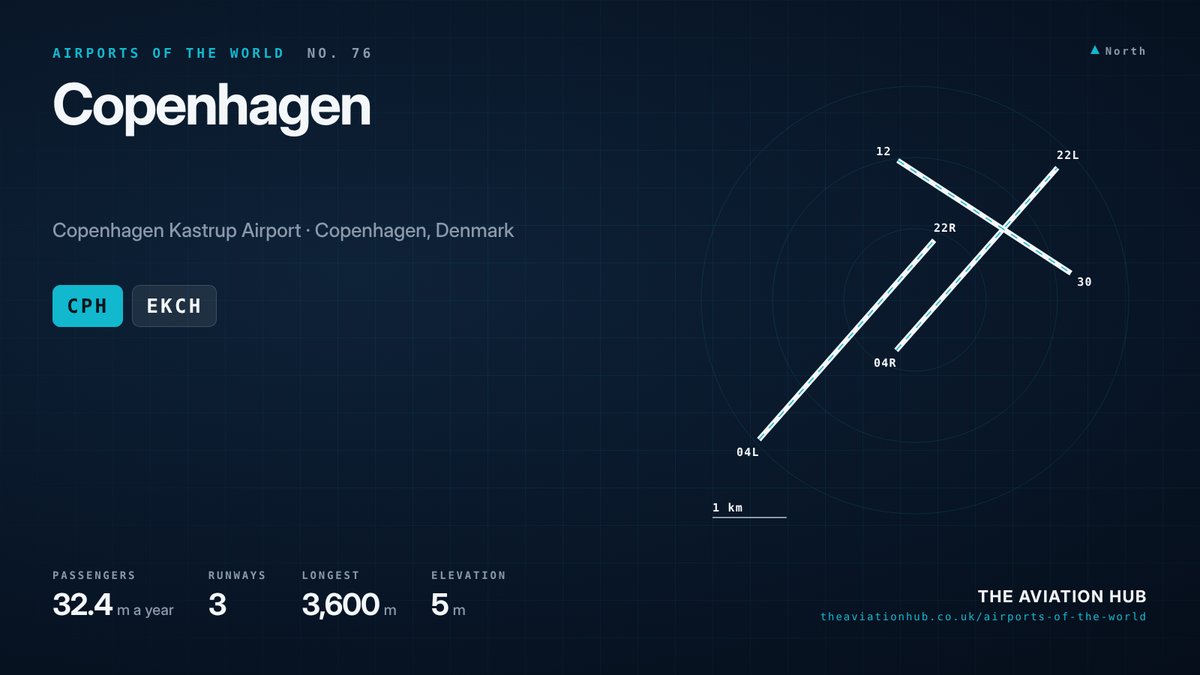
The codes are CPH and EKCH. The field lies only 5 m (17 ft) above sea level, with most of the site in Tarnby municipality and a corner in Dragor. It has three asphalt runways and a single terminal complex of Terminals 2 and 3 feeding six piers, A to F. Kobenhavns Lufthavne owns and operates it along with the smaller Roskilde Airport to the west, and the company is listed on the Copenhagen exchange with the Danish state and the pension fund ATP as major owners.
Copenhagen Airport handled about 32.4 million passengers in 2025, up 8.5 per cent, with 31.1 million of them on international flights. SAS is the home carrier, Norwegian, Ryanair, Sunclass Airlines and Jettime have bases, and Air Greenland and Finnair treat it as a focus city. Around 256,700 aircraft movements were recorded. Flight status and parking are on the airport’s official website.
How Copenhagen’s Airport Came to Be
The airport opened on 20 April 1925 as one of the first civil airports anywhere, with a wooden terminal, hangars, a balloon mast and a seaplane jetty. Grass fields served as runways and sheep kept them trimmed. Danish Air Lines, a founder of SAS in 1946, was the original tenant and traffic to Hamburg, Berlin and Amsterdam built up through the 1930s.
Paved runways came in the 1940s and the airport stayed open under German occupation. The 1960 terminal and the parallel runway system of the late 1960s set the modern layout, with Runway 04L/22R as the main strip. That expansion also moved domestic traffic into the eastern part of Terminal 1 and added a new control tower.
Terminal 3 opened in 1998, timed with the 2000 opening of the Oresund Bridge and its rail link under the terminal. The low cost pier CPH Go, now Pier F, followed in 2010, the metro arrived in 2007 and Pier E opened in June 2019 to house the SAS long haul operation. Terminal 1, the old domestic building, closed to departures in March 2015.
Runways at Copenhagen Airport
Copenhagen Airport has three asphalt runways, all 45 m wide. The two main strips run parallel from southwest to northeast and point out over the Oresund strait. Runway 04L/22R is the longest at 3,600 m (11,811 ft), while Runway 04R/22L is 3,300 m (10,827 ft) and was widened for the Airbus A380. Runway 22L has a Category IIIC instrument landing system for operations in near zero visibility.
The crosswind runway 12/30 is 2,800 m (9,186 ft) long and is used when strong westerly or easterly winds make the parallels difficult. Its approach from the northwest crosses Copenhagen’s southern suburbs, so noise rules limit use in that direction. The parallel pair allows simultaneous arrivals and departures, with the 22 direction favoured in the prevailing southwesterlies and arrivals coming in low over the Oresund.
In the 22 direction, 22L is the main arrival runway and 22R the main departure runway, and the pattern flips to 04L for arrivals and 04R for departures. A new control tower run by Naviair opened in 2008.
Terminals and Airlines
Terminals 2 and 3 handle check in for every flight and share one airside concourse, with arrivals, customs and baggage reclaim all in Terminal 3. SAS uses Terminal 3, as do its former Star Alliance partners such as Lufthansa, Swiss, Austrian, Air Canada, Singapore Airlines and Thai Airways. Pier E, opened in 2019, houses the SAS long haul gates. Piers A and B serve Schengen flights only and Pier C handles mostly non Schengen traffic.
Terminal 2 is the home of the leisure and low cost carriers. Norwegian, easyJet, Ryanair, Transavia, Sunclass and Jettime use it, with the Ryanair and easyJet operations concentrated at the pared back Pier F. KLM, Air France, British Airways and Finnair spread across the piers depending on Schengen status. SAS moved to SkyTeam in September 2024, so Delta, KLM and Air France now feed its network.
Routes and Destinations
London across all airports is the busiest destination from Copenhagen Airport with about 1.8 million passengers in 2023, followed by Oslo at 1.36 million, Stockholm at 1.19 million and Amsterdam at 1.12 million. Aalborg is the busiest domestic route at around 790,000, and Istanbul, Helsinki, Frankfurt, Vienna and Paris complete the top ten. SAS, Norwegian and easyJet dominate the London and Scandinavian routes with Airbus A320neos and Boeing 737-800s.
Long haul is led by SAS with Airbus A350-900s and A330-300s to New York, Chicago, Washington, Boston, Los Angeles, San Francisco, Toronto, Atlanta, Bangkok, Tokyo Haneda, Seoul and Mumbai. Emirates flies the Airbus A380 to Dubai, and Qatar Airways, Air India, Air China and Singapore Airlines add Asian links. Los Angeles at about 5,600 miles (9,000 km) is among the longest routes. Summer brings a surge of leisure flying to Greece, Spain and Turkey.
Cargo moves in wide body bellies and on freighters from Emirates SkyCargo, FedEx, West Atlantic, LATAM Cargo and Ethiopian.
Getting to and from Copenhagen Airport
The railway station under Terminal 3 is the best way into town. Regional trains reach Copenhagen Central Station in about 13 minutes for a modest standard fare, which makes rail the cheapest sensible option. Oresundstag trains cross the bridge to Malmo in 20 minutes and continue to Lund, Helsingborg and Gothenburg, and DSB InterCity trains run to Odense, Aarhus and Aalborg. Metro line M2 takes about 15 minutes to Kongens Nytorv and runs around the clock.
By road the E20 motorway passes Copenhagen Airport and leads over the Oresund Bridge, where the toll is around DKK 450 for a car. A taxi to the centre takes 20 to 30 minutes and costs DKK 300 to 350 (£35 to 40). Movia buses serve the suburbs and Amager, and coaches run to Jutland, Oslo and Sweden. Car parks hold 8,600 spaces and a free shuttle links them to the terminals.
Spotting and Photography
The best known viewpoint is Flyvergrillen, a grill bar with a wooden platform beside the taxiway between the parallel runways, which looks over arrivals on 22L and departures on 22R. On the northern side, car parks P15 and P17 also face the final approach to 22L. At the southwestern end, Tommerupvej near the village of Ullerup catches landings on 04L in northeasterly winds.
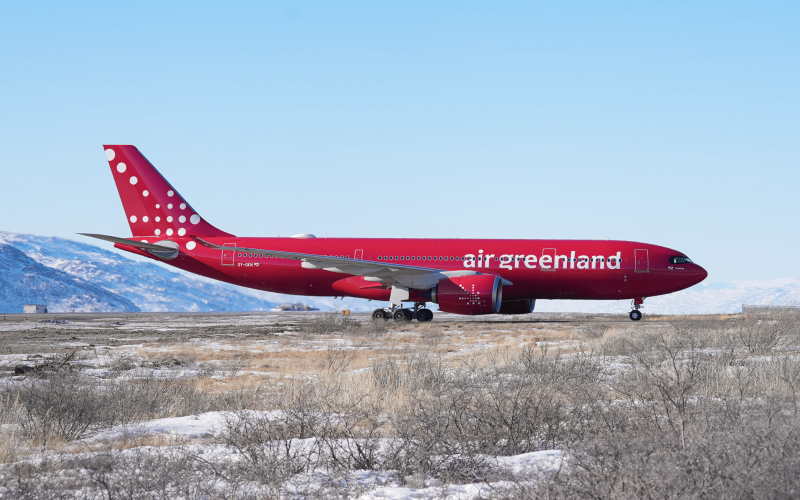
P17 works best in the morning and P15 in the evening. Highlights include the SAS A350s, the Emirates A380, Air Greenland’s A330-800 and the summer charter mix of Sunclass A330s. The airport is tolerant of spotters but ask before using ladders, keep off the perimeter fence and respect private land around the field.
What Comes Next
The operator’s long term plan targets 40 million passengers a year through expansion of the existing terminals rather than a separate Terminal 4. Terminal 3 is being extended with more check in, security and gate space, and Pier E will grow to take additional wide bodies. SAS is renewing its fleet with A320neos and A350s and is rebuilding its long haul network as a SkyTeam carrier, with Delta feeding traffic across the Atlantic.
The runways have capacity to spare and the rail links already cover Scandinavia, so growth is a matter of terminal space and airline appetite. Copenhagen Airport will stay the natural hub for northern Europe. See how it ranks against Stockholm and Oslo on the Airports of the World map.
Continue to follow The Aviation Hub for more analysis and insight.
Advertise with us Your brand, in front of an aviation audience Home page and in-article placements, sold directly, one advertiser per slot. From £250 a year. See the rates